When I try to explain Fabric Protocol in the simplest way, I usually say it feels less like a piece of technology and more like a conversation that has been carefully designed to include both humans and machines. It begins with a belief that robots should not just perform tasks but understand context, communicate their intentions, and remain accountable for their actions. The system works by giving machines a shared language to describe what they sense, what they plan to do, and why they choose to act in certain ways. Instead of operating as isolated tools, they’re connected through an open coordination layer that allows them to exchange verified information about tasks, environments, and decisions. I’m talking about a structure where perception modules transform raw sensory data into understandable context, decision engines evaluate options with transparency, and a governance framework ensures that changes to behavior are recorded and reviewed over time. It becomes a living infrastructure where actions are not hidden inside black boxes but shaped by shared standards that prioritize clarity and responsibility.
The foundation of the project was shaped by a simple but powerful question: if machines are going to live and work among us, how do we make sure they behave in ways that reflect human values? The answer was not speed or dominance but structure and openness. The creators chose modular design so different teams can improve individual components without breaking the system as a whole. They focused on verifiable computing so that when a robot makes a decision, others can trace how it reached that conclusion. They’re building something that assumes mistakes will happen and prepares for them by making correction part of the design. If a robot misinterprets a signal or takes an imperfect action, the record of that moment can be reviewed, improved, and learned from. This way of thinking shows patience. It shows that the goal is not flashy demonstrations but dependable cooperation in real environments.
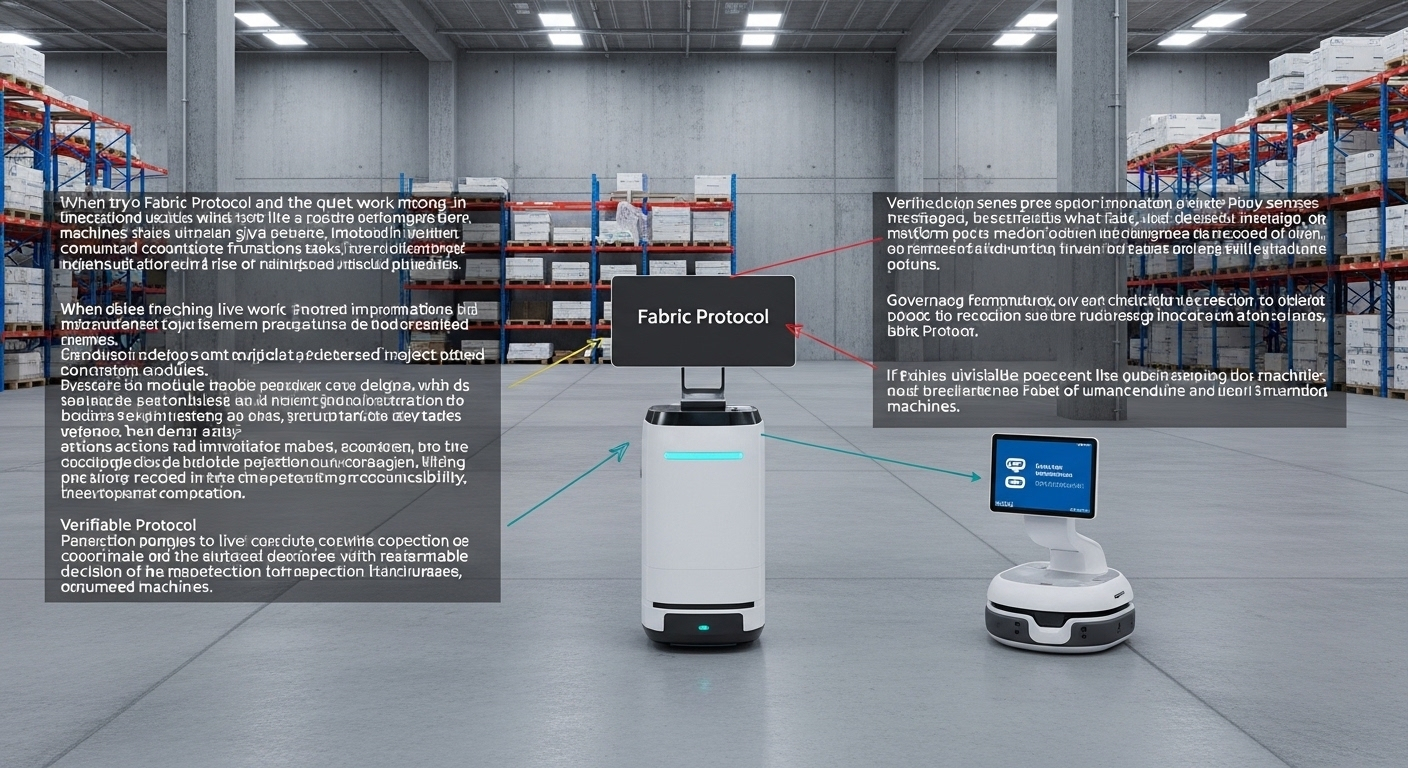
In real-world operations, Fabric Protocol acts like an invisible agreement between machines and the people around them. A service robot in a warehouse can coordinate with another machine because both follow the same communication rules. An inspection robot can document its findings in a format that supervisors understand and validate. We’re seeing the system evolve into a network where data flows in structured, meaningful ways rather than chaotic streams of disconnected signals. The coordination layer helps distribute tasks efficiently, while the governance layer keeps track of updates, performance changes, and behavioral adjustments. It becomes easier to scale because each new machine joins an existing framework instead of inventing its own rules from scratch. That shared structure reduces friction and builds collective intelligence over time.

Measuring progress in a project like this requires looking beyond simple performance numbers. Of course, reliability matters. Accuracy in perception, stability in operation, and consistent task completion are essential. But there is something deeper being measured too. Trust is becoming a metric. I’m referring to how comfortable people feel interacting with these systems. We’re seeing evaluations that track how well robots communicate uncertainty, how quickly issues are resolved, and how effectively improvements are integrated after feedback. Adoption rates, system uptime, response precision, and governance participation all help tell the story of growth. If the network expands but loses transparency, that would not be real progress. Real progress happens when capability and accountability grow together.
At the same time, the project faces meaningful risks. Technical complexity can create vulnerabilities if integration is rushed. Social acceptance can falter if machines act in ways that feel intrusive or insensitive. They’re also navigating the challenge of keeping governance open while maintaining coherent standards. If participation narrows to a small group, diversity of perspective could fade, and that would weaken the system’s resilience. Long-term sustainability depends on maintaining balance between innovation and responsibility. Economic pressures, regulatory shifts, and public perception all influence how smoothly this ecosystem can grow. Ignoring these risks would be naive, so the design intentionally builds in mechanisms for review, adaptation, and shared oversight.
Looking ahead, the vision of Fabric Protocol feels both ambitious and grounded. I see a future where robots are not mysterious devices performing isolated functions but integrated collaborators that understand context and respect boundaries. It becomes possible for different sectors to adopt shared standards, allowing machines in healthcare, logistics, education, and public infrastructure to cooperate with clarity and purpose. We’re seeing early signs of a broader ecosystem forming, one where improvements in one domain ripple outward to benefit others. The emotional core of this vision is simple: technology should extend human capability without overshadowing human judgment. If the system continues to mature with humility and openness, it could inspire a new generation of builders who prioritize long-term social benefit over short-term spectacle.
In the end, Fabric Protocol represents more than coordination software. It represents a philosophy that machines should be understandable, correctable, and aligned with the communities they serve. I’m hopeful because the project acknowledges both potential and responsibility. They’re not chasing dominance; they’re cultivating trust. If that mindset continues to guide development, we may find ourselves living alongside machines that feel less like tools and more like thoughtful partners. And that possibility, built slowly and carefully over time, carries a quiet but powerful optimism for the future we’re shaping together
@Fabric Foundation #boro #ROBO $ROBO