
I didn’t take Fabric Protocol seriously the first time I came across it.
That probably says more about the current state of tech language than it does about Fabric itself. Once you’ve seen enough projects mixing robotics, AI, tokens, networks, and grand claims about “the future,” you develop a reflex. You assume the same pattern is repeating: a real technological shift, wrapped in abstract language, with finance bolted onto it before the underlying thing has even stabilized.
So that was my first reaction here too. Another system trying to attach a market to an idea that doesn’t exist yet.
But the more I looked at Fabric, the more I realized I had misread what it was trying to do.
The point of Fabric, at least as I understand it now, is not really “robots” in the narrow sense. It’s not mainly about building better hardware, or making humanoids look impressive in demos, or riding the AI wave with a more futuristic wrapper. What Fabric seems to be trying to do is address a deeper question — one that most people still avoid because it’s more political than technical.
If machines start doing real work in the economy, who owns the value they produce?
That’s the question underneath everything. And once you see it, it becomes hard to unsee.
Because the real issue was probably never going to be robots themselves. We keep talking as if the central drama is whether robots will arrive, whether they’ll replace jobs, whether they’ll become capable enough to matter. But that’s only the outer layer of the story. The more important issue is what happens economically when machine labor becomes normal. Who captures the income? Who controls the infrastructure? Who has access to the upside? Who gets locked out?
That is where Fabric starts to feel less like a gimmick and more like an attempt — maybe an imperfect one, maybe even a doomed one, but still a serious attempt — to build a different answer before the default answer hardens around us.
We talk about automation like it’s about labor. It’s really about ownership.
A lot of discussions about robots still sound strangely shallow to me.
People ask whether machines will replace drivers, warehouse workers, cleaners, assistants, or technicians. They ask whether humanoids will become affordable. They ask when general-purpose robots will become useful enough to deploy everywhere. Those are reasonable questions, and obviously they matter.
But they also miss the point.
The larger issue is not simply that robots may perform tasks humans currently do. The larger issue is that machine labor, once it works at scale, becomes a new source of economic output. And unlike human labor, machine labor does not come with wages in the ordinary sense. It doesn’t need to be distributed across millions of households. It doesn’t naturally circulate. It produces returns for whoever owns the machine, the platform, the data layer, and the customer relationship.
That changes the shape of the economy.
Human labor has always been inefficient in certain ways. It is costly, political, emotional, embodied, resistant, inconsistent. But one thing it does — or at least can do — is distribute income broadly. People work, people get paid, and that becomes part of the social structure.
Machine labor breaks that link.
If a robot can do useful work for years, and if that robot is owned by a company, financed by capital, controlled through closed software, and scaled across thousands or millions of deployments, then the value of that labor doesn’t go “to labor.” It goes upward. It compounds as capital.
That’s why the future of robotics could become far more unequal than the future of software ever was. Software created huge winners, but machine labor could create something even more concentrated: a world where the productive capacity once spread across human workers is increasingly owned as a private asset.
That is the part people don’t want to dwell on, because once you name it clearly, the conversation gets uncomfortable.
Fabric, for all its abstraction, at least seems to start from that discomfort.
The current robotics model is closed almost by design
To be fair, the closed nature of robotics today didn’t appear by accident.
Building and operating robots is hard. The hardware is expensive. The environments are messy. Reliability matters. Safety matters. Integration is a nightmare. If you’re a robotics company, of course you want control. You want to own the stack, own the software, own the updates, own the operating assumptions, own the data, own the deployment contracts. From a business perspective, that’s rational.
But the same structure that makes sense now could become dangerous later.
Because if the future of robotics is built entirely through closed systems, then we’re not just talking about companies selling machines. We’re talking about companies building privately controlled labor networks.
That’s a very different thing.
A closed robot fleet is not just a product offering. It’s an economic enclosure. The manufacturer or operator controls who can access the machine, how tasks are assigned, how performance is measured, where the data goes, how payment works, what can be audited, and who gets a share of the value. The more capable those systems become, the more power that structure accumulates.
And once machines are doing meaningful work across logistics, service industries, maintenance, healthcare support, infrastructure, domestic environments, maybe even care work or field operations, those closed systems become something larger than businesses. They become the hidden operating layer of the economy.
That’s the part that worries me.
Not the robot itself. Not the spectacle of automation. The enclosure.
Because if we let machine labor emerge entirely inside proprietary corporate systems, then we’re effectively allowing one of the most important productive forces of the future to be privately absorbed from the beginning.
Fabric’s big idea is actually simple: build public rails before private control becomes permanent
Once I stripped away some of the protocol language, Fabric’s underlying thesis started to feel surprisingly straightforward.
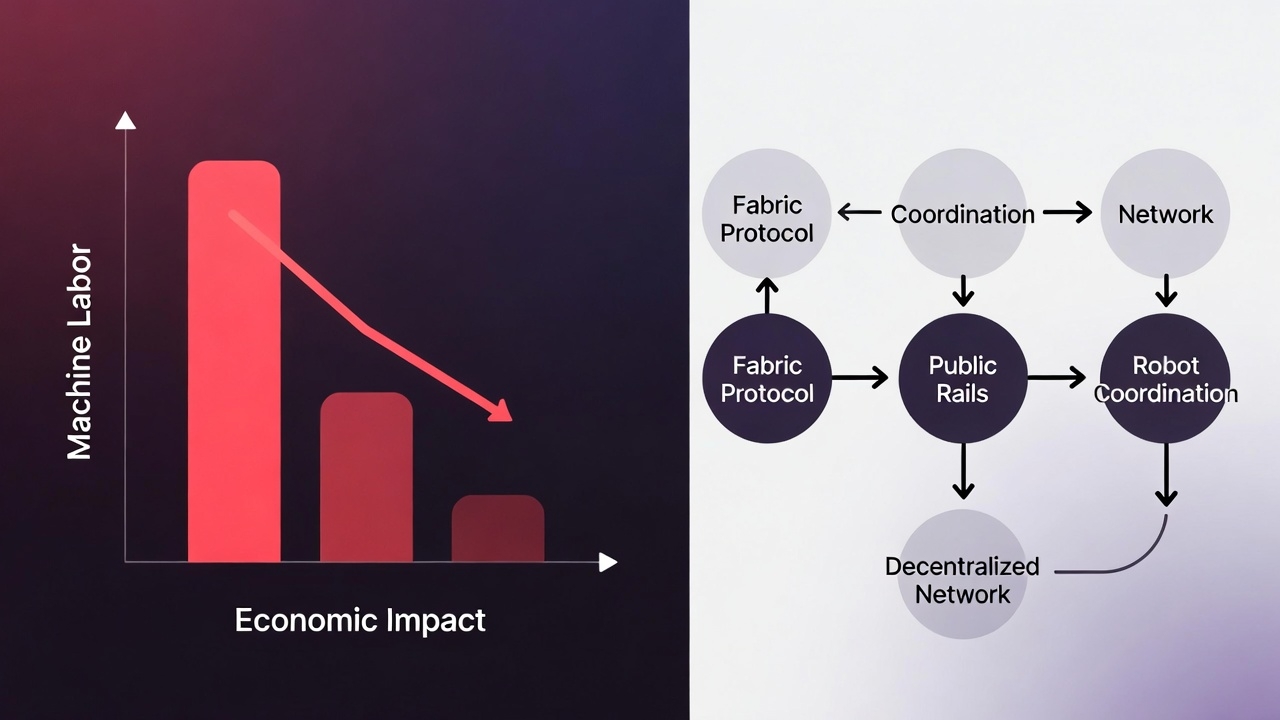
It is trying to build a shared infrastructure layer for machine labor — a public set of rails for identity, verification, transactions, governance, and coordination, so that robots do not exist only as captive assets inside closed company systems.
That, to me, is the real idea.
Not “put robots on a blockchain” in some shallow sense. Not “tokenize the future.” Something more structural than that.
Fabric seems to be asking: what if robots become economically important, but instead of being organized purely through private platforms, they operate through an open network where work can be registered, verified, priced, coordinated, and settled in a more transparent way?
That sounds technical, but the implications are social.
Because if there is a shared network around machine labor, then the value generated by that labor doesn’t have to disappear into one company’s internal ledger. It becomes visible. It becomes measurable. In theory, it becomes something multiple participants can help support and benefit from — operators, developers, validators, maintainers, data contributors, maybe even communities that help bring machine systems into existence.
That doesn’t automatically make it fair. Open systems can still become concentrated. But it changes the starting conditions.
And that matters more than people think. The early infrastructure choices around a new economic layer often determine who gets included long before the public notices what’s happening.
The most unsettling part of Fabric is also the most important: it treats robots like economic actors
This is where Fabric moves from interesting to genuinely strange.
It does not seem to think of robots merely as tools. It treats them, or at least wants to treat them, as participants in an economic system.
That idea can sound ridiculous if you hear it too quickly. Robots are not people. They do not deserve political rights. They are not moral agents in any meaningful human sense. But that’s not really what Fabric is saying.
What it is saying, as far as I can tell, is that machines may need a kind of economic legibility if they are going to operate at scale in the future economy.
A robot may need a persistent identity. It may need a verifiable record. It may need a wallet. It may need to receive payment, hold assets, pay for services, access software, purchase compute, request maintenance, or interact with other agents and systems in ways that cannot be manually handled every time by a human owner pressing a button in the background.
That doesn’t make the robot a citizen. But it does make it something more than an appliance.
And once you really think about that, it starts to seem less bizarre than it first appears.
If machines are going to work in the world — not as isolated tools, but as active, ongoing, connected systems — then they will need some infrastructure that allows them to function inside markets. That means identity, permissions, transaction rails, accountability, and records that can persist across time.
In that sense, Fabric is trying to prepare for a world where robots are not simply used. They are deployed into economic life.
That is a very different future from the one most people imagine when they picture “robots.”
Trust is everything, because machine labor is worthless if nobody can verify it
One thing I appreciate about Fabric’s framing is that it at least appears to understand the hardest problem here.
It’s not enough to say robots can work. You have to be able to trust the work.
That sounds obvious, but it’s where many machine-economy ideas start to collapse. In software, it’s relatively easy to pretend everything is measurable. In the physical world, it isn’t. Work can be incomplete, faked, low-quality, interrupted, exaggerated, misreported, or difficult to evaluate. Sensors fail. Conditions change. Humans interfere. Environments are messy. Proof is often partial.
So if you want to build an economy around machine labor, the real question is not “can the robot do the task?” It’s “how do we know what actually happened?”
That is where Fabric’s emphasis on verifiable computing becomes important.
Not because it solves trust in some perfect way, but because it seems to understand that trust has to be built from multiple layers: cryptographic proof where possible, validation where necessary, reputation over time, public records, challenge systems, penalties for dishonest reporting, and an economic model where lying is supposed to be more costly than telling the truth.
That is not glamorous, but it is real.
The future machine economy, if there is one, won’t be held together by intelligence alone. It will be held together by credible accounting. Someone has to know whether the work was done, whether it met a standard, whether the machine was operating honestly, and who is responsible when something goes wrong.
Without that, “machine labor market” is just a phrase.
With it, you at least have the beginning of an institution.
“Agent-native infrastructure” sounds abstract until you realize our systems were built for humans, not machines
There’s a phrase attached to Fabric that I initially found a little irritating: agent-native infrastructure.
It sounded like one of those terms designed to sound profound while saying very little. But the more I thought about it, the more I understood what it was pointing to.
Most of our existing systems — legal systems, payment systems, compliance systems, even software interfaces — are built around humans and human organizations. A person can prove identity. A business can open accounts, sign contracts, and assume liability. Those are the basic units our institutions understand.
Machines do not fit neatly into that.
A robot can do useful work, but it cannot open a bank account in the ordinary sense. It cannot carry conventional documentation. It cannot navigate all the legacy structures designed for human agency. And yet if machine labor becomes meaningful, it will need to transact somehow. It will need to pay and be paid somehow. It will need an operational identity somehow.
That is what “agent-native” means here, at least in the best reading of it: infrastructure that assumes autonomous or semi-autonomous agents will exist as active participants in economic systems.
In other words, Fabric is not just imagining robots as tools attached to humans. It is imagining a world in which machine agents require infrastructure built for their mode of operation.
Maybe that sounds premature. But maybe it is exactly the kind of thing that has to be built before the world notices it needs it.
Standardization may be the least exciting part of this story, but it might be the most important
If Fabric has any chance of mattering, it will depend on something people rarely get excited about: standards.
Not vision. Not branding. Not market narrative. Standards.
Because a machine economy cannot exist in any meaningful sense if every robot lives inside a sealed ecosystem. If every manufacturer builds its own isolated environment, then there is no shared market for machine work. There are only scattered private empires.
That is why the idea of a universal operating layer — something like OM1 — matters so much.
A common operating framework, or at least a common enough one, gives robotics a chance to become interoperable rather than permanently fragmented. It creates the possibility that different machines can plug into the same economic logic: the same identity layers, the same coordination systems, the same payment rails, the same task abstractions, the same verification frameworks.
That may sound dry, but it is foundational.
Without standardization, “open robot economy” is mostly fiction.
With standardization, the idea becomes at least technically imaginable.
And there is something deeper here too. Standards are not neutral. They quietly decide who gets to participate. If the standards are open and widely usable, the market can widen. If the standards are proprietary and tightly controlled, the market narrows around whoever owns them.
That is why I think Fabric’s attention to infrastructure is more important than its surface branding. It seems to understand that whoever defines the standards for machine labor may end up defining the terms of participation in the future economy.
Proof of Robotic Work is only meaningful if it is tied to reality
I’m still instinctively skeptical of phrases like Proof of Robotic Work.
And honestly, I think that skepticism is healthy.
There is a long history of technical language being used to make weak economic models sound more grounded than they are. A phrase like that could easily become a wrapper for speculation, where “work” ends up meaning some internally generated metric that looks productive without corresponding to anything of substance.
So the phrase itself doesn’t impress me.
What matters is the principle underneath it.
And the strongest version of that principle is actually pretty compelling: rewards in the network should come from real, verified machine labor and from the real supporting activity that makes that labor possible — actual completed tasks, actual useful data, actual validated compute, actual system maintenance, actual skill development, actual oversight.
That is a serious standard.
If Fabric can keep the connection between rewards and real-world productivity tight, then Proof of Robotic Work becomes something unusual: an attempt to create an economic system where token incentives are anchored to measurable, non-fictional output.
If it cannot do that, then it becomes what these things often become — a vocabulary of labor floating above an economy of speculation.
So I don’t think the concept should be dismissed. But it absolutely should be judged harshly.
Because the whole thing lives or dies on whether “work” means work.
$ROBO matters only if it becomes a tool for coordination, not just a thing to trade
The same logic applies to $ROBO.
I don’t think it’s useful to pretend any token can escape speculation completely. If it can be traded, it will be traded. People will always try to price future stories before the underlying systems are mature. That is not unique to crypto; it’s just a more visible version of a general pattern.
But I also think it would be a mistake to evaluate ROBO only as a speculative asset, because that ignores what it is clearly trying to be.
In the best case, $ROBO is not mainly an investment object. It is a coordination mechanism. A way to price participation in a machine labor network. A tool for settlement, bonding, signaling, governance, and access.
That makes it less interesting as a symbol and more interesting as infrastructure.
If operators need it to register and bond robots, if users need it to pay for machine work, if validators need it to secure honest behavior, if builders need it to access the system, then the token starts to take on a real economic role. It becomes part of the machinery of coordination.
That still doesn’t guarantee healthy economics. Plenty of coordination systems fail. But it creates a meaningful test: does the token become necessary because real robot activity is happening, or does it remain valuable only because people expect activity someday?
That is the dividing line.
The more I think about it, the less I care whether ROBO looks impressive as an asset. What matters is whether it can function as pricing infrastructure for actual machine labor. If it can’t, then the story falls apart pretty quickly.
A machine economy without governance would be a quiet disaster
One of the easiest mistakes to make in these conversations is to treat governance like a secondary feature — something you tack on later once the “real” system is working.
But if robots are going to become economically active in a meaningful way, governance is not a decorative layer. It is part of the operating system of the market itself.
Someone has to decide what counts as valid machine behavior. Someone has to set standards for registration, quality, fraud, dispute resolution, and accountability. Someone has to determine what can be challenged, what gets slashed, what gets suspended, what gets rewarded, and what becomes normal.
If those decisions happen inside closed companies, then the governance still exists — it is just private, invisible, and unaccountable to everyone outside the system.
Fabric’s attempt to make some of that visible and structured in a public network is, to me, one of the most important parts of the idea.
Not because public governance is automatically wise. It often isn’t. But because the alternative is worse: an economy increasingly shaped by machine labor, with the rules written entirely by whichever firms happen to dominate the infrastructure.
That would be a profound transfer of power disguised as technical progress.
So yes, governance here matters. Identity matters. Transparency matters. Accountability matters. If robots are going to become part of economic life, we cannot afford to treat those questions as optional.
Fabric is not the only one thinking about this, but it does seem to be aiming at a deeper layer
There are other projects that touch parts of this same territory. Some focus on machine identity. Some focus on devices transacting. Some focus on IoT networks, autonomous payments, or decentralized coordination around machines and data.
But what makes Fabric stand out to me is that it seems to be aiming at a broader institutional layer than most of them.
Not just “machines should have wallets.” Not just “devices should be able to sell data.” Not just “robots can operate in decentralized networks.”
Fabric appears to be trying to build a framework around machine labor as an economic category in its own right.
That is a larger claim, and a riskier one. It is one thing to build a network for devices. It is another thing to build a network that tries to define how work performed by machines gets verified, priced, governed, and distributed.
That is not a narrow technical feature. That is an argument about the future structure of the economy.
And maybe that is why I find it difficult to dismiss, even while remaining uncertain about whether it can work.
The doubts are real, and they should be
None of this means Fabric is destined to succeed. In fact, there are several obvious reasons it might not.
Manufacturers may simply have no incentive to cooperate with open standards if proprietary control remains more profitable. That alone could be enough to limit adoption. The more powerful the incumbents become, the less likely they may be to support infrastructure that weakens their grip.
Then there is the verification problem. Physical work is messy in a way software people often underestimate. It may be possible to make fraud expensive, but making real-world robot activity consistently legible, auditable, and trustworthy is an enormous challenge. There will be edge cases, disputes, blind spots, manipulation, and operational overhead. The question is whether the system can stay economically worthwhile under those conditions.
There is also the basic problem of scale. It is one thing to imagine a machine labor network in theory. It is another thing to support large numbers of active robots, high-frequency transactions, coordination flows, dispute systems, reputation layers, and governance mechanisms without the whole thing becoming cumbersome or expensive.
And then there is the question that hangs over all of it: can real robot activity actually sustain the economy being proposed here?
That may be the most brutal test of all.
Because if the robots do not become useful enough, cheap enough, reliable enough, and common enough to generate continuous real demand, then the entire architecture risks existing ahead of its material base. In that case, the economic layer becomes more symbolic than substantive.
That is not a small concern. It may end up being the decisive one.
But even if Fabric fails, the question stays with us
This is probably where I ended up changing my mind most.
At first, I thought the obvious way to judge Fabric was to ask whether its token model, technical design, or adoption strategy would work. Those questions still matter. They matter a lot.
But I don’t think they are the deepest reason to pay attention.
The deeper reason is that Fabric is forcing a more fundamental question into view — one that is going to matter whether this specific protocol succeeds or not.
What happens to ownership when labor is no longer primarily human?
That is the real question here.
As robots become more capable and more embedded in ordinary economic life, we are going to have to decide how machine labor is organized. Not just technically, but financially and politically. Will it be enclosed inside a handful of corporate systems? Will it be visible and contestable? Will participation in the upside be broad or narrow? Will the rules be public or private? Will machine productivity become a shared layer of the economy or just another engine of concentration?
Fabric is one answer to that problem. Maybe not the answer. Maybe not even a successful one.
But it is trying to answer the right question.
And even if it never becomes the dominant infrastructure for anything, the issue it raises will remain long after the protocol itself is forgotten.
Because the future of robotics is not only about what machines can do.
It is about who gets to own what they do.
And if we wait until that answer is already locked inside closed systems, it will be much harder to change.
#ROBO @Fabric Foundation $ROBO