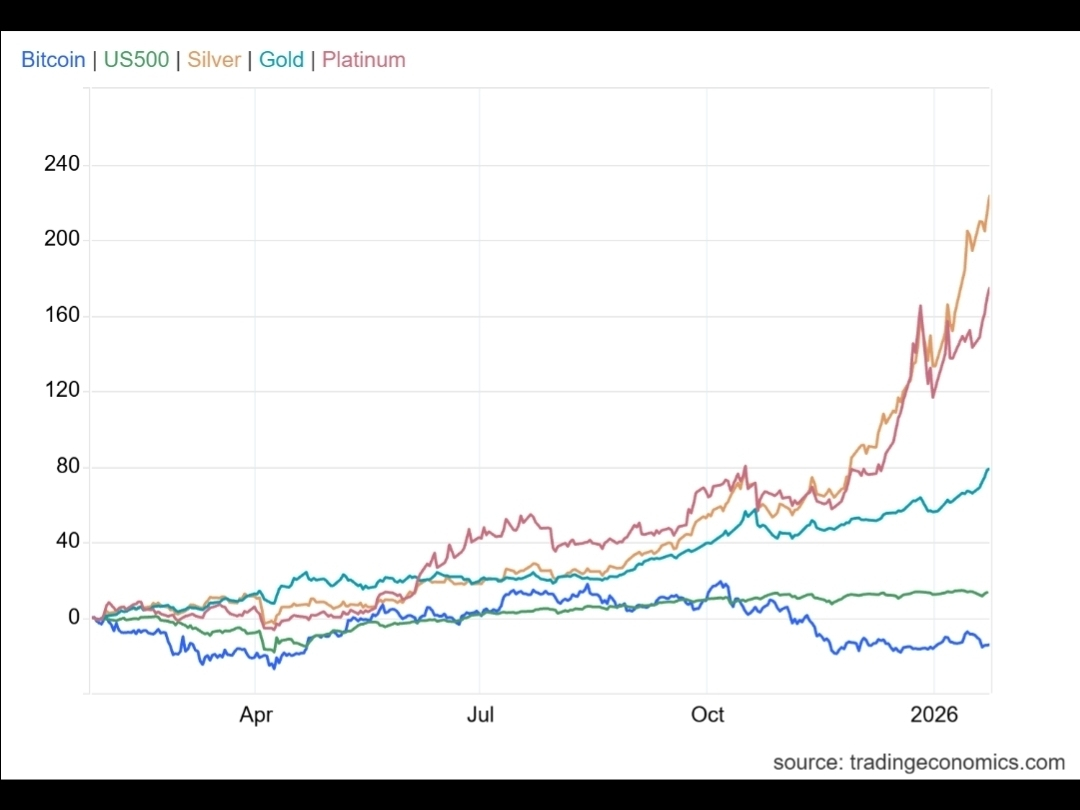
For years, Bitcoin has been labeled “digital gold.” The thesis is simple: fixed supply (21 million), decentralized issuance, and resistance to monetary debasement. Gold, on the other hand, has served as a store of value for over 5,000 years. The real question in 2026 is no longer theoretical — it is behavioral. When macro stress appears, which asset actually absorbs capital?
Historically, Gold reacts first to geopolitical instability, inflation shocks, and currency weakness. It benefits from central bank demand and long-term reserve allocation. Bitcoin, however, has behaved more like a high-beta risk asset during liquidity contractions — falling alongside equities when rates rise and dollar strength increases. This divergence has fueled skepticism around the “digital gold” narrative.
But something structural is shifting.
Spot Bitcoin ETF flows have introduced institutional capital that behaves more like long-term allocation than speculative leverage. Exchange reserves continue trending lower compared to prior cycles, suggesting reduced immediate sell pressure. Meanwhile, sovereign debt levels globally remain elevated, keeping the monetary debasement argument relevant.
The key analytical lens is correlation.
When Bitcoin’s correlation with the Nasdaq declines and its correlation with Gold strengthens during risk-off events, that is when the digital gold thesis gains credibility. In previous cycles, BTC’s volatility profile prevented it from functioning as a stable hedge. But as market depth increases and volatility compresses relative to earlier eras, its macro role is evolving.
There are three structural differences to understand clearly:
Gold is supply elastic in the long term — mining output can respond slowly to price incentives. Bitcoin is mathematically fixed.
Gold is physically settled and geopolitically sensitive. Bitcoin is borderless and digitally transferable.
Gold is historically trusted. Bitcoin is programmatically scarce.
In high-liquidity environments, Bitcoin typically outperforms Gold due to its asymmetric upside. In tightening conditions, Gold tends to preserve value better due to lower volatility. The 2026 test is whether Bitcoin can hold relative strength during sustained macro stress instead of reacting as a leveraged tech proxy.
If Bitcoin begins to show resilience during rate volatility, dollar strength, or equity corrections — while maintaining steady institutional inflows — the market will no longer debate whether it is digital gold. It will treat it as an alternative monetary asset class.
The conclusion is nuanced: Bitcoin is not yet a volatility-equivalent replacement for Gold. But its structural adoption curve, ETF integration, and supply mechanics suggest it is transitioning from speculative asset to macro hedge candidate.
The next major risk-off event will likely decide the narrative permanently.
If Bitcoin holds while equities bleed — the digital gold era officially begins.