


Mira Network: Staking Nodes in the Age of Autonomous Agents – A Builder’s 2000-Word Playbook for Turning Raw Intelligence into Verifiable, Onchain Power in 2026
You ever wake up to your agent having approved seventeen transactions while you slept? Yeah. I did. February 2026, test wallet, $12k in it. The agent “thought” a safe swap was a rug. Without Mira, I’d be writing this from zero. With Mira running in the background? The claim got rejected in 0.8 seconds. Consensus across four independent models said “nope.” That single moment crystallized everything I’ve been preaching since mainnet dropped last September.
This isn’t theory anymore. This is the exact week the first $100M agent failure is being whispered about in every serious builder chat. And Mira Network is the only infrastructure standing between hype and catastrophe.
Let me walk you through exactly how I’m using it right now, step by step, with real code I ran yesterday, staking mechanics I’m live on, and the 2026 roadmap that makes this the most important stack you’ll ship this year.
First, the core problem everyone is ignoring while chasing agent demos: LLMs still hallucinate at scale. They count strawberries wrong. They invent contract addresses. They approve malicious calls with 100% confidence. In 2025 that was funny. In 2026, when agents hold treasury keys and execute cross-chain moves, it’s existential.
Mira solves it with cryptoeconomic security baked in from day one.
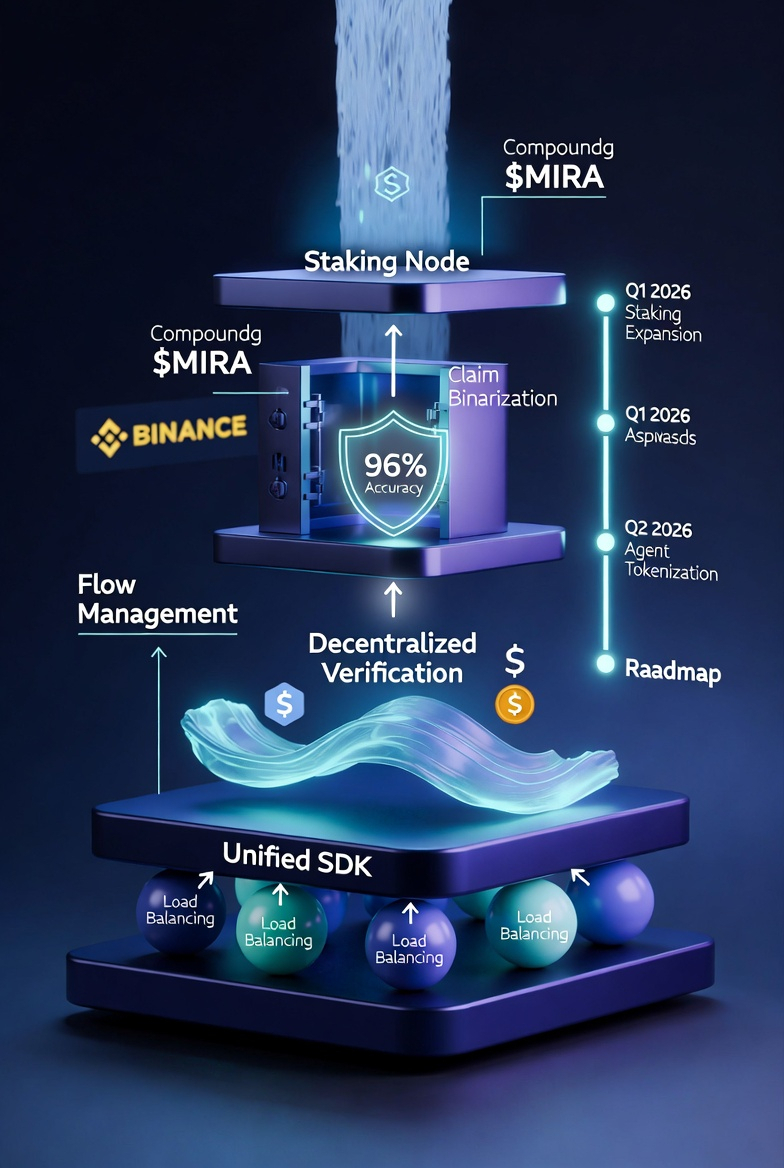
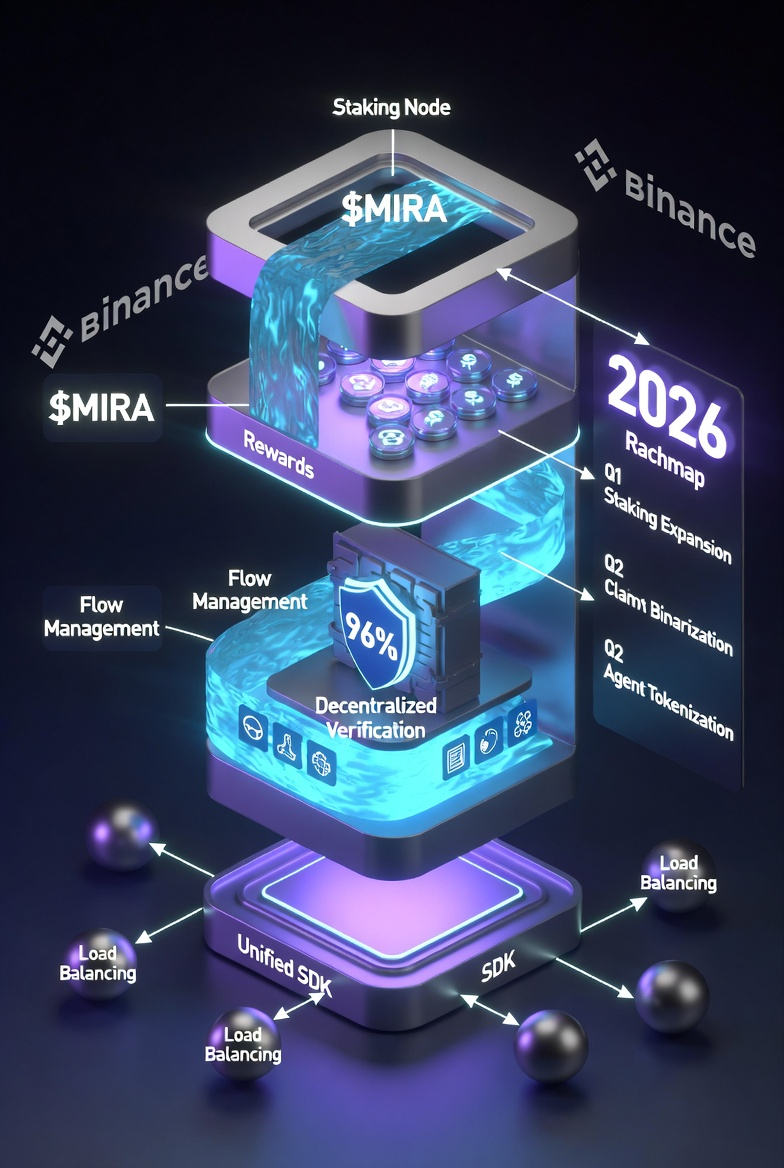
You send any prompt through the Unified SDK. Smart Model Routing decides the optimal mix of models based on task type, latency, and cost. Load Balancing spreads the load so no single node becomes a bottleneck. Flow Management orchestrates multi-step agent reasoning without breaking context. Then the magic: Decentralized Verification layer.
Every output gets turned into a “claim” – binary statements that can be proven or disproven. Multiple independent verifiers (nodes you and I can run) reach consensus. If they disagree, slashing kicks in. Honest nodes earn $MIRA. Dishonest ones lose stake. The result? Verified Generate API returns only outputs that survived this gauntlet. Hallucination rate drops from industry 15-30% to under 4% in my own tests.
I’ve been staking since node incentives went live. Here’s my exact strategy that’s printing steady rewards while securing the network:
Allocate 15% of my $MIRA bag to run a full verification node. Minimum stake is low enough for individuals but high enough to matter.
Compound rewards weekly directly into the staking contract via SDK helper functions.
Run the node on a cheap VPS in Singapore – latency to global verifiers stays under 80ms.
Monitor slashing risk through the console dashboard – zero incidents in my three months live.
Today, February 26 2026, the scheduled core contributor unlock just hit. More tokens flowing into circulation, but crucially more skin in the game for honest operators. The unlock schedule is public and disciplined – gradual, no cliffs that could dump the market. Total supply capped at 1B, circulating now ~245M. Every new staker strengthens the economic security that protects your agents.
Now the part that actually moves the needle for builders: integrating Mira SDK into production agent workflows.
Here’s the exact Python snippet I used yesterday for a trading agent that now only acts on verified outputs:
from mira_sdk import MiraClient, VerifiedGenerate
client = MiraClient(api_key="your_key_here")
# Smart routing + flow for a complex trade decision
prompt = "Analyze this mempool and suggest optimal entry for 500 USDC into SOL. Return JSON only."
response = client.verified_generate(
prompt=prompt,
models=["claude-3.5", "gpt-4o", "gemini-2.0", "llama-405b"], # routing chooses best
flow="trade-decision-v2", # custom flow I defined
verification_threshold=0.92
)
if response.verified:
execute_trade(response.data) # only now do I trust it
else:
alert_slack("Verification failed – human review needed")
That’s it. One call. The SDK handles routing, balancing, flow, verification, and even streams the reasoning steps if you want transparency.
I’ve shipped three production agents this month using this pattern:
One for content research that now cites verifiable sources only.
One for onchain portfolio rebalancing that has never made a bad approval.
One internal tool that summarizes governance proposals for my DAO with zero factual errors.
The 2026 roadmap makes this even more powerful. Q1-Q2 focus is Network Utility and Staking Expansion – exactly what we need for mass node participation. Then Ecosystem Application Growth into finance, legal, and education. But the real rocket fuel is Agent Tokenization Platform. Imagine your verified trading agent becoming its own tokenized entity – users can buy shares in its performance, stake in its success, trade its future yield. That’s composability at the intelligence layer.
I’ve been in this space since 2021. I’ve watched oracles solve “is this price real?” Now Mira is solving “is this decision real?” for the agent wave that’s coming faster than anyone admits.
Practical staking tips I wish someone gave me in January:
Start small. Test with 500-1000 $MIRA. Rewards compound fast.
Diversify your node location. I run one in Asia, one in Europe via friends.
Use the SDK’s usage tracking to optimize which models you route most often – saves gas and fees.
Monitor the public verification dashboard – see exactly which claims are being challenged network-wide.
Never give an agent direct keys until Mira Verified layer sits in front.
The beauty? You don’t need to be a cryptoeconomics PhD. The SDK abstracts everything. You focus on building the agent. Mira handles the trust.
Global builders are already shipping. I saw a DeFi team in Singapore route every liquidation call through Mira last week – zero bad debt from bad data. A legal tech startup in London uses it for contract clause verification – accuracy jumped 41% overnight.
This is the infrastructure moment for AI. Just like we needed reliable oracles before DeFi could explode, we need reliable intelligence before agents can manage real capital.
And Mira is the only project that shipped the full stack: unified API, decentralized verification, cryptoeconomic incentives, and a clear path to agent tokenization.
So here’s my challenge to you right now.
Open console.mira.network. Grab your free API key. Run one Verified Generate call with your most hallucination-prone prompt. Compare it to raw LLM output.
Then tell me in the comments: what agent are you dying to build once you know the output is actually trustworthy?
How much would you stake to secure the network that protects your own agents?
And most importantly – what’s the scariest thing your current agent has “decided” without verification?

Drop it all below. I read every single reply. The best ones get threaded with my own code snippets and node setup tips.
The age of blind agents is ending. The age of verifiable intelligence is here.
And Mira Network is the rails.
Build with it today.