

The next phase of blockchain infrastructure will not be defined by generic smart-contract capability. It will be defined by execution quality.
FOGO is designed around that premise.
Rather than positioning itself as another multi-purpose Layer-1, Fogo focuses on a single objective: delivering institutional-grade, low-latency, deterministic execution for financial markets on-chain.
This is not marketing language. It is architectural intent.
Built on the Solana Virtual Machine — Optimized for Speed
Fogo is an SVM-compatible Layer-1. That compatibility matters because it allows developers familiar with the Solana stack to migrate tooling, programs, and infrastructure without rebuilding from scratch.
But Fogo is not simply copying Solana’s blueprint.
Its validator architecture leverages Firedancer, the high-performance client originally engineered to push throughput and efficiency to the limits. Firedancer is written in C for maximum performance optimization, minimizing overhead and enabling extremely fast block production.
The result is a chain targeting ~40 millisecond block times and near-instant finality, a threshold that begins to narrow the performance gap between centralized exchanges and decentralized infrastructure.
For high-frequency DeFi environments, milliseconds are not theoretical. They determine slippage, liquidation accuracy, and order execution fairness.
Why Execution Speed Changes Everything
Most blockchains optimize for decentralization first and accept latency as a trade-off. Fogo approaches the problem differently:
• Predictable block times
• Deterministic ordering
• High throughput
• Reduced latency variability
This makes the network particularly suited for:
• On-chain order book exchanges
• Perpetual futures markets
• Liquidation engines
• Algorithmic trading strategies
• Real-time lending and borrowing protocols
In traditional finance, execution precision is non-negotiable. Fogo’s thesis is simple: if DeFi is going to compete seriously with centralized venues, it must match them on speed and reliability.
The $FOGO Token — Functional, Not Decorative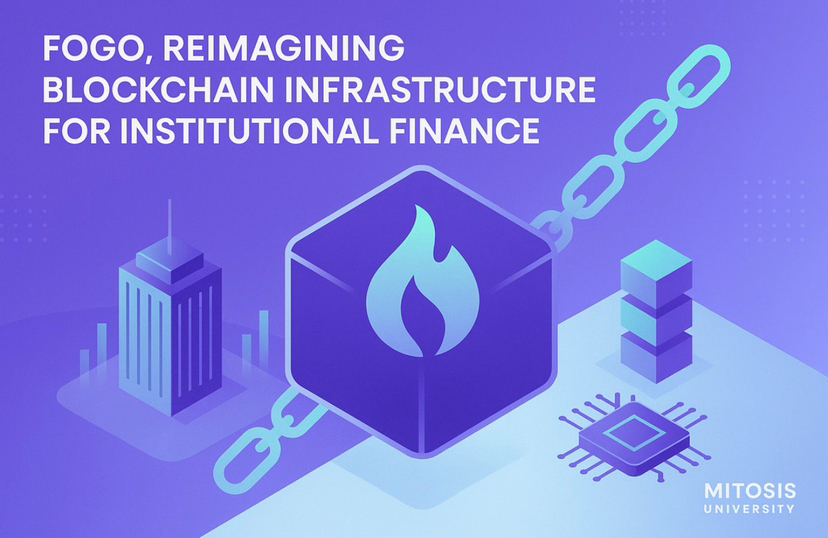
The FOGO token powers the network at every level.
1. Gas and Transaction Fees
All network activity settles in FOGO. Every trade, contract interaction, and validator reward flows through the token.
2. Staking and Network Security
Validators stake FOGO to participate in block production. Delegators can stake to validators, aligning economic incentives across the ecosystem.
3. Governance
Protocol upgrades, parameter changes, and ecosystem incentives are shaped by token holder participation.
The utility structure is straightforward. No unnecessary complexity. The token secures, powers, and governs the chain.
Architecture Designed for Markets
What distinguishes Fogo is not just speed. It is intentional specialization.
Instead of trying to support every possible Web3 use case, Fogo concentrates on financial infrastructure. That focus enables tighter performance optimization at the network layer.
Validator coordination and geographic optimization reduce propagation delay.
Execution scheduling minimizes contention.
Throughput design supports order-book style systems rather than purely AMM-based models.
This specialization may limit general experimentation in other verticals. But it strengthens its position in a specific category: high-performance DeFi.