
Most blockchains are still designed as marketplaces. Fees float, priority is auctioned, and outcomes depend on who bids hardest at a given moment. That design works when speculation is the dominant activity. It breaks down completely when systems become automated.
Machines do not tolerate ambiguity. Autonomous software requires cost certainty, execution guarantees, and predictable ordering. This is the lens through which @Vanar makes the most sense — not as a consumer chain, but as economic infrastructure for non-human actors. In that context, $VANRY becomes less a speculative token and more a settlement primitive. #vanar
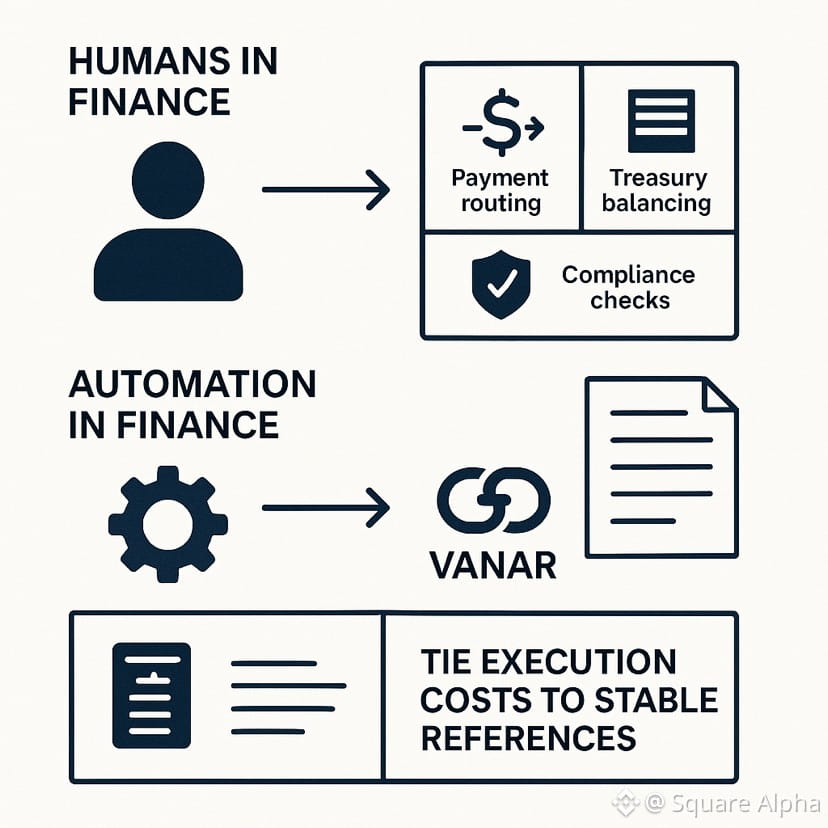
The transition underway in finance is not about more users. It is about fewer humans in the loop. Payment routing, treasury balancing, compliance checks, reconciliation — these processes are increasingly automated. A blockchain serving this environment must behave less like an open auction and more like a deterministic system.
Vanar’s design choices reflect this reality. Rather than allowing transaction costs to fluctuate wildly with token price and congestion, Vanar ties execution costs to stable economic references. This enables systems to model expenses ahead of time. For an AI agent managing thousands of micro-transactions, predictability is not a preference — it is a requirement.
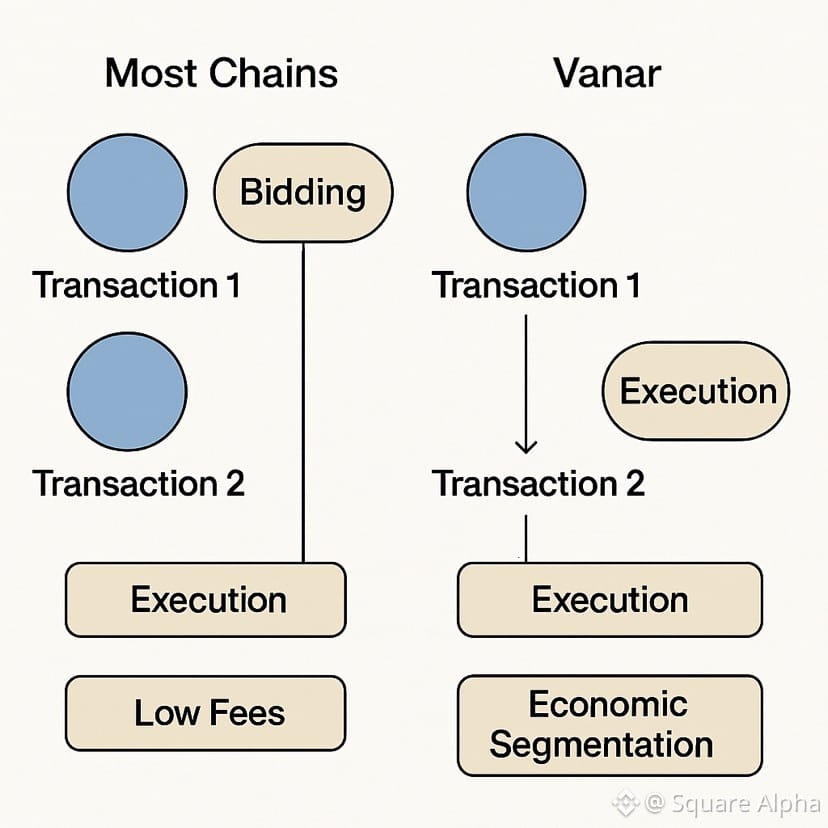
This predictability extends beyond fees. Transaction ordering on most chains is adversarial by default, rewarding whoever pays more in the moment. That model introduces uncertainty, latency, and extractive behavior. Vanar removes this variable by enforcing ordered execution. For automated systems, this eliminates an entire class of failure modes. The outcome of a transaction becomes dependent on logic, not bidding wars.
Low fees alone do not solve this problem. When networks become too cheap without safeguards, they invite spam and instability. Vanar addresses this through economic segmentation: routine activity remains inexpensive, while resource-intensive operations scale in cost. This ensures that normal usage stays viable while attacks become economically irrational. It is a practical defense mechanism, not an ideological one.
From an institutional standpoint, these decisions matter. Enterprises do not evaluate blockchains based on decentralization purity or narrative alignment. They evaluate them based on reliability under load, cost modeling, and operational risk. Vanar’s governance approach reflects this as well, prioritizing accountable validation early and transitioning toward reputation-based participation over time. Stability is favored first, decentralization evolves later — a sequence institutions understand well.
Vanar’s treatment of intelligence follows the same pragmatic logic. Instead of bolting AI features onto applications, it embeds meaning at the infrastructure layer. Data is not merely stored; it is compressed, verifiable, and usable by software. This allows automated systems to reason about documents, transactions, and context — the ingredients of real financial activity.
This matters because payments never exist in isolation. Every transfer is tied to contracts, invoices, identities, and regulatory obligations. When this context is machine-readable, autonomous systems can move beyond simple value transfer and into compliant financial workflows. Vanar positions itself at this intersection, where intelligence meets settlement.
The strategic focus on real payment integration reinforces this direction. Adoption does not come from ideology alone. It comes from distribution — merchants, processors, institutions willing to plug into infrastructure that behaves predictably. Vanar’s interest in stablecoins and traditional rails suggests a long-term goal: becoming a backend layer that existing financial systems can rely on without reengineering their assumptions.
Token economics quietly support this thesis. Issuance prioritizes validators and network growth rather than short-term insiders. Emissions decline over time, reinforcing sustainability over hype. The structure reflects an understanding that infrastructure compounds slowly, not explosively.
The risk, as always, is execution. Deterministic systems must remain deterministic under stress. Reputation-based validation must resist capture. Intelligent data layers must perform beyond controlled environments. These are non-trivial challenges.
But if Vanar succeeds, it occupies a rare position in crypto: a chain chosen not for excitement, but for dependability.
The future of blockchains will not be loud. It will be invisible — running in the background as machines move value autonomously. Vanar is building for that future, and $VANRY is its economic spine.