

I still remember the first time blockchain truly impressed me. It felt like the internet discovering money. Everything was open. Transactions moved across borders without permission. Code replaced middlemen. It seemed like we had finally built a financial system that belonged to everyone. But the longer I watched, the more I noticed a tension that nobody wanted to talk about. The very thing that made blockchain revolutionary was also the thing keeping serious financial institutions at a distance.
Public blockchains were built like open books. Every transaction could be seen. Every wallet could be traced. That transparency created trust in a world where people did not want to rely on banks or governments. But traditional finance does not work in public view. Banks cannot expose client balances. Investment firms cannot reveal trading strategies. Companies cannot show payroll flows or sensitive acquisitions to the entire world. Privacy in finance is not secrecy for its own sake. It is protection, legality, and responsibility.
That realization changed how I saw the industry. The question was no longer how fast blockchain could replace the old system. The real question became whether blockchain could grow into something mature enough to work with the financial world as it actually exists. That is where the story of Dusk begins.
Dusk was founded in 2018 with a perspective that felt different from the loud disruption narrative. Instead of declaring war on traditional finance, the project focused on a more grounded challenge. How do you build blockchain infrastructure that institutions can legally and safely use. How do you create a system where privacy and compliance are not afterthoughts but foundations.
Most early blockchains made a trade. You get decentralization and transparency, but privacy becomes difficult. Financial institutions operate under a different trade. You get privacy and regulatory structure, but innovation slows and intermediaries stack up. Dusk asked whether that trade off was necessary. If technology could prove transactions were valid without exposing sensitive data, then maybe trust did not have to come from visibility alone.
This is where the core idea of Dusk takes shape. The network uses advanced cryptographic methods that allow participants to prove something is true without revealing all the underlying information. In simple terms, a transaction can be verified as legitimate and compliant without broadcasting personal or strategic details to the public. I find this idea powerful because it changes the old equation. Privacy does not automatically mean less trust. Trust can come from mathematics and protocol rules rather than exposure.
Dusk is a Layer 1 blockchain, meaning it is the base network where transactions are recorded and secured. But its design reflects the needs of regulated finance. The architecture is modular, with different components handling different responsibilities. One part of the system focuses on consensus and settlement, making sure the ledger remains secure and consistent. Another environment handles smart contracts, which are programs that automate financial logic such as issuing assets, managing transfers, or distributing returns.
What stands out is that compliance logic can be built directly into how assets function. If a digital asset represents something regulated like a security, rules about who can hold it, how it can move, and under what conditions can be embedded at the protocol level. It becomes infrastructure that understands regulation instead of trying to bypass it. If oversight is required, selective disclosure mechanisms can allow authorized parties to review necessary information without opening everything to the world.
This design is especially relevant in the context of tokenized real world assets. Traditional instruments like bonds, equities, and funds follow strict legal lifecycles. They are issued under regulations, traded within defined frameworks, and monitored by authorities. Bringing these assets on chain is not just a technical task. It is a legal and operational one. Many blockchain experiments have stumbled here because full transparency conflicts with privacy laws and business realities.
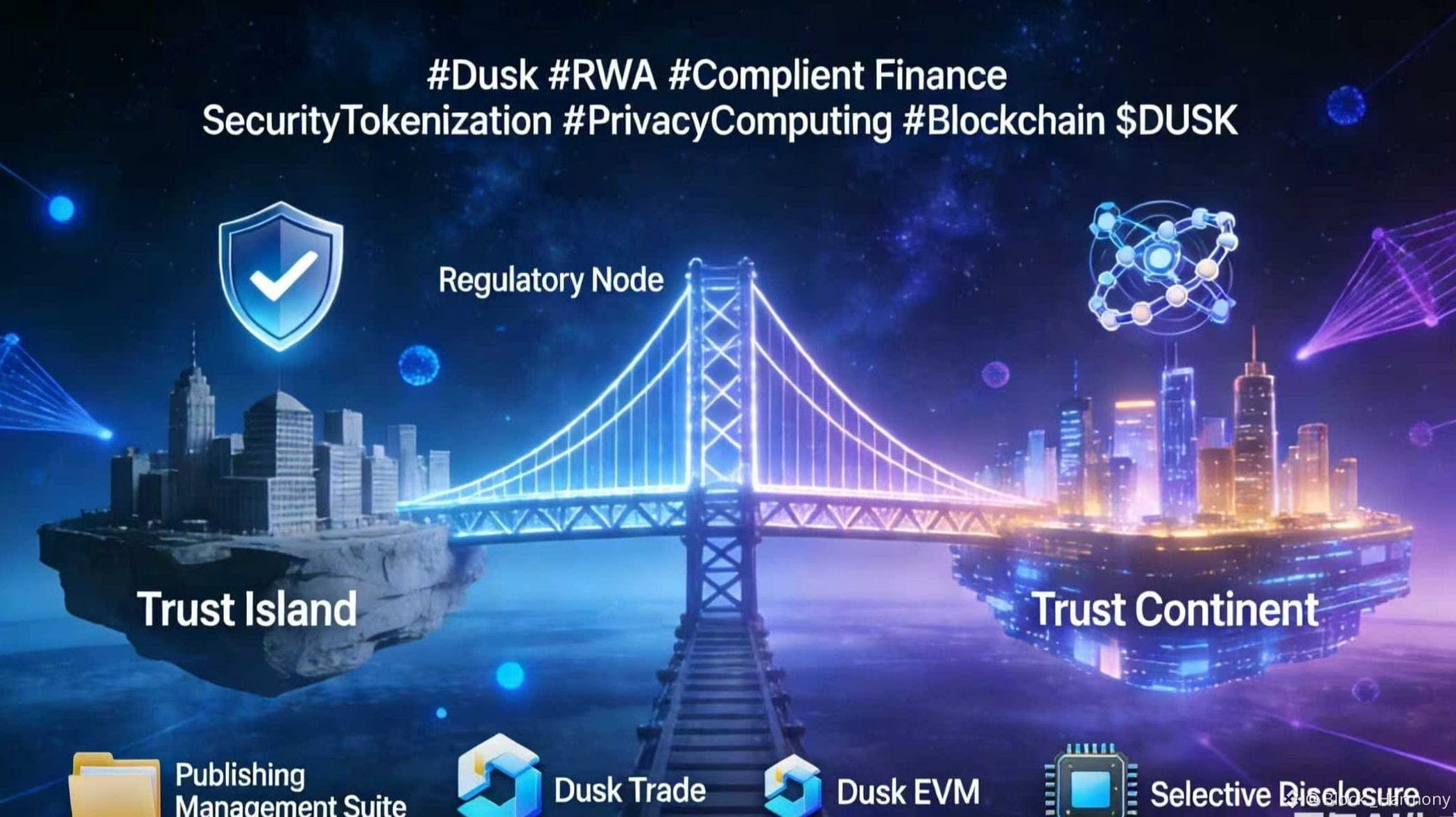
Dusk was built with this use case in mind. Ownership records, transfers, and corporate actions can be managed on chain while sensitive participant data remains protected. The system aims to provide both confidentiality for market participants and auditability for regulators. It becomes a bridge between decentralized technology and established financial structures rather than a replacement that ignores existing rules.
As I followed this approach, I realized the project represents a shift in how blockchain is maturing. Early waves focused on speed, speculation, and radical openness. Now we are seeing a phase where integration with the real economy matters more. Institutions are exploring digital assets, but they cannot compromise on legal duties. Regulators are learning about blockchain, but they need systems that support oversight. Individuals are becoming more aware of data privacy and do not want their financial lives permanently exposed.
In that environment, a network designed specifically for regulated and privacy focused financial applications fills a growing need. It suggests a future where decentralization does not mean the absence of rules, and regulation does not mean the end of innovation. Instead, both are encoded into the same infrastructure.
What moves me about this story is that it feels less like rebellion and more like evolution. Financial systems carry the weight of salaries, pensions, savings, and livelihoods. They cannot be rebuilt recklessly. Dusk’s path acknowledges that reality. It tries to modernize the rails beneath finance without removing the protections people depend on.
When I think about where digital finance is heading, I no longer imagine a world where everything is either fully public or locked behind walls. I imagine layered systems where privacy is respected, compliance is automated, and trust comes from strong design rather than blind exposure. Dusk represents one attempt to build that kind of future.
It reminds me that innovation does not always have to be loud to be transformative. Sometimes progress looks like careful engineering, thoughtful balance, and respect for human needs. If blockchain is going to support the next era of global finance, it has to grow in this direction. It has to learn that power is not only in being seen. Sometimes real strength is in protecting what should remain private while still proving that everything is done right.
That is the journey Dusk is part of. Not a spectacle, but a steady effort to bring privacy, compliance, and decentralization into the same conversation. And in a world where trust in financial systems is constantly tested, that quiet ambition may turn out to be exactly what the future needs.