
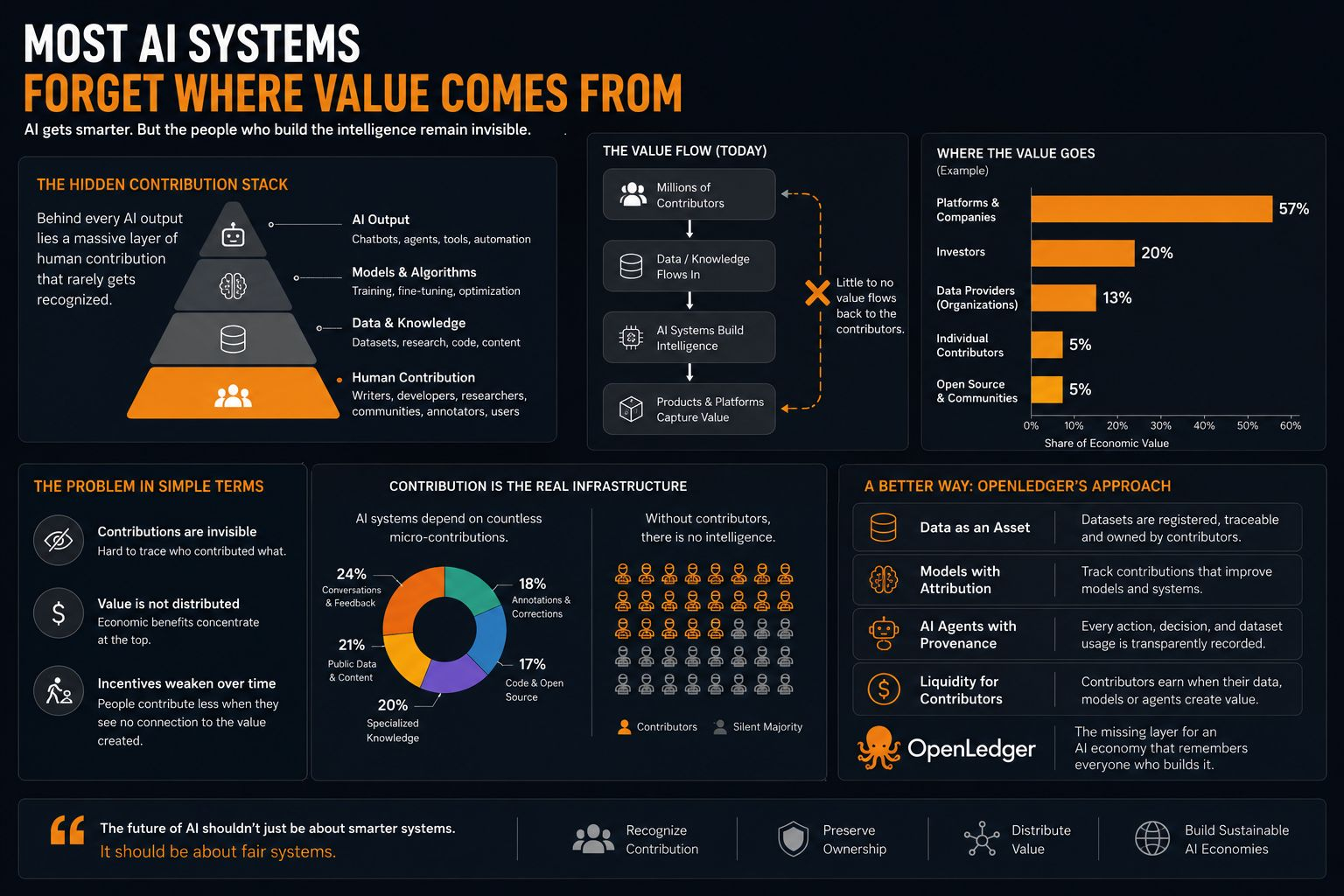
The first thing that unsettled me about AI was not the intelligence itself. It was the strange silence around where that intelligence actually comes from.
When people talk about AI, the conversation usually revolves around scale. Bigger models. Faster responses. Smarter agents. More automation. But the more time I spend watching this space evolve, the more I feel the real issue sits somewhere deeper and less visible.
AI systems are becoming incredibly good at absorbing human knowledge, yet increasingly disconnected from the people who produced that knowledge in the first place.
That disconnect changes the feeling of the internet in ways that are subtle at first, but difficult to ignore once you notice them.
For years, the web operated on an imperfect but understandable exchange. People shared ideas, code, tutorials, research, opinions, and creativity because something still flowed back toward them. Sometimes it was attention. Sometimes reputation. Sometimes opportunity or community. The system was messy, but contribution remained visible enough for people to feel connected to the value they created.
AI quietly changes that relationship.
Now information can be collected, compressed, retrained, and reproduced inside systems that no longer carry the identity of the people behind the original work. A writer publishes insight publicly, a developer solves a niche problem, a small online community spends years refining knowledge around a topic — and eventually fragments of all that effort become part of a much larger machine.
The machine gets smarter.
The contributors slowly disappear.
I think this is the part people are starting to feel, even if they cannot fully explain it yet. There is a growing sense that the modern internet extracts value more efficiently than it returns recognition.
And maybe that is why conversations around data suddenly feel different now.
Data used to sound abstract, almost technical. But in the context of AI, data starts looking more like labor. Not traditional labor in the industrial sense, but continuous intellectual and behavioral contribution. Every correction, preference, interaction, annotation, conversation, and piece of public knowledge becomes part of a training loop somewhere.
The problem is that most systems still treat those contributions as raw material rather than ongoing participation.
That distinction matters.
Because the internet does not function without millions of people continuously adding context into it. AI models may appear autonomous on the surface, but underneath them sits an enormous layer of invisible human input. Researchers, writers, moderators, open-source developers, niche experts, online communities — all of them shape the intelligence people interact with every day.
Yet very little of that contribution remains economically visible after the value gets packaged into polished interfaces and commercial products.
That creates a structural imbalance.
Over time, systems that continuously absorb value without clearly acknowledging where that value originated tend to weaken the incentive to contribute openly. People become more protective of knowledge. Smaller communities become harder to sustain. Creative work starts feeling detached from ownership. The internet becomes richer in outputs while poorer in participation.
I do not think this is simply a technological issue. It feels economic and cultural at the same time.
And this is where blockchain starts becoming interesting again, at least to me.
Not from the usual speculative perspective, but from the perspective of memory and coordination.
At their core, blockchain systems are really mechanisms for recording relationships. Who contributed. Who participated. Who owns what. Who helped create value inside a network.
That framing feels increasingly important in the age of AI.
Because one of the biggest weaknesses in current AI infrastructure is not intelligence. It is attribution. The systems generating enormous value still struggle to preserve transparent links between contribution and outcome.
Projects like OpenLedger become interesting within that context.
What stands out is not simply the idea of combining AI and blockchain. That narrative already exists everywhere. The more important idea is the attempt to treat data, models, and AI agents as economically connected components rather than isolated black boxes.
That may sound like a small distinction, but I think it changes the direction of the conversation completely.
If AI increasingly depends on collective human contribution, then the infrastructure around AI probably needs better ways to recognize and coordinate that contribution. Not only socially, but economically as well.
Who provided the data that improved a model?
Who refined the outputs?
Who created the specialized knowledge that agents now rely on?
Who benefits as those systems become more valuable over time?
Current digital systems are surprisingly weak at answering those questions clearly.
And I suspect this becomes more important as AI grows beyond chat interfaces into autonomous agents, automated workflows, and machine-to-machine economies. Once intelligence becomes part of everyday infrastructure, questions around ownership and participation stop being abstract philosophical debates. They become practical economic problems.
Crypto may end up playing a role there, not because decentralization magically fixes everything, but because blockchains are naturally designed to preserve traceability inside complex systems.
In a strange way, AI may force the internet to rethink memory itself.
Not memory in the technical sense, but in the economic sense. Who gets remembered by the system after value is created? Who remains visible after intelligence becomes abstracted into products and platforms?
I think people underestimate how important that question is becoming.
Because the next phase of the internet may not be defined only by smarter machines. It may also be defined by whether the people feeding those machines remain connected to the value they help create.
Right now, that connection still feels fragile.
And honestly, that fragility may end up shaping the future of AI more than the models themselves.
