
Key features of @Dusk are:
• Segregated Byzantine Agreement
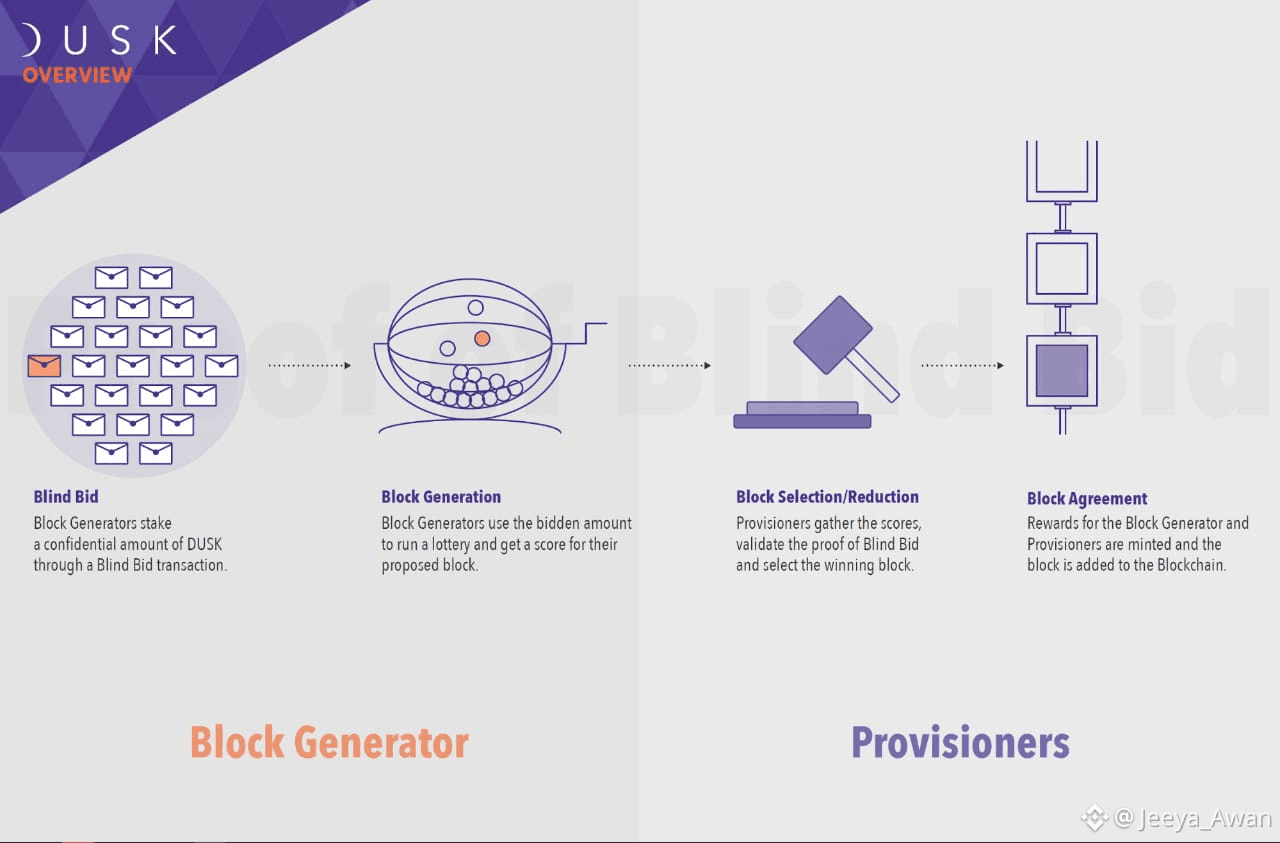
The roles in the protocol are split between two different node types: Block Generators and Provisioners.
1. Block Generators compete in a recurring lottery for the right to submit block candidates, while Provisioners run consensus over the selection of the lottery winners and acceptance of their proposed block.
In order to become Block Generators, full nodes submit a confidential transaction called Blind Bid. Provisioners, instead, are required to stake their DUSK publicly, while participating in the consensus.
• A unique consensus mechanism:
• Blind Bid Phase:
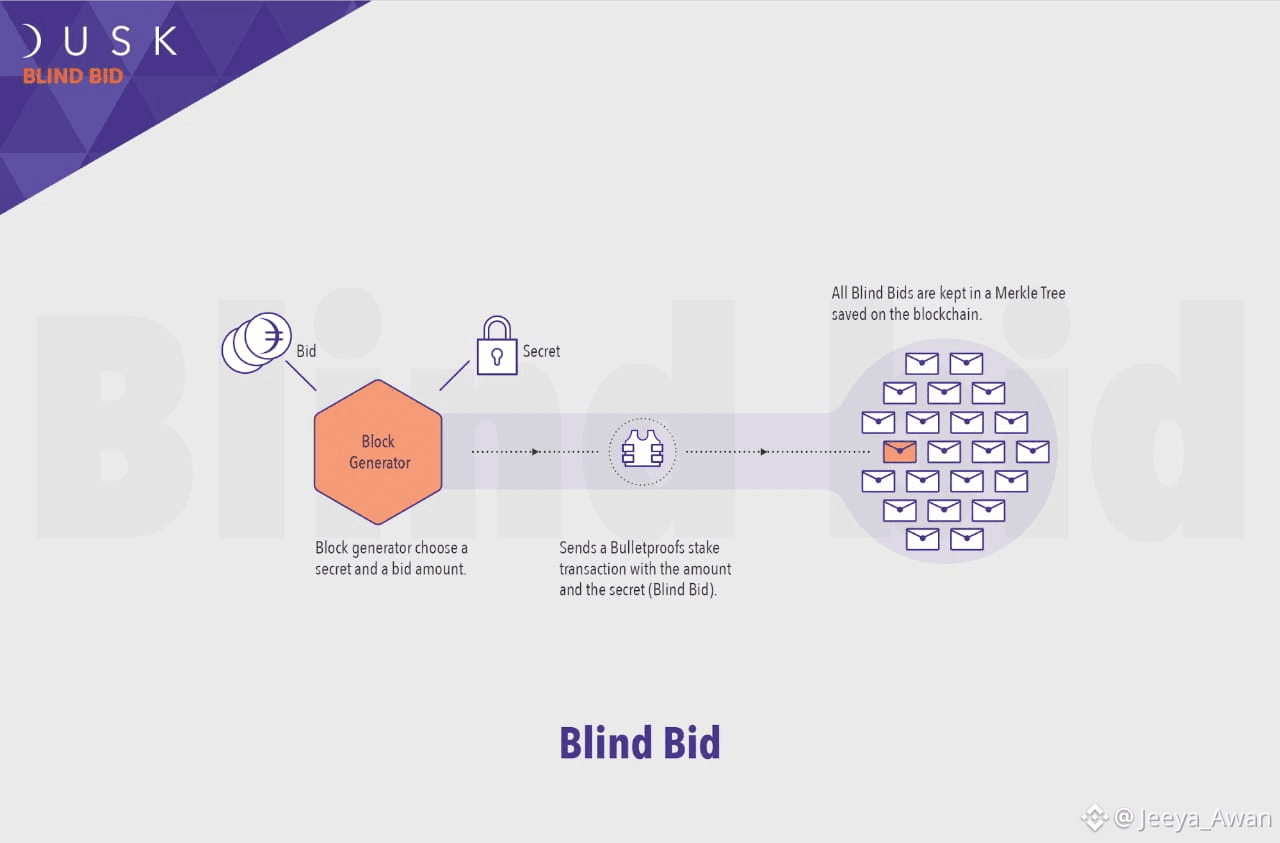
During the Blind Bid phase, aspiring Block Generators stake an amount of DUSK for the right to participate in the block generation lottery. The stake transaction is called a Blind Bid, because the amount of DUSK staked and the identity of the Block Generator are kept confidential. The Blind Bid also carries a secret number 'k' chosen arbitrarily by the Block Generator. This way she can claim ownership of her own transaction at any time, despite its confidentiality and without disclosing her identity. All valid Blind Bids are kept in a Merkle Tree saved on the blockchain.
• Consensus Phase - Block Generation and Selection:
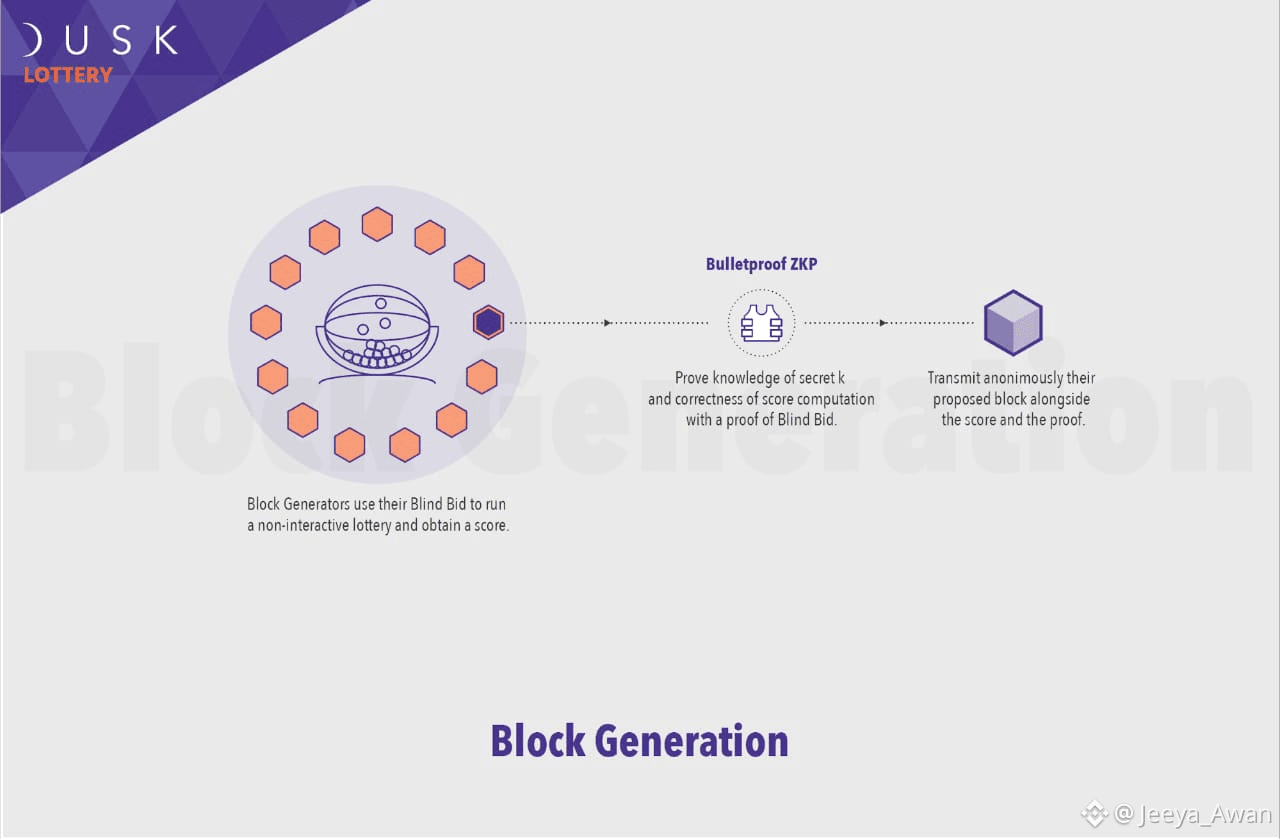
During each round, Block Generators use their Blind Bid to run a non-interactive lottery and obtain a score.
The amount of DUSK in the Blind Bid positively affects this score.
Thus, Block Generators anonymously transmit their proposed block to the Provisioners alongside the obtained score and the Zero Knowledge proof of Blind Bid; therefore proving knowledge of the embedded secret 'k' and the correctness of the score computation. Due to the reliance upon Zero Knowledge proof of correctness, proof of Blind Bid provides a significantly higher level of security if compared to public Proof-of-Stake systems while showing an equal resilience to Sybil attacks.
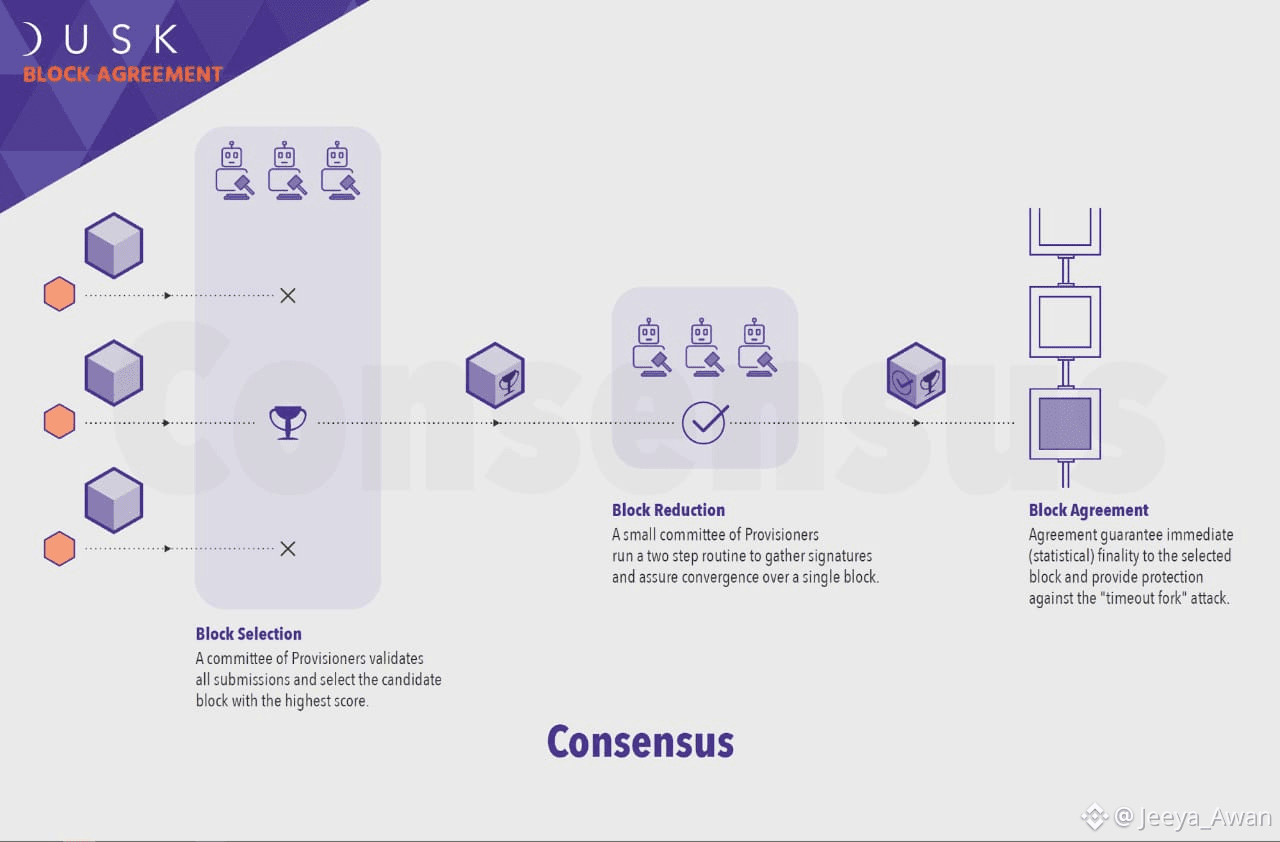
A committee of Provisioners validates all submissions and select the candidate block with the highest score.
• Consensus Phase - Block Reduction:
After the Selection phase, a small committee of Provisioners perform Block Reduction: a two step routine to gather Provisioners' signatures and assure convergence over a single block. If more signatures than a threshold of 75% of committee participants are collected, the candidate block is then established. The committee chosen for Block Reduction is always a small subset of the entire provisioner population, deterministically extracted through a non-interactive algorithm called "deterministic sortition". The non-interactive deterministic extraction algorithm additionally enables every node in the network to calculate who is in the committee from public parameters. This can be used to single out compromised participating Provisioners and decrease their reputation.
• Consensus Phase - Block Agreement':
The Block Agreement is an additional phase designed to guarantee immediate finality to the selected block and provide protection against the "timeout fork" attack. During this phase, an additional committee gathers and verifies the signatures collected at the Reduction phase. This phase provides a statistical guarantee that at least one honest node has received a set of votes exceeding the minimum threshold required to successfully terminate the respective phase of the protocol.
If the candidate block does not reach sufficient signatures, or agreement votes, the candidate block is omitted from the pool of candidate blocks and the process loops back to the selection stage. This time another candidate block with the highest score is selected and the process repeats until a favorable outcome is reached.
• Key metrics:
Token name is $DUSK and the token type is ERC-20 and BEP-2.
