

Storage is usually sold as a room with fixed walls. You pay for a size. You accept the shape. When your needs change, you move to a bigger room or you start throwing things away. This model is familiar, but it is also rigid. It assumes one owner, one account, one simple lifecycle, and one provider who quietly enforces the rules.
Walrus is built for a different environment. It is a decentralized storage protocol designed to store and retrieve large, unstructured blobs, meaning files or data objects that are not stored as rows in a database table. Walrus stores blob contents off-chain on decentralized storage nodes, and it uses the Sui blockchain for coordination, payments, and system orchestration. Walrus is explicit that only metadata is exposed to Sui or its validators; the blob content remains off-chain. This boundary shapes everything. If the chain is coordinating resources and responsibility, then “storage” must be described in a way that is clear, transferable, and verifiable.
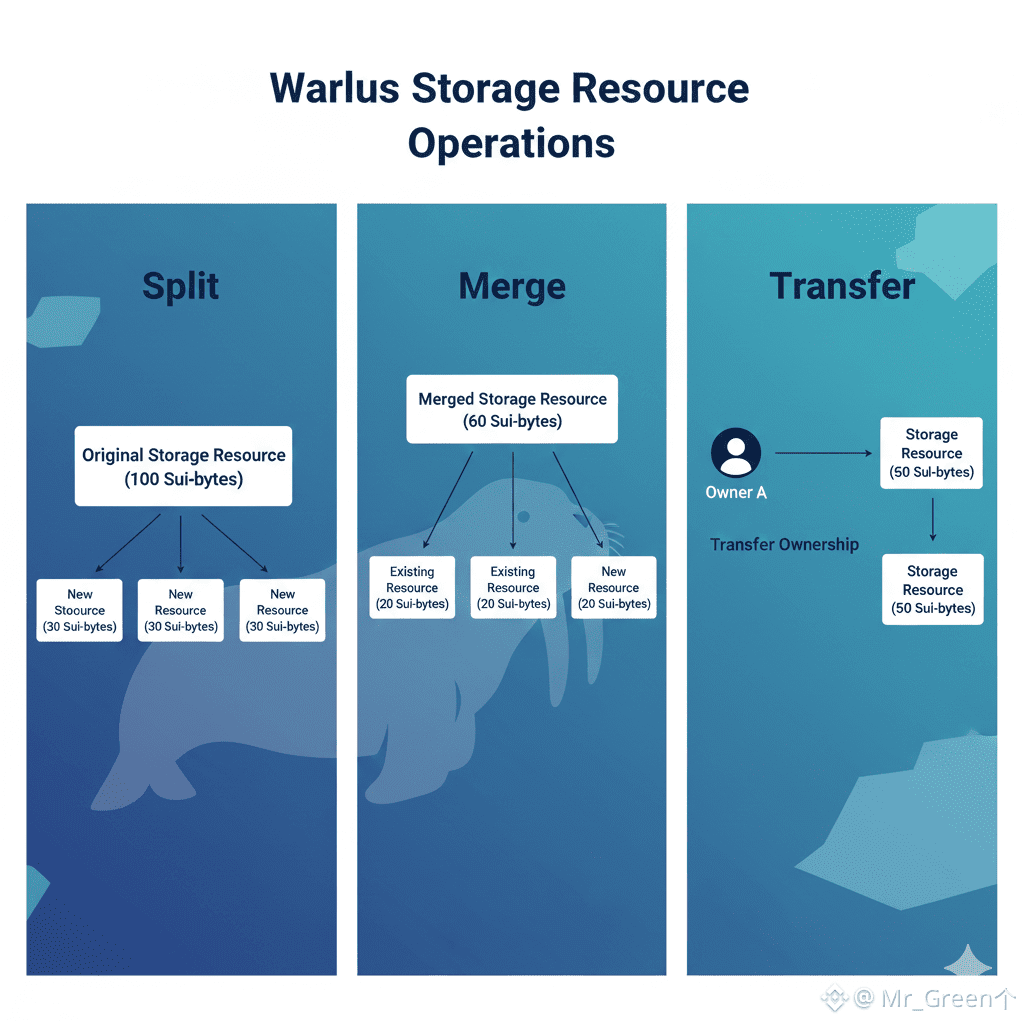
That is why Walrus represents storage space as a resource on Sui that can be owned, split, merged, and transferred. These three actions sound like simple mechanics, but in a protocol setting they become a way to manage real-world variability. They let users and applications match storage capacity to the size, ownership, and lifetime of the blobs they want to store, without depending on private agreements or manual coordination.
To understand why this matters, it helps to first remember what Sui is doing for Walrus. Sui smart contracts coordinate Walrus storage operations, resource lifetimes, governance for shard assignments, and payment flows. Users acquire storage resources and later attach them to blob IDs. Storage nodes watch for on-chain events to know what uploads are authorized. When enough storage node signatures are collected and submitted as an availability certificate, Sui emits an availability event. That event marks the Point of Availability, the moment when Walrus takes responsibility for maintaining availability for the availability period. These are protocol facts, not informal promises. And storage resources are one of the main ways those facts are expressed.
Split: When one allocation must become many responsibilities
Splitting a storage resource means taking a single capacity object and dividing it into smaller capacity objects. This has obvious convenience value, but the deeper reason is that real data rarely arrives as one neat package.
A builder might be storing many blobs: images, videos, training data segments, model artifacts, web assets for a site, or archival chunks. Each blob may have a different size and a different intended duration. If storage could not be split, the builder would have to purchase separate storage allocations for each blob, or allocate a single large resource to one blob and waste the remainder. Splitting makes it possible to fit the resource to the job.
Splitting also matters for governance and accounting. Walrus ties storage to time. A blob has an availability period after PoA, and users can extend availability by providing additional storage resources with longer expiry. If a single storage resource could not be split, it would be hard to manage separate renewal schedules. One part of your application might need long-lived data, while another part might need short-lived data that is updated frequently. Splitting allows those schedules to diverge cleanly.
In many systems, “separating budgets” becomes a social process. Teams create internal rules and spreadsheets. In Walrus, splitting can make this separation a protocol-visible act. One account can hold multiple smaller storage objects, each attached to different blob IDs and different lifetimes. This does not remove the need for planning, but it gives planning an object-level shape the protocol can enforce and applications can reason about.
Merge: When many small pieces must become one usable whole
Merging is the inverse operation: combining multiple storage resources into one larger resource. In practice, fragmentation is a common problem. You might acquire storage in pieces over time. You might receive transfers from different sources. You might split resources earlier to fit small blobs, then later need to store a large blob that requires more capacity than any single remaining piece.
Without merging, fragmentation becomes waste. You could have enough total capacity, but not in a form that can be assigned to a single blob. Merging solves that by letting you consolidate capacity into a resource large enough for the blob you want to store.
Merging also helps with lifecycle management. Suppose you want to create one long-lived “archive resource” that will be used to extend availability for a set of foundational blobs. You may collect capacity from different operations, different accounts, or different time periods. Merging allows you to consolidate those pieces into a single resource object that can be managed, transferred, or attached as a unit.
A subtle point here is that merging supports composability for applications. A dApp could choose to accept storage resources from users in various sizes, then merge them into a unified pool it uses to maintain the availability of shared assets. Another dApp might do the opposite: maintain a large storage object, then split and distribute portions to users as part of a workflow. The ability to move between “many small” and “one large” without leaving the protocol is what makes the resource model flexible.
Transfer: When ownership must move without breaking verification
Transfer is where the storage resource model becomes truly social. Transfer means moving a storage resource object from one owner to another. In familiar Web2 storage, transfer is usually informal: share credentials, add a collaborator, or send an invoice and hope the provider updates permissions correctly. In Walrus, transfer is explicit and on-chain. Ownership changes are recorded as part of the system’s public state.
Walrus mentions that users can acquire storage resources either by buying them from the Walrus system object or through a secondary market. Transfer is the mechanism that makes that possible. But the importance is broader than market language. Transfer enables real application patterns that do not require a single custodian.
Consider a few grounded scenarios that become simpler when storage is transferable:
A team is building an application with a separate operational wallet for paying storage. They can transfer storage resources to the account that will attach them to blob IDs and manage renewals.
An app wants to sponsor early users by giving them storage capacity for their first uploads. Instead of holding users inside a centralized publishing service, the app can transfer storage resources to users, and the users can store blobs directly under their own ownership.
A creator wants to publish media for a limited time and later hand over the responsibility of keeping it available to a community or DAO. Transfer allows that shift in responsibility to be visible and verifiable, without re-uploading content.
A service provider (or publisher) may help users store blobs, but users may still want to retain ownership of the storage resources that back those blobs. Transfer supports a clean separation between “who performs the operational steps” and “who owns the capacity.”
In all these cases, transfer is not merely about convenience. It is about aligning responsibility with ownership in a way that the protocol can observe.
How composable resources connect to Walrus’s broader lifecycle
Split, merge, and transfer make the most sense when you place them inside the full Walrus lifecycle.
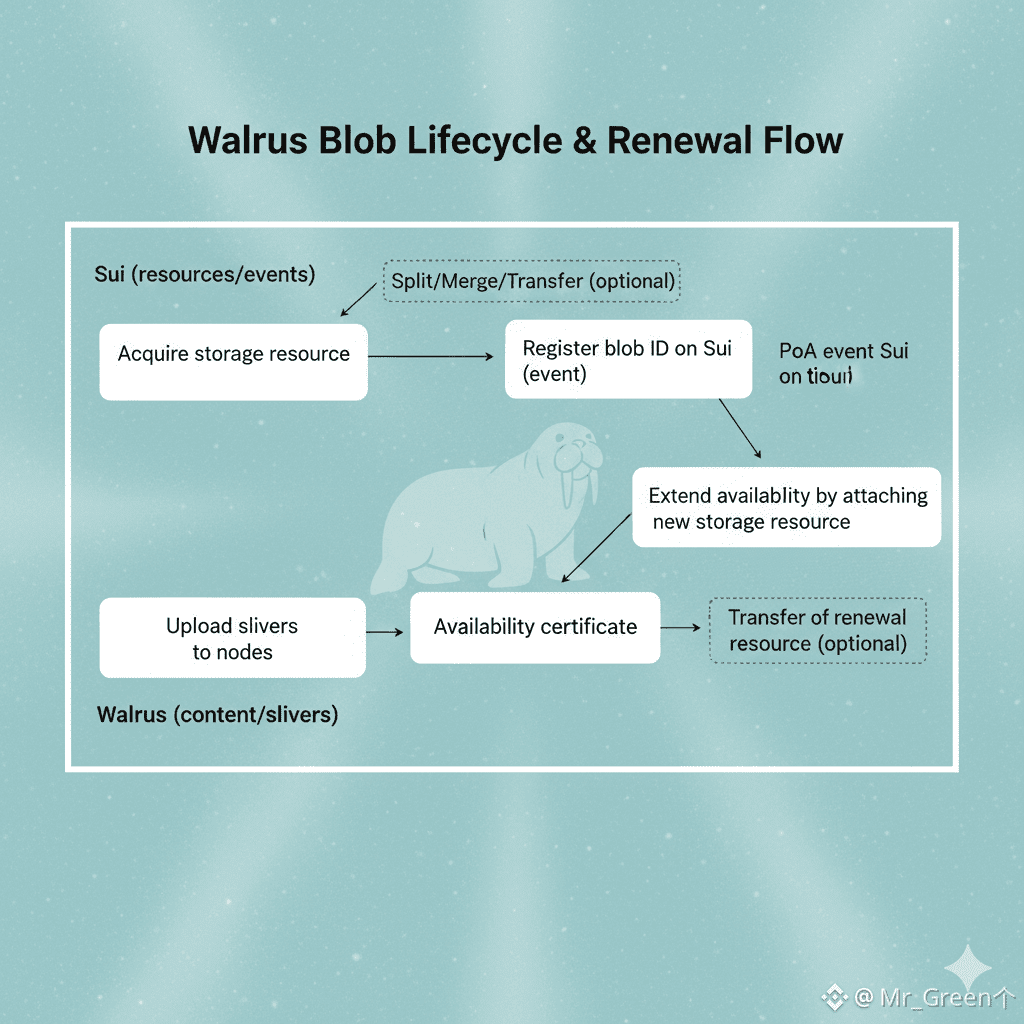
Walrus uses Sui smart contracts to coordinate storage operations as resources that have a lifetime and payments. Storage nodes and clients rely on on-chain events to coordinate what happens off-chain. A user acquires storage resources on-chain. A user prepares a blob off-chain (including erasure coding and computing a blob ID) and then registers the blob ID with a storage resource on-chain, emitting an event that storage nodes listen for. The user uploads slivers to storage nodes. Nodes verify and sign receipts. The user submits an availability certificate on-chain. When verified, Sui emits an availability event that marks the Point of Availability. After PoA, Walrus is responsible for maintaining availability for the availability period.
Now notice what split/merge/transfer allow you to do inside this flow.
Before writing, you can reshape storage so that each blob gets a properly sized resource.
During writing, you can ensure the owner of the resource is the entity that should be accountable for it, whether that is a user or an application.
After PoA, you can manage long-lived availability by attaching additional storage resources to extend expiry. If you previously split resources into many pieces, you might merge them to create one extension resource. If responsibility should move to a new owner, you can transfer resources that will be used for renewal.
In other words, composability is how the resource model stays human. It reflects that people and projects do not remain static across time. Teams change. Budgets change. Data sizes change. And storage obligations must be able to move with those changes.
Why this matters for decentralization without pretending complexity disappears
Walrus supports interacting through CLI tools, SDKs, and HTTP technologies. It supports optional infrastructure like publishers, aggregators, and caches. Those layers exist because decentralization should not require every user to become a protocol expert. But when optional infrastructure exists, ownership becomes an important anchor. If an uploader uses a publisher, who owns the storage resource? If a cache serves content, who is responsible for keeping it available for the promised period? The resource model, combined with on-chain events like PoA and availability extensions, helps keep these questions answerable.
Walrus also emphasizes that it does not reimplement a CDN and it does not reimplement a full smart contracts platform. It relies on Sui for coordination and uses traditional Web2 caching and delivery patterns where appropriate. In that design, split/merge/transfer are part of making storage composable enough to fit diverse application needs, without forcing the chain to store the bytes.
A calm summary
Split, merge, and transfer are not decorative features. They are a way to treat storage as a modular resource rather than a fixed subscription. Splitting helps match capacity to many blobs and many lifetimes. Merging helps undo fragmentation and support large or consolidated commitments. Transfer lets responsibility move between owners in a visible, verifiable way, supporting real application workflows where different parties store, renew, and maintain data over time.
In a decentralized environment, these simple verbs reduce the need for private coordination. They make storage a thing that can be shaped, not just consumed. And they help turn “I hope this stays stored” into “this resource is owned, this blob is tied to it, and the system’s commitments can be checked.”