A yes-or-no authorization result can reveal more about me than the policy intended.
That is the privacy risk I keep thinking about while studying @NewtonProtocol.
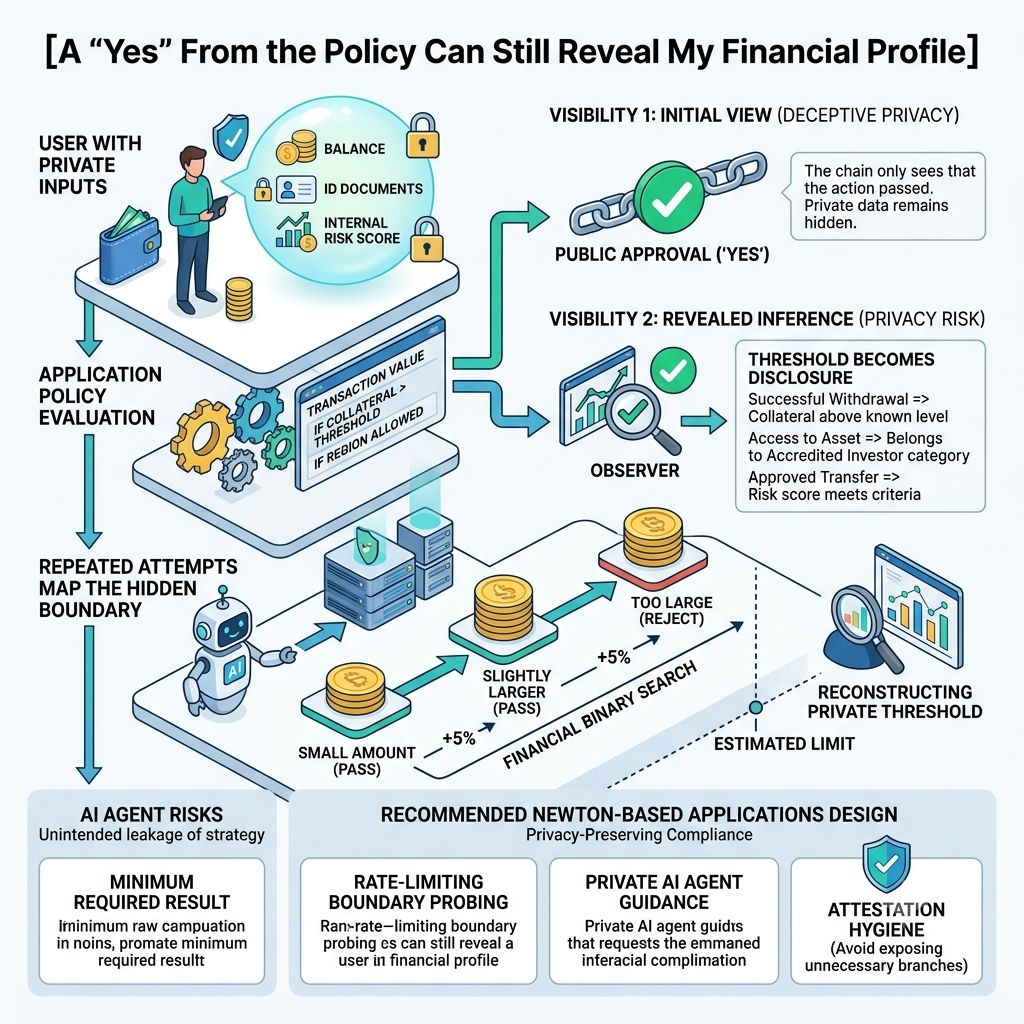
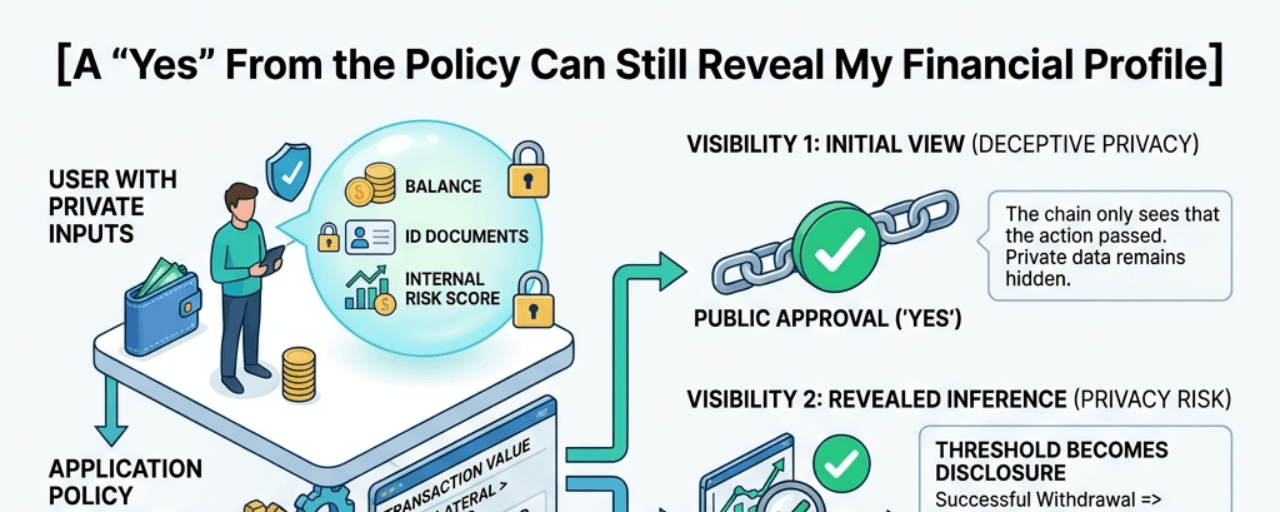
A financial application may check whether my transaction satisfies a defined condition before settlement. The private input can remain hidden. My balance, identity documents, internal risk score, or exact eligibility category may never appear publicly.
The chain may only see that the action passed.
At first, that looks like minimal disclosure.
But a public approval can still communicate something valuable when the threshold behind the decision is known—or can be estimated.
Suppose a vault only allows a particular transaction when collateral remains above a defined level. If my action is authorized, an observer may conclude that my status now meets that requirement. Imagine a scenario in which access to a tokenized asset is restricted to a particular category of investors. A successful authorization may reveal that my wallet belongs to that category even if the credential itself remains private.
Suppose larger transfers require stronger eligibility or risk checks. The size of the transaction and the aproval result may allow outsiders to estimate my limits.
The system does not publish the private data.
The decision still narrows the possibilities.
The threshold can become the disclosure
Newton Mainnet Beta and VaultKit are interesting to me because they move policy enforcement before settlement. An application can evaluate whether an action fits its rules, and a signed attestation can provide evidence that the required check occurred.
I think that is a meaningful improvement over rules that exist only in documents, dashboards, or manual review procedures.
But I also think policy designers need to ask what each visible result allows outsiders to infer.
If everyone knows that a vault blocks withdrawals below a particular collateral ratio, then a successful withdrawal reveals something about the user’s position.
If an application applies different transaction limits to different risk categories, repeated approvals may expose which category a wallet belongs to.
If a compliance rule changes across jurisdictions, the authorization path may indirectly reveal the user’s regional classification.
None of those results has to expose a name.
Privacy can still weaken through classification.
For me, this is especially important for NEWT because authorization is not only about proving that a rule was followed. It is also about deciding how much information the proof itself should carry.
A binary result may appear harmless.
Its meaning depends on the context surrounding it.
Repeated attempts can map the hidden boundary
The risk becomes stronger when a user—or an automated system—can test the policy repeatedly.
Imagine an AI agent submits a transaction for a certain amount.
The action passes.
The agent submits a slightly larger amount.
That also passes.
It continues increasing the size until the policy rejects the request.
The private limit was never published.
The sequence of approvals and rejections still reveals approximately where the boundary sits.
An outside observer may perform the same analysis by watching normal onchain activity over time.
This resembles a financial form of binary search.
Each individual result says very little.
Together, the results can reconstruct a hidden threshold.
That matters because thresholds can expose more than system configuration. They can reveal user limits, vault health, liquidity constraints, institutional mandates, or changes in internal risk policy.
I would not consider a policy truly private if its hidden conditions can be mapped cheaply through repeated interaction.
AI agents can leak information without intending to
I think automated agents make this problem more serious because they interact more frequently than human users.
An agent may continuously test whether it can rebalance, increase exposure, move funds, or enter a new position. If an action fails, the agent may automatically adjust the parameters and try again.
From an execution perspective, that can look efficient.
From a privacy perspective, it can create a detailed record of the permission boundary.
The agent may gradually reveal:
its maximum allowed position size,
the point where additional collateral is required,
which counterparties receive approval,
when its mandate becomes more restrictive,
or when a risk condition changes.
The agent never publishes its strategy.
Its authorization behavior can reveal parts of that strategy anyway.
That is why I think privacy-aware automation needs to control not only the data inside the check, but also how the requester learns from repeated outcomes.
What I would want from Newton-based applications
I am not claiming Newton exposes private thresholds by design. I see this as an implementation question for applications using programmable authorization.
I would want policies to reveal only the minimum result required for the action.
I would want repeated failed attempts to be limited when they start looking like boundary probing.
I would want an AI agent to receive enough private guidance to respond safely without testing every possible value publicly.
I would want attestations to avoid exposing unnecesary policy branches, risk categories, or exact threshold identifiers.
I would also want applications to consider whether the transaction amount itself, combined with a visible approval, reveals more than the proof alone.
A privacy model cannot evaluate the attestation in isolation.
It has to evaluate the attestation, the transaction, the timing, and the known policy context together.
Verifiability should not make users measurable
I still see strong value in pre-settlement authorization.
I want financial rules to be enforced before capital moves.
I want evidence showing that the correct evaluation occurred.
I want automated agents to remain inside defined mandates.
But I do not want every successful authorization to become a public statement about my financial capacity, eligibility, or risk clasification.
That is the distinction I am watching with #Newt.
The strongest authorization proof should confirm that the transaction satisfied the required condition.
It should not help outsiders estimate the private value sitting behind that condition.
For me, privacy-preserving compliance is not only about hiding documents and personal details.
It is also about preventing a sequence of valid decisions from turning the user into a measurable financial profile.
A policy can protect my data and still expose my boundary.
The better design protects both.