

Most of us grow up believing something very simple. If someone owns something, they should be free to use it whenever they want.
It's such a normal idea that we rarely question it. If the money is yours, the car is yours, or the account belongs to you, using it feels like a personal decision. Ownership and permission almost feel like the same thing.
That's why this belief makes sense.
In everyday life, ownership usually comes with control. You don't ask for approval every time you unlock your phone, spend from your wallet, or drive your own car. We get used to thinking that possession automatically gives us the right to act.
But there's a hidden assumption inside that belief.
We're assuming that having control over an asset automatically means every possible action with that asset is appropriate.
The real world doesn't actually work that way.
Think about a company credit card.
The card is real. The balance is available. The payment terminal accepts it.
Yet an employee still can't buy whatever they want just because the card works.
The finance department has spending policies.
There are merchant restrictions.
There are approval limits.
There are compliance rules.
The payment system isn't just checking whether the transaction can happen.
It's checking whether it should happen.
Now imagine that same situation in onchain finance.
A treasury holds millions in stablecoins.
Or an institution manages tokenized real-world assets.
One employee signs a transaction.
Everything is technically correct.
The wallet owns the assets.
The signature is valid.
Gas is available.
The smart contract accepts the transaction.
From the blockchain's perspective, nothing is wrong.
But what if the destination wallet has suddenly become high risk?
What if that transfer breaks internal investment policies?
What if regulations require extra verification before assets can move?
The blockchain doesn't know any of that.
It simply executes what it's asked to execute.
And once value has already moved, fixing the mistake becomes much harder.
When situations like this happen, the blockchain doesn't absorb the damage.
The institution deals with regulatory consequences.
Compliance teams investigate.
Risk managers explain what happened.
Customers lose confidence.
Sometimes investors pay the price.
Sometimes the reputation of an entire protocol takes the hit.
That makes me think we've been solving only half of the infrastructure problem.
We've become incredibly good at building systems that move value faster.
But moving value safely isn't only about speed.
It's about making sure every movement matches the rules that organizations, regulators, and users actually care about.
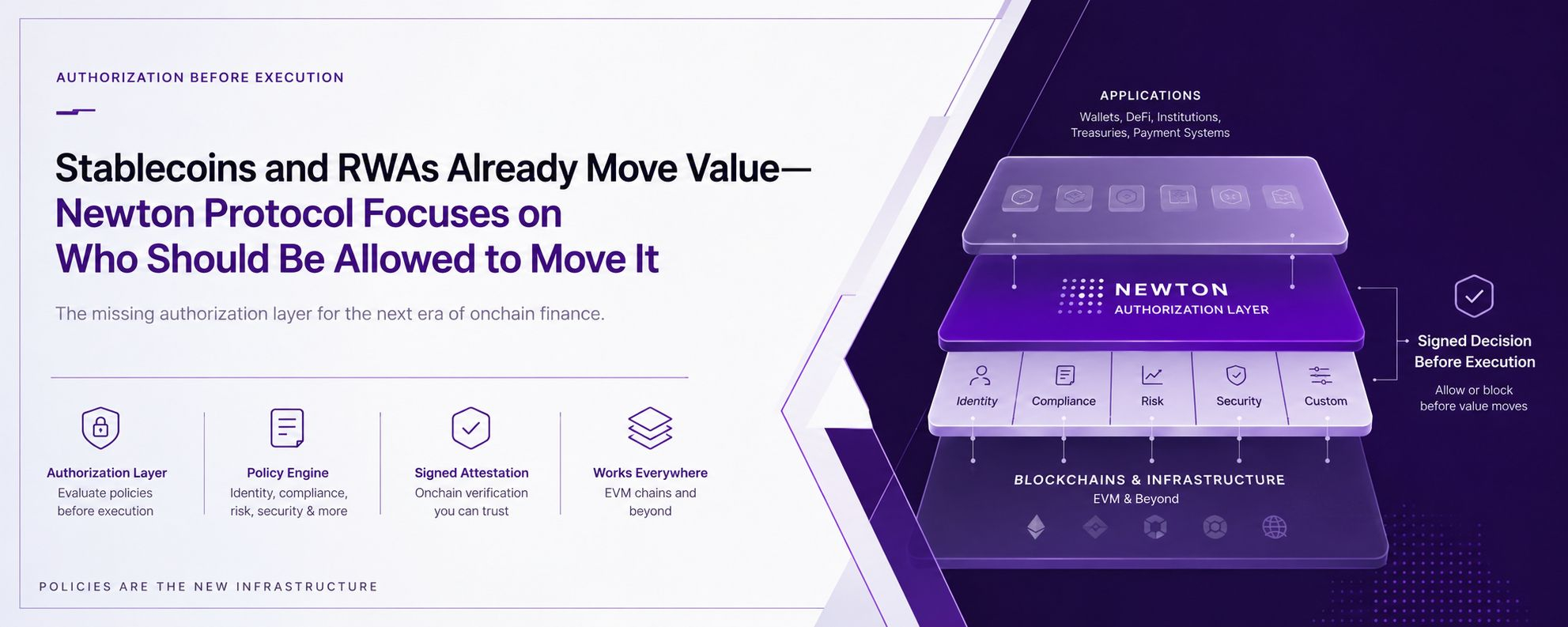
That's the gap Newton Protocol's Mainnet Beta is trying to address.
Instead of waiting until after execution, it introduces an authorization layer that evaluates policies before assets move.
Identity requirements.
Compliance checks.
Risk signals.
Security conditions.
Custom organizational rules.
These can all be evaluated before execution, producing an authorization decision that applications can use before settlement happens.
To me, that's a meaningful shift.
For years we've treated blockchain infrastructure as a system for verifying transactions.
Maybe the next stage is building infrastructure that verifies decisions.
As stablecoins and RWAs continue bringing traditional finance onchain, authorization could become just as important as execution itself.
The question may no longer be:
"Can this transaction execute?"
The more important question could become:
"Who decided this transaction should happen and can everyone trust that decision?"