

I wasn't looking for anything specific when I started reading through Newton Protocol's documentation. I'd seen the phrase "authorization layer for onchain transactions" enough times that it had started to feel like marketing shorthand, the kind of phrase that sounds important without telling you anything. So I went looking for the part that actually does the work, the mechanism underneath the pitch, and I kept returning to one detail that the rest of the material seemed to treat as settled: who, exactly, evaluates a policy before a transaction is allowed to happen, and what it means that this evaluation is done by a decentralized set of operators rather than a single trusted party.
On the surface this looks like a clean design decision. Instead of a centralized compliance server deciding whether a transaction is allowed, Newton distributes that decision to operators who are economically secured through Ethereum's restaking model. The logic is familiar from other restaking-based systems: instead of building a new validator set from scratch, borrow the security of Ethereum's existing stake and let slashing conditions punish operators who misbehave. It sounds straightforward until you start asking what "misbehave" actually means in the context of evaluating a policy rather than, say, signing a block or attesting to data availability.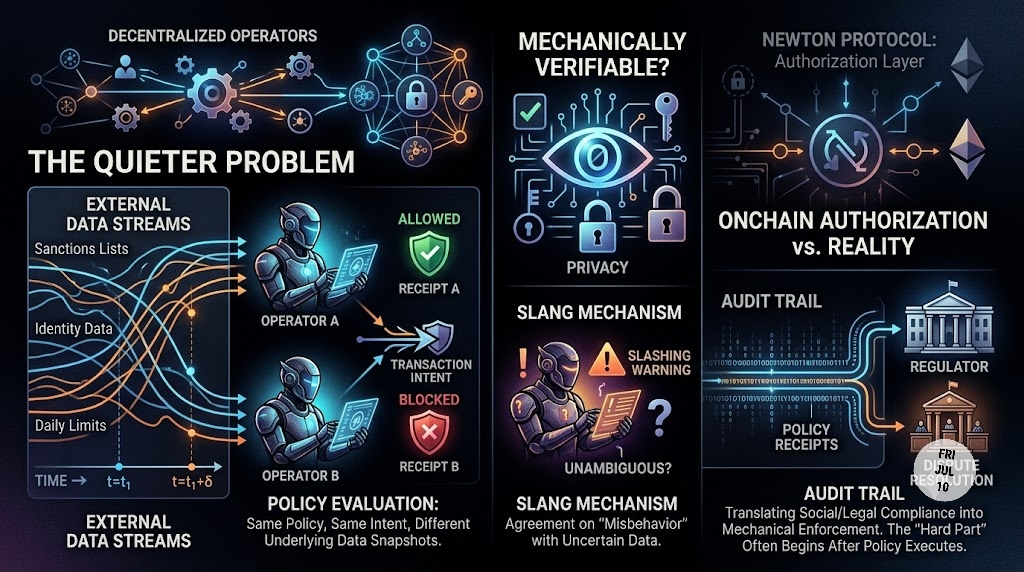
Signing a block is a mechanical act. Either the operator followed the protocol or they didn't, and that's usually verifiable in a fairly binary way. Evaluating a compliance policy is a different kind of task. A policy might say something like allow transfers under a certain daily limit to a whitelisted address, or block anything tied to a sanctioned entity, or require an attestation above some threshold. These rules sound precise when written down, but the inputs feeding them, identity data, jurisdictional status, sanctions lists, are not static facts sitting on a blockchain waiting to be read. They come from somewhere off-chain, they change over time, and different operators might be working from slightly different snapshots of that information at the moment they evaluate a transaction. What happens if two operators evaluate the same intent against the same policy and reach different conclusions, not because either one is dishonest, but because the underlying data they consulted was stale in different ways?
I sometimes wonder whether this is actually the harder problem hiding underneath the more visible one. The visible problem is enforcement: can the protocol stop a bad transaction from executing. The quieter problem is agreement: can a distributed set of operators consistently agree on what "bad" means at the exact moment a transaction is submitted, when the ground truth they're checking against is itself uncertain or delayed. The whitepaper leans on Rego, the Open Policy Agent language, to make rules human-readable and auditable, which is a reasonable choice, and it pairs that with zero-knowledge proofs for cases where the underlying credential shouldn't be revealed. But readability of the rule and consistency of its evaluation across a decentralized operator set are not the same property, and I haven't yet seen this distinction addressed directly in what I've read so far.
What makes this difficult isn't the cryptography, which seems to be the part everyone wants to talk about. Zero-knowledge proofs are genuinely useful for proving that a check passed without revealing the input, and I don't think that part is where the interesting tension lives. The interesting tension lives in the fact that every policy evaluation produces a receipt, a record meant to be auditable or even streamed to regulators, and that this receipt has to exist even when the underlying credential is hidden behind a proof. So you end up with a system that is simultaneously trying to preserve privacy at the data layer and produce a durable, regulator-facing audit trail at the decision layer. Those two goals aren't contradictory exactly, but they pull in different directions, and I kept wondering how much operational complexity gets absorbed by whoever has to design the policy itself, since the policy author is the one who has to decide what gets proven versus what gets revealed, transaction by transaction.
Looking from the outside, there's also a question about what happens under load, or under dispute. If a transaction is blocked because a policy evaluation failed, and the party affected disagrees with that outcome, what's the actual recourse. Is there a way to challenge a specific operator's evaluation, or does the system only offer the receipt as evidence after the fact, meaning disputes get resolved off-chain through whatever governance or legal process exists around the protocol rather than through the protocol itself. This isn't unique to Newton, most systems that claim to enforce rules "onchain" eventually hit a boundary where the actual dispute resolution happens somewhere more mundane, but it's worth noticing because the marketing language tends to imply that the hard part is finished once the policy executes, when in practice the policy executing is often just the beginning of a longer, messier  process.
The restaking security model is supposed to make misbehavior costly, and slashing is the mechanism that's meant to align operator incentives with correct evaluation. But slashing works best when incorrect behavior is unambiguous, and I'm not completely sure that policy evaluation, especially policy evaluation that depends on external, time-sensitive data, is ever going to be as unambiguous as the block-signing analogy suggests. This may simply be an unavoidable engineering tradeoff, the price of trying to make compliance programmable rather than manual, and it's possible that in practice the disagreements are rare enough that the system works fine most of the time. But "works fine most of the time" is a different claim than "verifiably enforced," and the gap between those two phrases is exactly the kind of thing that tends to stay invisible until a high-value transaction gets caught in it.
What I keep coming back to is that Newton is trying to turn a fundamentally social and legal category, compliance, into something mechanically verifiable, and that translation is where all the real difficulty accumulates, even though it's the part that gets the least attention in the documentation. The parts that get the most attention, the zero-knowledge proofs, the restaking, the human-readable policy language, are the parts that are easiest to describe cleanly. Whether the harder, quieter problem of cross-operator agreement under uncertain data turns out to be a minor implementation detail or a structural limitation probably won't be answered until institutions start routing real volume through the system and the edge cases stop being hypothetical.
