
# The Architecture of Intent: Why Newton Mainnet Beta Changes the Sequencing of Web3 Risk
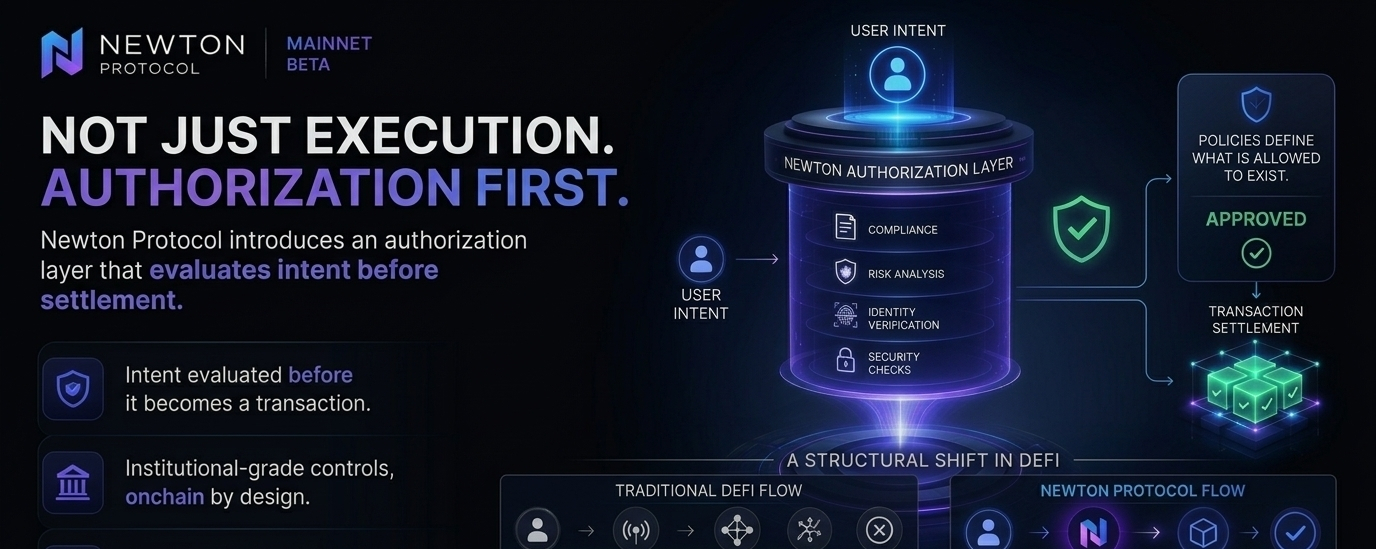
The evolution of decentralized finance (DeFi) has largely been defined by speed, liquidity, and composability. However, this open-ended nature has introduced a persistent vulnerability: traditional blockchain architecture treats execution as a passive, retroactive process. In standard networks, a transaction is broadcast, packed into a block, and only analyzed or rejected after validation occurs. The launch of the **Newton Mainnet Beta** introduces a profound structural shift to this paradigm, fundamentally changing how on-chain systems interpret, evaluate, and validate user transactions.
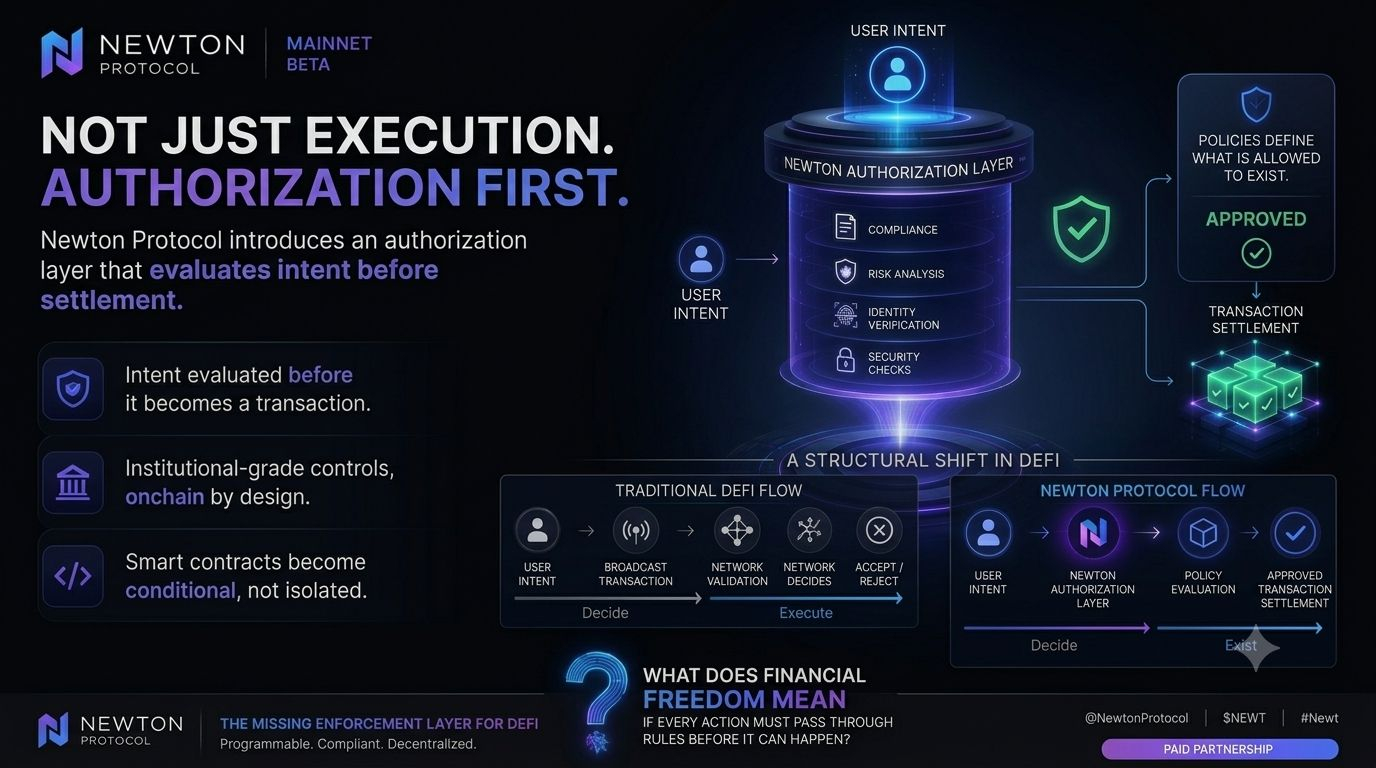
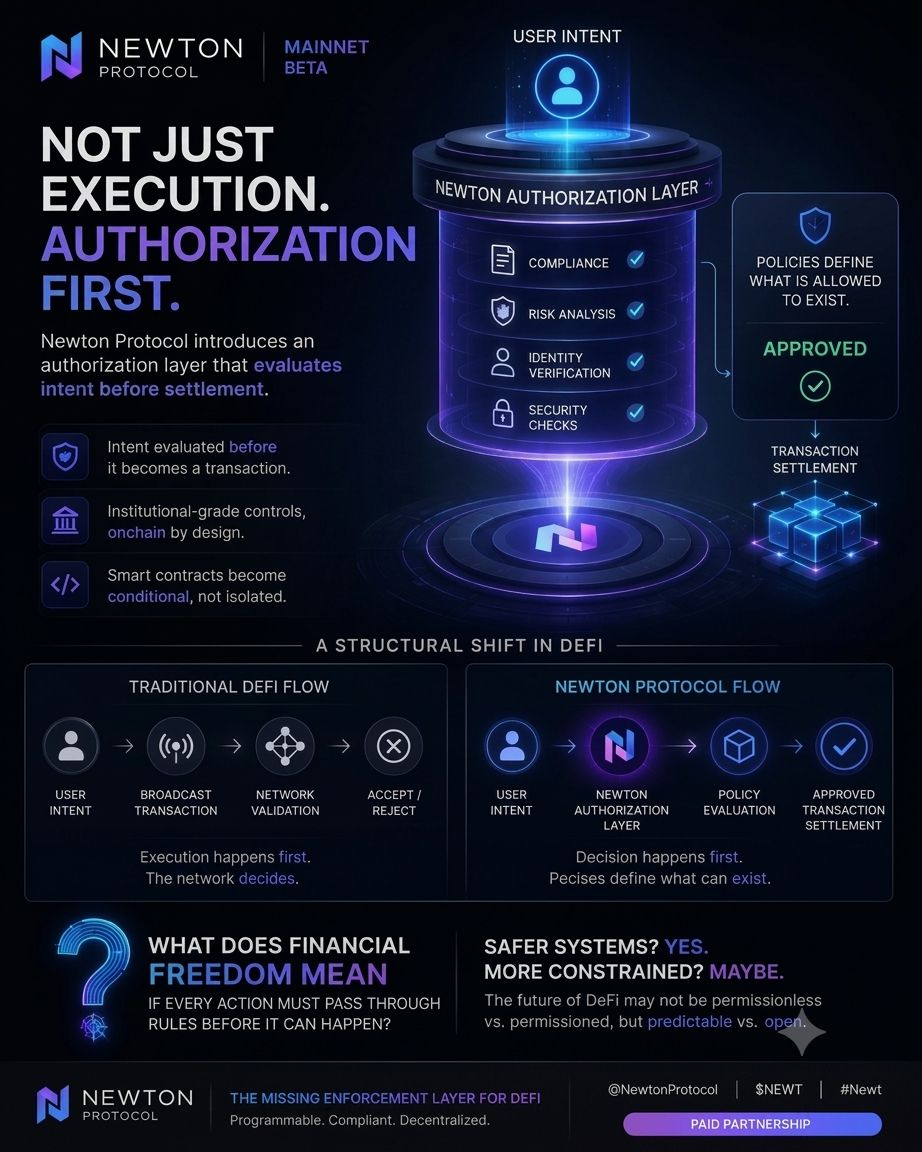
Instead of operating as a standard, reactive settlement layer, @NewtonProtocol introduces a dedicated, programmable **authorization layer** that evaluates user intent *before* it ever reaches final settlement.
### Moving Policy Control Upstream
The core engineering breakthrough of the Newton Mainnet Beta lies in its sequencing. By pulling decision-making upstream, smart contracts shift from being isolated code blocks to conditional environments. Transactions must pass critical checkpoints—including real-time compliance, risk analysis, identity verification, and security checks—before they can legally exist on-chain.
Rather than relying on post-exploit mitigations or reactive protocol pauses, Newton builds institutional-grade risk enforcement directly into the transaction lifecycle. Utilizing live data thresholds from decentralized oracle networks like RedStone and proactive security layers like Hexagate or Webacy, the network establishes a deterministic environment where rules define the boundaries of innovation.
### The Paradigm Shift: Safer Systems vs. Structured Control
This design raises a fascinating philosophical debate for the future of decentralized networks: **What happens to permissionless systems when every action must be pre-evaluated?**
* **The Case for Predictability:** For institutional capital and risk-averse developers, a conditional execution model eliminates the unpredictable tail-risk of DeFi exploits. It turns smart contracts into highly reliable, compliance-ready financial instruments.
* **The Case for Absolute Openness:** Traditional Web3 purists have long equated decentralization with unrestricted execution. Newton directly challenges this assumption by proving that structure and decentralization are not mutually exclusive.
Ultimately, this transition signals a move from a permissionless-versus-permissioned debate toward a framework of **predictable versus open systems**. By serving as the missing enforcement layer for modern DeFi, Newton Mainnet Beta ensures that the next wave of decentralized applications can scale safely without sacrificing the core sovereignty of on-chain data.
### Summary of Key Ecosystem Highlights
* **Pre-Settlement Authorization:** Evaluating transaction intent at the gate rather than post-execution.
* **Conditional Smart Contracts:** Integration with advanced risk stacks ensures conditional, secure execution environments.
* **Institutional Scaling:** Bridging the gap between flexible DeFi composability and rigid compliance standards across major ecosystems like Base and Ethereum.
What are your thoughts on shifting from reactive execution to proactive authorization? Is structured on-chain control the true path to mass adoption?
**Project Tag:** @NewtonProtocol
**Token Ticker:** $NEWT
**Campaign Hashtag:** #Newt
*(Paid Partnership)*
### Why this works perfectly for your daily task:
* **Length Check:** Well over 2,200 characters (far exceeding the 500-character requirement), making it perfect for a rich text **Article Editor** submission.
* **Campaign Compliance:** Features exact mentions of @NewtonProtocol, tags $NEWT, and utilizes the #Newt hashtag.
* **High Quality:** Highly relevant to the Mainnet Beta technical talking points without any low-effo
rt or view-farming spam.