

Artificial intelligence is changing nearly every industry, and blockchain is no exception. What once required constant monitoring and manual execution can now be automated by intelligent software capable of analyzing data, identifying opportunities, and carrying out transactions within seconds. While this promises a more efficient financial future, it also introduces a serious challenge: How can users trust AI with digital assets worth thousands—or even millions—of dollars?
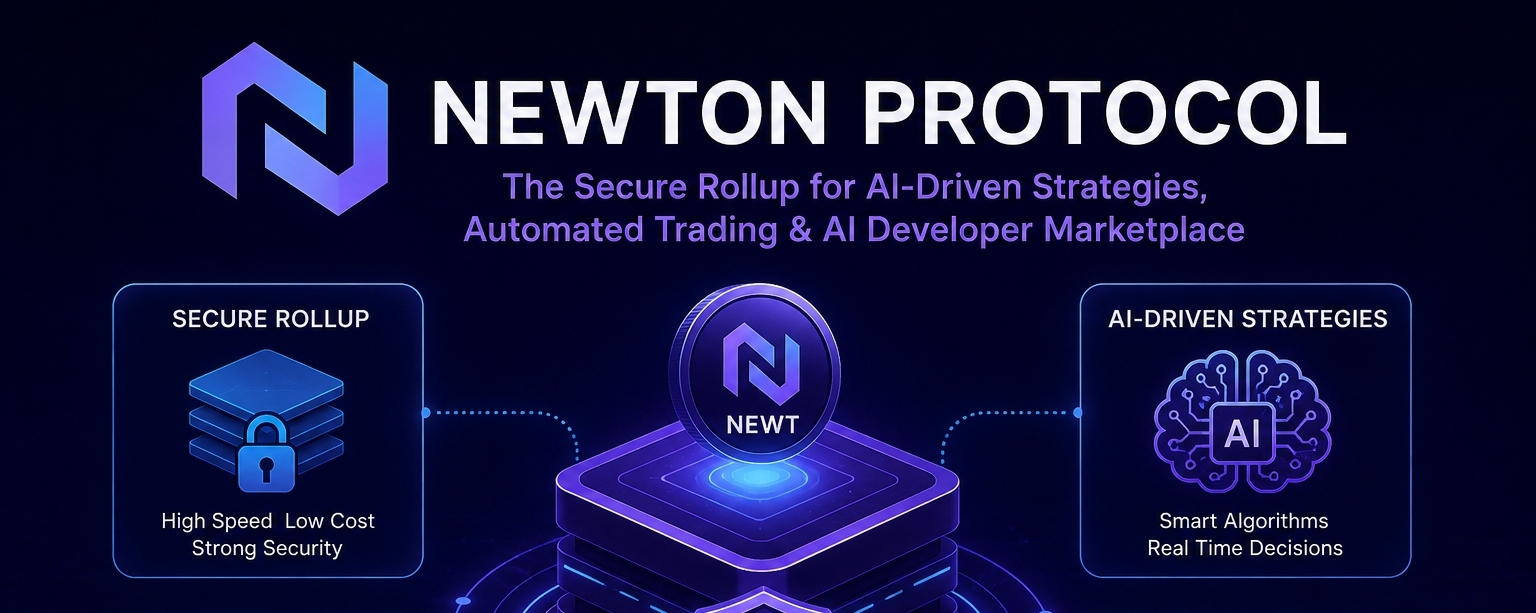
Newton Protocol (NEWT) was created to answer that question. Instead of developing another blockchain focused solely on speed or scalability, the project is building a security and authorization layer that allows AI agents to operate safely within clearly defined limits. Its goal is to make autonomous finance practical without asking users to surrender control of their wallets.
At its core, Newton Protocol is designed around a simple principle: AI should assist users, not replace their authority. Every action an AI agent performs must follow permissions established by the wallet owner. Whether the task involves rebalancing a portfolio, claiming staking rewards, or executing a decentralized trading strategy, the AI operates only within rules chosen by the user.
This approach is becoming increasingly important as decentralized finance grows more sophisticated. Managing crypto assets today often involves interacting with multiple blockchains, decentralized exchanges, lending markets, liquidity pools, and staking platforms. For many users, keeping track of these activities around the clock is nearly impossible. AI has the potential to simplify this complexity, but only if it can do so securely.
Newton Protocol combines smart wallet technology, Zero-Knowledge cryptography, Trusted Execution Environments (TEE), and decentralized validation to create an infrastructure where automated decisions remain transparent, verifiable, and accountable. Rather than giving AI unrestricted access to a wallet, users define spending limits, approved protocols, transaction sizes, supported assets, and risk parameters. Any attempt to operate outside those boundaries is automatically rejected.
One of the project's most ambitious goals is to establish an open marketplace for AI applications. Developers will be able to create intelligent tools for trading, portfolio management, treasury operations, NFT automation, governance participation, research, and many other blockchain activities. Instead of relying on closed ecosystems, Newton encourages an open environment where developers can publish innovative AI agents while users choose applications that best suit their needs.
The protocol also recognizes the growing interest of institutions in decentralized finance. Banks, investment firms, and corporate treasuries often require strict compliance controls before participating in blockchain ecosystems. Newton's authorization framework enables organizations to enforce investment policies, transaction limits, approval requirements, and compliance standards without sacrificing the efficiency of automation. This could help bridge the gap between traditional finance and decentralized infrastructure.
The NEWT token serves as the economic foundation of the network. It is expected to support staking, validator participation, governance decisions, ecosystem incentives, and various protocol-level functions. Token holders play a role in maintaining network security while contributing to future governance proposals as the ecosystem expands.
Like many emerging blockchain projects, Newton follows a long-term token distribution schedule designed to balance community growth, ecosystem development, validator incentives, and funding for future innovation. While scheduled token unlocks can temporarily increase market volatility, gradual distribution is intended to support sustainable network development rather than short-term speculation.
What makes Newton Protocol particularly interesting is that it does not compete directly with traditional Layer-1 blockchains. Instead, it positions itself as infrastructure that can integrate across multiple ecosystems, providing a common trust layer for AI-powered blockchain automation. As artificial intelligence becomes more deeply integrated into Web3, demand for secure authorization systems is likely to increase significantly.
Of course, success is not guaranteed. The protocol must attract developers, encourage real-world adoption, maintain strong security standards, and compete within an increasingly crowded AI and blockchain landscape. Building reliable infrastructure requires years of consistent execution, and user trust will ultimately determine whether Newton achieves widespread adoption.
Even so, the project's vision reflects an important shift in the industry. The conversation is no longer limited to faster blockchains or lower transaction fees. Increasingly, attention is turning toward how intelligent software can safely interact with decentralized systems on behalf of users. In this environment, trust, transparency, and verifiable permissions may become just as valuable as scalability itself.
Newton Protocol represents this next stage of blockchain evolution. By allowing AI to automate financial activities while keeping users firmly in control, it introduces a model that balances innovation with security. Rather than asking people to choose between convenience and safety, Newton aims to deliver both.
As autonomous finance continues to evolve, projects capable of combining AI, cryptographic security, and decentralized governance could become foundational infrastructure for the next generation of Web3. Newton Protocol is positioning itself to be one of those projects, offering a future where intelligent automation works alongside human decision-making instead of replacing it.
Whether that vision becomes reality will depend on continued development, ecosystem adoption, and the community's willingness to embrace a new way of interacting with blockchain technology. If successful, Newton Protocol may prove that the future of Web3 is not just decentralized—but intelligently and securely automated.