
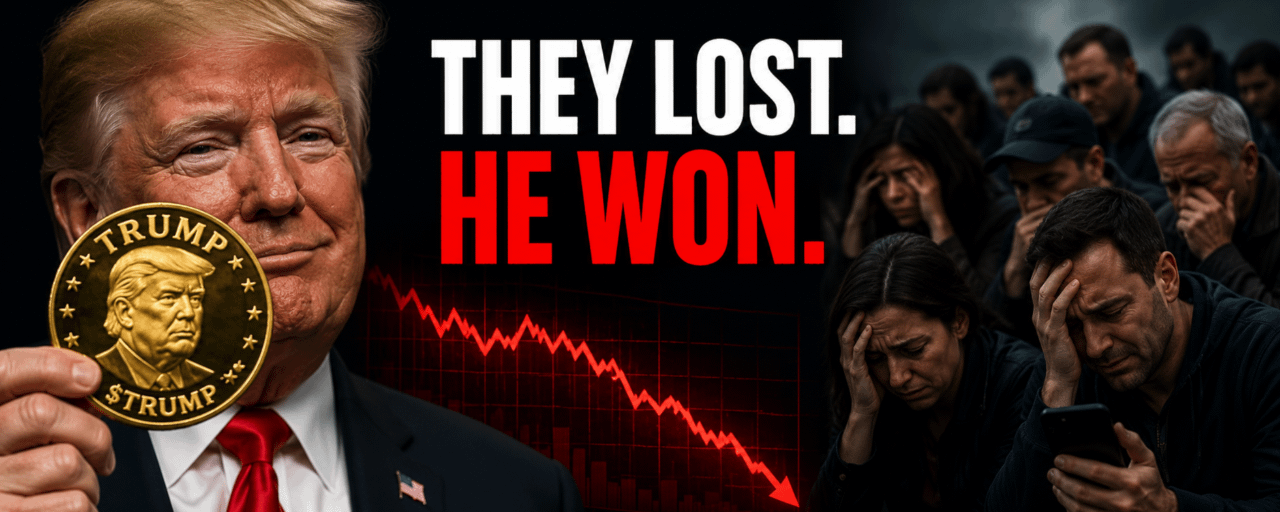

The numbers came out on July 5. Almost nobody has processed them yet.
Blockchain analytics firm Nansen just published a full breakdown of what happened with the $TRUMP memecoin, the token Donald Trump launched in January 2025, back when he was President-elect. The results are brutal.
988,905 wallets lost money. Total losses: $3.81 billion. Average loss per wallet: roughly $3,850. The token is down 97 percent from its all-time high.
And Trump? He personally made $636 million from the project in 2025, according to his financial disclosures. His company, World Liberty Financial, took a 75 percent cut of all token purchases.
Read that again. Seventy-five percent. Of every dollar that went in.
How this actually worked
Most memecoins are a free-for-all. The creators take a small fee, the rest trades on the open market, and whoever buys early and sells late wins.
The $TRUMP token was different. World Liberty Financial, the crypto venture tied to Trump and his family, structured the deal so they got the lion's share of the money before any trading even happened. They didn't have to win on price action. They got paid upfront.
This is the part that should make anyone pause. A normal crypto project might give founders 10 or 15 percent. Trump's venture took 75 percent. The buyers were the product.
Who lost the money
The Nansen data shows nearly a million wallets ended up underwater. Some lost a few hundred dollars. Some lost tens of thousands. A small number of large buyers lost millions each.
The token launched on January 17, 2026, three days before Trump's inauguration. It shot up to a peak above $75 within 48 hours. Then it started falling. And it kept falling. By June 2026, it was down 97 percent from that high.
The people who bought in the first week were largely Trump supporters. Many had never bought crypto before. They saw the launch on social media, heard the President-elect talk it up, and put their savings in.
They are now holding tokens worth three cents on the dollar.
The political angle nobody wants to touch
Here is the part that crosses from bad economics into something darker.
When a sitting President launches a financial product, personally profits from it, and one million people lose money on it, that is not a normal market event. It is a political event. And yet, the response from Washington has been silence.
Senator Elizabeth Warren has previously warned about conflicts of interest in crypto policy. The Democrats on the House Financial Services Committee released a letter in January 2026 noting that the SEC, under Chairman Paul Atkins, has dropped or closed at least a dozen crypto-related cases since the start of 2025. The $TRUMP token was not one of them.
There has been no SEC investigation announced. No Congressional hearing scheduled. No statement from the Treasury Department. The same government that spent years suing Ripple, Coinbase, and Binance has had nothing to say about a token with the President's name on it.
What this means for crypto
The crypto industry has spent years asking for legitimacy. It wanted mainstream adoption. It wanted regular people to take it seriously.
Well, regular people showed up. Nearly a million of them. And they got cleaned out by a token launched by the President of the United States.
This is the kind of story that turns people against crypto for a generation. It does not matter that the technology is neutral. It does not matter that Bitcoin and Ethereum had nothing to do with it. What matters is that a million people will forever associate "crypto" with "I lost money on Trump's coin."
The industry's biggest advocates should be the loudest voices calling for an investigation. Instead, they are mostly quiet. That silence is going to cost them.
The bigger picture
The Trump memecoin was not an accident. It was a test case.
If a President can launch a token, take 75 percent of the money, watch it crash 97 percent, and face zero consequences, then every future politician will try the same thing. The precedent is set. The norms are gone.
And the people who paid for this lesson were the ones who could least afford it. The Nansen data does not break down losses by income, but we know who buys memecoins. It is not Wall Street. It is regular workers, small business owners, retirees, and young people trying to get ahead.
They trusted the brand. They lost their money. And nobody in power seems to care.
That is the story. Not the price chart. Not the trading volume. The story is that one million people got fleeced, and the system that was supposed to protect them looked the other way.