
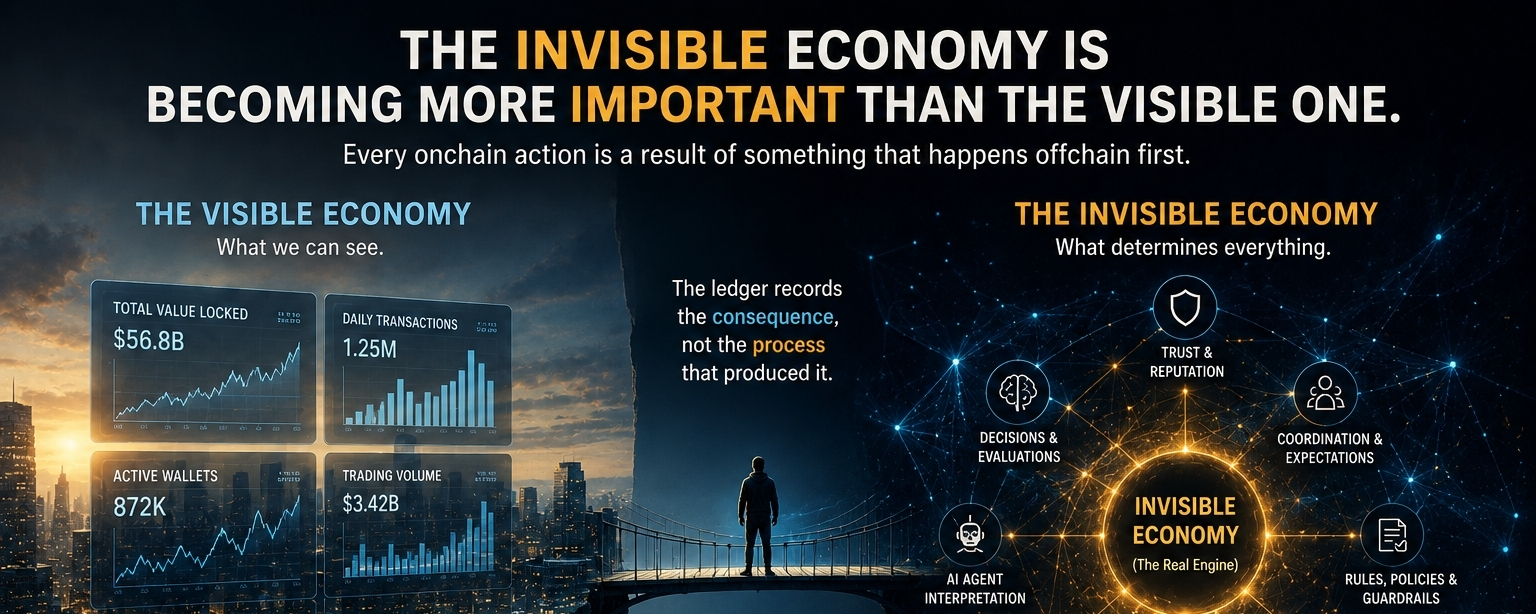
The more I watch crypto evolve, the more I feel we've become distracted by the visible economy. We measure TVL, trading volume, active wallets, stablecoin flows, and transaction counts because they're easy to quantify. They make the market feel understandable. But I'm starting to wonder if those numbers are becoming the least interesting part of what's actually changing.
Every visible transaction begins inside an invisible system first.
Someone decides to trust. Someone evaluates risk. An AI agent interprets a policy. An institution decides whether the environment feels predictable enough to participate. None of those decisions appear onchain, yet every onchain action depends on them. The ledger records the consequence, not the process that produced it.
For a long time I assumed this invisible layer would always remain informal. Humans would simply rely on judgment, reputation, and experience. But the arrival of autonomous systems makes that assumption feel increasingly fragile. AI doesn't inherit social intuition. Institutions don't scale on assumptions. As participation becomes more automated, invisible coordination quietly becomes more valuable than visible execution.
That changed how I started thinking about projects like Newton Protocol. The protocol itself isn't what caught my attention. It's what its existence quietly suggests. Across Web3, infrastructure seems to be drifting away from optimizing movement and toward organizing the invisible conditions that make movement possible in the first place.
Halfway through this thought, I realized we've been treating markets as if capital creates ecosystems. Maybe it's the other way around. Perhaps ecosystems emerge from invisible expectations that eventually attract capital. Liquidity doesn't invent confidence. Confidence invites liquidity.
That would explain something I've never been able to reconcile. Two ecosystems can offer similar technology, similar costs, and similar access, yet one quietly attracts institutions while the other struggles to build lasting participation. The visible metrics look almost identical. The invisible environment doesn't. One feels predictable. The other feels uncertain, even if nobody can easily explain why.
Maybe that's why reputation, verification, coordination, and behavioral incentives keep appearing across completely different conversations in AI and Web3. They're not separate trends. They're pieces of an economy that rarely appears in dashboards but quietly determines everything those dashboards eventually display.
I'm beginning to think the next generation of crypto won't be defined by who moves the most capital. It may be defined by who builds the strongest invisible economy beneath it—one where expectations, trust, interpretation, and coordination become so reliable that the visible economy simply follows without needing to be persuaded. And if that's true, we've probably been watching the scoreboard while missing the game itself.