

The more I explored Newton Mainnet Beta, the more I realized that one phrase appears repeatedly:
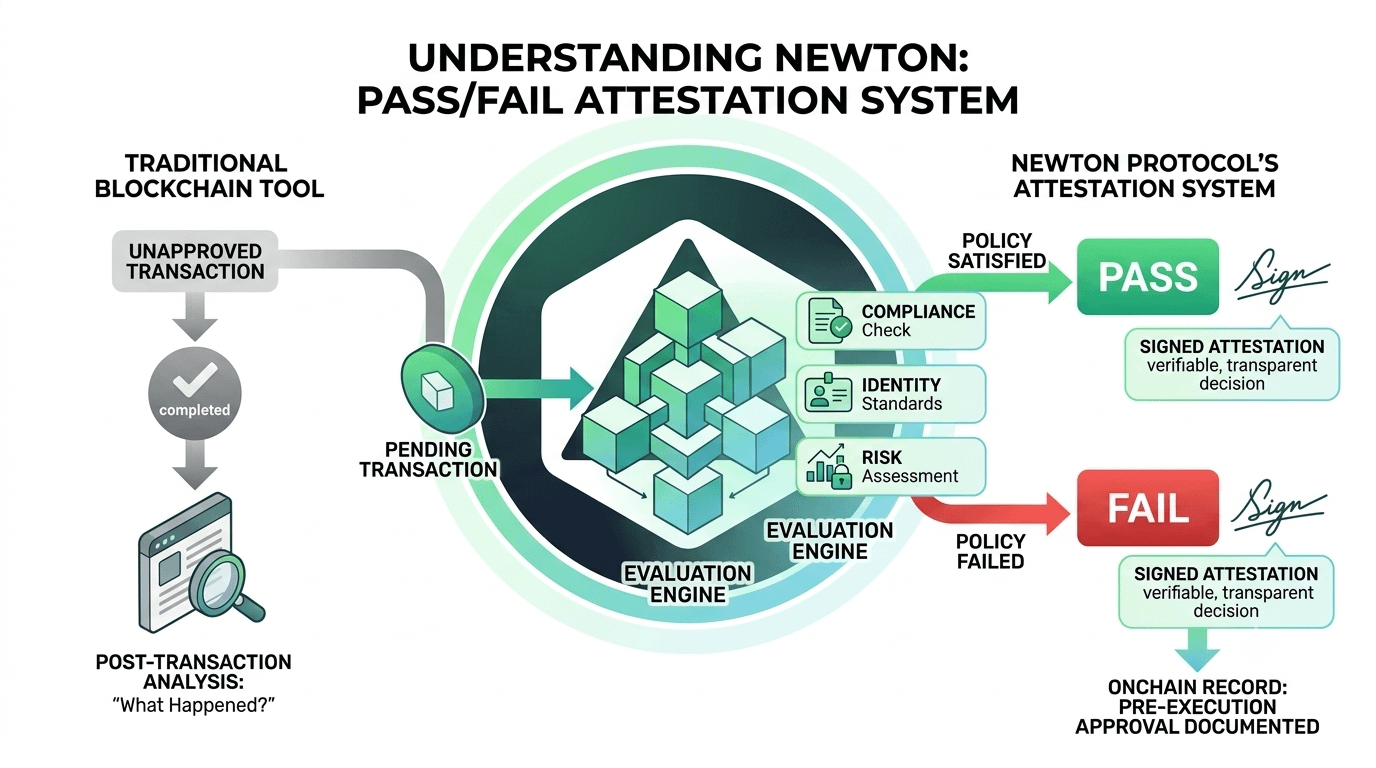
"Signed pass/fail attestation."
At first, it sounded like another technical blockchain term. But after digging deeper, I think it's actually one of the easiest ways to understand what makes Newton different.
Most Blockchain Tools Tell You What Already Happened
If you've spent time in DeFi, you've probably used block explorers, analytics dashboards, or security monitoring platforms.
They help answer questions like:
- Where did the funds go?
- Which wallet interacted with the protocol?
- What contract was executed?
- Was anything suspicious detected?
Those insights are valuable, but they all share one thing in common.
They describe completed transactions.
The action has already happened.
Newton Starts With a Different Question
Instead of asking, "What happened?", Newton asks something much earlier:
"Should this transaction be allowed to proceed?"
Before a transaction reaches settlement, Newton evaluates it against predefined policies.
Those policies can include compliance requirements, identity checks, security conditions, or risk controls.
Once the evaluation is complete, Newton returns a signed pass/fail attestation that records whether the transaction satisfied the required rules.
That decision becomes part of the onchain process itself.
Why Is a Signed Attestation Important?
What stood out to me is that the result isn't just an internal approval.
It's a signed onchain record showing that the transaction was evaluated according to active policies.
That creates transparency around the decision-making process rather than relying on hidden or manual approvals.
For protocols managing significant value, having a verifiable authorization record can be just as meaningful as recording the transaction itself.
A Practical Example
Imagine a DeFi vault responsible for managing user funds.
The vault may define several operating rules:
- Only approved assets can be used.
- Certain wallet addresses must be blocked.
- Risk thresholds cannot be exceeded.
- Identity requirements must be satisfied before specific actions.
Without an authorization layer, many of these checks happen through separate systems or operational procedures.
With Newton, those same rules can be evaluated before settlement, and the outcome is captured through a signed pass/fail attestation.
That creates a clear record that the transaction was reviewed before execution.
Why This Could Matter More Over Time
Today's DeFi ecosystem is becoming increasingly sophisticated.
Institutional products are expanding.
Tokenized real-world assets continue to develop.
AI agents are beginning to automate financial decisions.
As these systems become more autonomous, relying only on post-transaction monitoring may no longer be sufficient.
An authorization decision made before execution could become an important part of responsible onchain infrastructure.
My Perspective
The more I looked into Newton's architecture, the more I felt that the signed pass/fail attestation isn't just another technical feature.
It's evidence that someone, or in this case, a programmable policy framework, evaluated the transaction before assets moved.
That changes how I think about blockchain security.
Instead of simply documenting events after they occur, Newton is trying to document the approval process itself.
For me, that's one of the most interesting ideas behind Newton Mainnet Beta, and it's a direction worth paying attention to as DeFi continues to evolve.