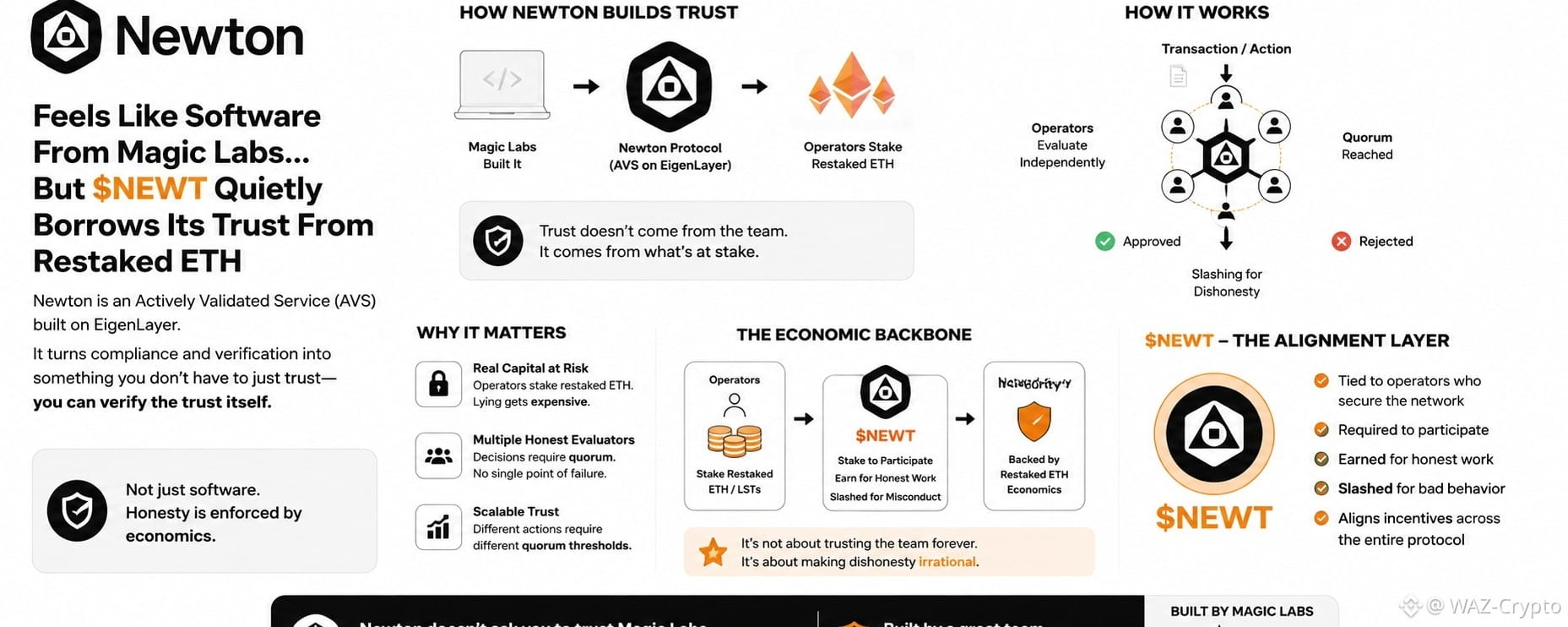
I used to assume a project's credibility came from who built it. A known team, a funded company, a recognizable name attached to the commit history. That's usually where people stop looking.
But sitting with Newton for a while, I noticed the team part is almost the smaller story.
Yes, Magic Labs built it. The same people behind embedded wallets, the kind of infrastructure that's already quietly running under products most people have used without knowing it. That matters. It's not a weekend project dressed up as protocol.
Still, a good team building something doesn't automatically make the thing trustworthy once it's live.
That's the part I kept circling back to.
Because software built by a credible team is still just software. Someone has to run it, evaluate it honestly, and have a reason not to lie when it would be easy to. That's a different problem than "who wrote the code."
Newton answers it in a way I didn't expect at first.
It doesn't ask you to trust Magic Labs to keep operating it correctly forever. It routes that trust through something external, EigenLayer's restaking framework, where the network itself runs as an Actively Validated Service.
Which sounds abstract until you follow what it actually means.
Operators don't just get whitelisted and start signing off on transactions. They stake real capital, restaked ETH or liquid staking tokens, before they're allowed to evaluate anything. That stake sits there as collateral against honesty.
If an operator clears a transaction it shouldn't have, that's not a warning email. It's a slashing event.
I keep thinking about how different that is from a typical centralized API. A compliance vendor can be wrong, quietly, for a long time, and the worst outcome is usually a bad review or a lost client. There's no capital actually at risk in the moment the wrong call gets made.
Newton doesn't work that way.
Being wrong here costs something immediately, priced in ETH, not reputation. That's a much sharper incentive than please don't lie.
It also changes what "backed by a good team" even means in this context. Magic Labs didn't just build a product and ask people to trust its uptime. They built a system where trust doesn't depend on the team staying honest forever, it depends on economics staying expensive to break.
That's a subtle but important shift.
Most infrastructure asks you to believe the builders are good actors. Newton asks something smaller and more testable: are the people currently securing it holding enough at stake that lying is irrational.
I think that distinction gets lost in how people usually describe this kind of protocol. They mention the team, they mention the tech, and they stop there. Team plus tech feels like enough of a story.
But the operator layer is where the actual guarantee lives.
A single dishonest operator isn't really the risk. It's whether enough capital would need to collude, and whether that amount is large enough to make the attempt not worth it. Configurable quorum thresholds exist for exactly this reason. A routine check doesn't need the same weight of agreement as something moving real institutional size.
$NEWT sits underneath all of it, tied to the operators who are staking to participate at all.
So when I look at Newton now, I don't really see "a Magic Labs product." I see a product that deliberately stopped depending on Magic Labs alone to stay honest.
The team built the house..
The restaked capital is what's actually holding the walls up...