
#opg $OPG The intersection of artificial intelligence and blockchain technology is evolving rapidly. At the forefront of this shift is OpenGradient (OPG), a newly decentralized AI compute infrastructure network built on the Base layer-2 blockchain. Following its highly anticipated listing on Binance, OpenGradient is capturing major attention by solving one of AI's biggest modern flaws: the lack of execution transparency.
Here is a deep-dive look at what OpenGradient is, how its unique architecture enables Web2-speed AI on a Web3 backbone, and the role of the OPG token.
The Core Problem: The AI "Black Box"
When a centralized AI agent manages an investment portfolio, approves a smart-contract loan, or automatically moderates online content, users are forced to rely entirely on trust. There is no independent way to verify exactly which model ran, what prompt was fed into it, or whether the final output was silently manipulated or downgraded by the provider to save costs.
For high-stakes decentralized applications (dApps), this structural "black box" presents a massive security risk. OpenGradient steps in by providing a permissionless network where AI workloads are run on specialized nodes, making every single execution cryptographically verifiable.
OpenGradient’s Hybrid AI Compute Architecture (HACA)
Standard blockchains cannot handle intensive AI model workloads because their standard consensus design requires every single validator to re-execute every transaction. To circumvent this limitation, OpenGradient utilizes a Hybrid AI Compute Architecture (HACA), which decouples model execution from proof verification.
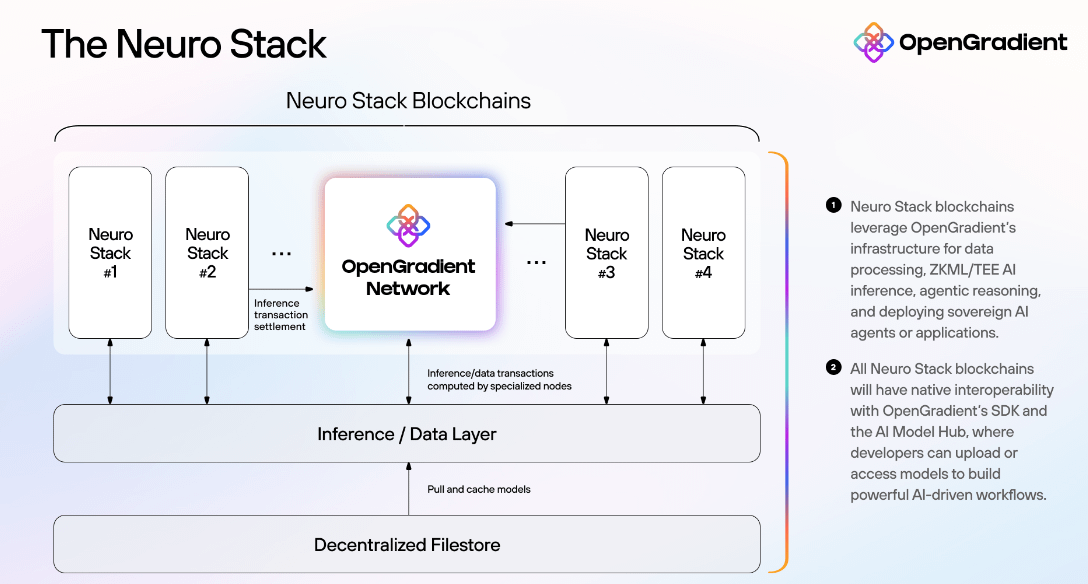
As seen in the technical structural blueprint above, the network breaks down operations into specialized layers and distinct node varieties:
Inference Nodes: Powerful, stateless GPU workers dedicated solely to executing AI requests. These include local inference nodes that run open-source models directly, and proxy nodes that safely route complex prompts to closed-source providers (like OpenAI) using tamper-proof hardware enclaves.
Full Nodes & Data Layers: These network participants handle block validation, transaction scheduling, and historical storage. They verify execution data asynchronously without clogging the active generation pipeline.
Web2 Speeds with Web3 Security
To make this practical for everyday users, HACA utilizes asynchronous settlement. When a dApp requests an AI generation, the request hits an inference node and returns an answer instantly, mirroring Web2 latencies.
The cryptographic proof of that execution is compiled and submitted to the blockchain afterwards. Full nodes validate the proof during the subsequent consensus rounds. This means smart contracts and users do not have to wait for block confirmations to get an AI response, while maintaining a fully auditable on-chain paper trail.
Three Levels of Cryptographic Verification
Depending on how critical the AI task is, developers can select from three different security profiles on the network to optimize for speed versus computational cost:
Trusted Execution Environments (TEEs): Hardware-based secure enclaves prove that un-tampered code was executed. This method offers negligible performance lag and handles standard, daily workloads efficiently.
Zero-Knowledge Machine Learning (ZKML): For absolute cryptographic certainty on high-value financial actions, ZKML produces mathematical proofs that verify a specific dataset ran through a specific model. This provides the highest level of trust, though it requires more computational power.
Vanilla Signature Verification: A lightweight option that bypasses heavy cryptographic generation, reserved exclusively for low-risk, non-critical workloads.
The OPG Tokenomics
The OPG token serves as the economic fuel and governance foundation for the entire decentralized network.
Token Allocation Breakdown
OPG operates with a strictly fixed total supply of 1,000,000,000 (1 billion) tokens deployed on the Base network, ensuring no inflation from additional minting.
Allocation SectorPercentageDetails & UtilityEcosystem & Node Rewards40%Incentivizes GPU data providers, validators, and inference node hosts.Core Contributors30%Allocated to the foundational development and engineering teams.Investors & Advisors10%Distributed to early strategic backers.Staking Rewards10%Dedicated to securing the validation layers of the network.Liquidity & Public Launch6%Fully unlocked at launch to facilitate initial market pairs.Airdrop4%Distributed directly to the early adopting Web3 community.
Trading OPG on Binance
Following its official listing on Binance, OPG was designated with the Seed Tag, indicating it as a highly innovative project with higher volatility and risk profiles compared to legacy tokens. OPG is traded directly against USDT on both the Binance Spot and Futures markets, supporting high-volume liquidity for ecosystem participants needing to procure gas and inference fees.
Risk Warning: Because OpenGradient represents an infrastructure layer at the cutting edge of Web3 AI, traders are encouraged to conduct thorough fundamental analysis and monitor node expansion metrics before engaging in heavy asset positioning.