
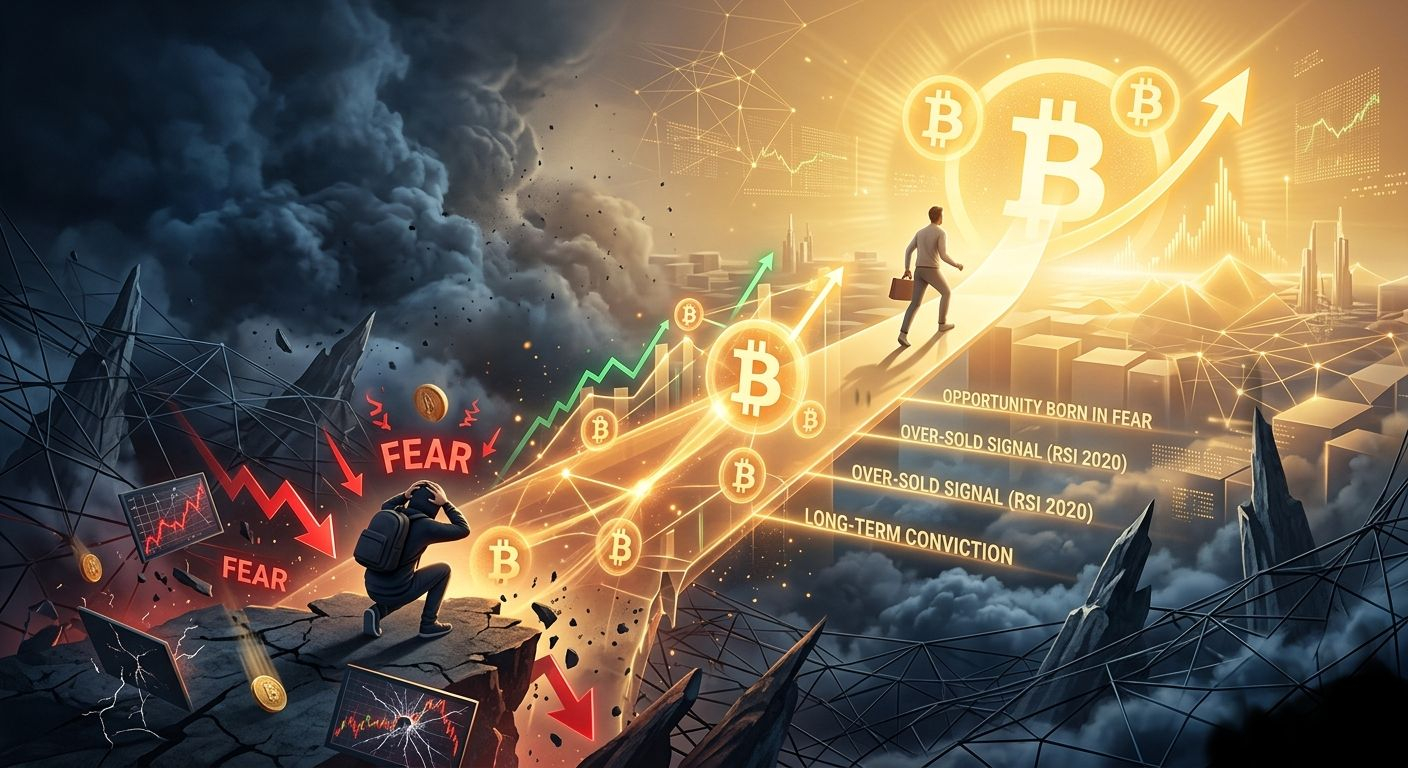
There are moments in every market cycle that only become obvious in hindsight.
Most people recognize them after prices have already exploded higher, after headlines turn bullish again, and after social media begins celebrating “easy gains.” But the real opportunities rarely feel exciting in real time. In fact, the strongest setups usually appear when fear is everywhere, confidence disappears, and the majority become convinced that the market is broken beyond repair.
That is exactly why the current Bitcoin setup deserves far more attention than it’s receiving right now.
The daily RSI on $BTC has fallen to levels we have not witnessed since the historic collapse of March 2020. Think about that for a moment. More than six years have passed without Bitcoin reaching this kind of deeply oversold technical condition. In a market driven heavily by emotion, momentum, and crowd psychology, signals like this do not appear often.
And when they do appear, they tend to matter.
Right now, most traders are obsessed with short-term candles, hourly volatility, liquidation levels, and the next intraday move. Every tiny drop creates panic. Every small bounce creates false hope. But long-term market opportunities are rarely built inside emotional noise. They are built quietly, underneath periods of maximum uncertainty — when almost nobody wants to believe in the asset anymore.
That is what makes this moment so interesting.
The last time Bitcoin’s RSI became this washed out was during the COVID panic crash of 2020. Global markets were collapsing. Fear dominated every financial headline across the world. Liquidity vanished overnight. Investors rushed to sell almost everything they owned just to protect cash positions. Bitcoin itself crashed violently, and sentiment became overwhelmingly bearish.
At the time, buying Bitcoin felt terrifying.
Most people believed the crypto market was finished. Analysts predicted much lower prices. Social media was filled with panic, doom, and fear. Yet beneath all that chaos, something extraordinary was happening quietly in the background: one of the greatest accumulation opportunities in Bitcoin’s history was forming.
Within the following year, Bitcoin didn’t simply recover.
It exploded into a historic bull run.
BTC went from being declared “dead” during the crash to printing brand new all-time highs while many of the same people who sold in panic watched helplessly from the sidelines. Those who had conviction during fear were rewarded the most.
That doesn’t mean history will repeat perfectly today.
Markets evolve. Conditions change. Every cycle has its own structure.
Today’s environment is very different from 2020 in several important ways. Institutional participation is significantly larger. Spot Bitcoin ETFs now influence liquidity and market structure. Global interest rates remain an important macro factor. Governments, regulations, central bank policies, and global liquidity conditions all play a role in determining how aggressively risk assets can move.
This cycle is also psychologically different.
Back in 2020, Bitcoin was still considered highly speculative by most traditional investors. Today, some of the world’s largest financial institutions openly hold or support Bitcoin exposure. That changes market behavior dramatically. Volatility still exists, but the ecosystem itself has matured.
Even so, one thing has remained surprisingly consistent throughout every major cycle:
Extreme pessimism often appears near major turning points.
Not near euphoric tops.
Not when everyone feels confident.
But when fear becomes emotionally exhausting.
That is why this RSI signal deserves attention. RSI is not a magic predictor, and no indicator guarantees immediate reversals. Markets can always fall lower than expected. Bitcoin could absolutely experience additional downside volatility before finding a true bottom.
But technical indicators become important when they align with emotional extremes.
And right now, that alignment is difficult to ignore.
Selling pressure has become unusually stretched. Fear across the market is elevated. Confidence is weak. Many traders are expecting further collapse. Historically, these are exactly the environments where long-term opportunities begin forming beneath the surface while the majority remain focused only on short-term pain.
Markets are designed to punish emotion.
When greed becomes excessive, markets often reverse downward unexpectedly. When fear becomes overwhelming, markets frequently begin stabilizing when nobody believes recovery is possible. This psychological cycle repeats constantly across every financial market in history.
That is why experienced investors spend more time studying sentiment than headlines.
Because by the time the news becomes positive again, a significant portion of the move is often already over.
The uncomfortable reality about successful investing is that the best opportunities rarely feel safe. They rarely arrive with certainty. They usually appear surrounded by fear, doubt, negative sentiment, and constant predictions of disaster.
Bitcoin has repeatedly demonstrated this pattern throughout its history.
In 2011, it crashed over 90%.
In 2014, many believed the Mt. Gox collapse would permanently destroy crypto.
In 2018, Bitcoin lost over 80% of its value during the brutal bear market.
In 2020, global panic created one of the fastest crashes financial markets had ever experienced.
And yet every major collapse eventually became part of a much larger long-term growth story.
That does not mean Bitcoin is guaranteed to rise forever. No market moves in a straight line. Risks always exist. Volatility will always remain part of crypto investing. Smart investors understand risk management matters just as much as conviction.
But ignoring extreme oversold conditions entirely can also become dangerous.
Because historically, some of the greatest opportunities in financial markets emerge precisely when most participants become emotionally incapable of acting rationally.
Right now, many investors are asking the wrong question.
Instead of asking, “How low can Bitcoin fall tomorrow?” perhaps the more important question is:
“What happens if this period eventually becomes another long-term accumulation zone?”
That possibility alone deserves serious attention.
Especially when technical conditions are reaching levels that have historically appeared only during periods of maximum fear.
This is why long-term investors often behave differently from short-term traders. Traders focus heavily on immediate price action. Long-term investors focus on asymmetric opportunity. They understand that extraordinary returns are usually created during emotionally difficult periods, not during comfortable rallies.
Anyone can feel confident buying green candles after markets recover.
Very few can maintain conviction when fear dominates the timeline.
And that psychological difference often determines who captures the biggest opportunities.
Maybe Bitcoin drops further from here.
Maybe volatility increases before stability returns.
Maybe the market needs more time before momentum truly shifts.
All of those outcomes remain possible.
But if history is even partially rhyming with previous cycles, these conditions may eventually be remembered as one of those rare periods where fear became larger than reality — and where opportunity quietly began forming while the crowd focused only on panic.
The market rarely rings a bell at the exact bottom.
It simply becomes so uncomfortable that most people refuse to buy.
And sometimes, the strongest opportunities arrive precisely when conviction feels hardest to maintain.
#BitcoinDunyamiz #cryptouniverseofficial #Follow_Like_Comment $USDC $XRP