

I’ve been keeping an eye on OpenLedger for a while, not because of the AI narrative surrounding it, but because it seems to be focused on a problem that feels increasingly important as AI grows. Crypto has never struggled to create big stories, and AI is currently one of the biggest. What’s harder to find are projects that are trying to solve practical issues beneath the headlines. That’s the part I pay attention to, especially in a market where excitement often arrives long before real utility.
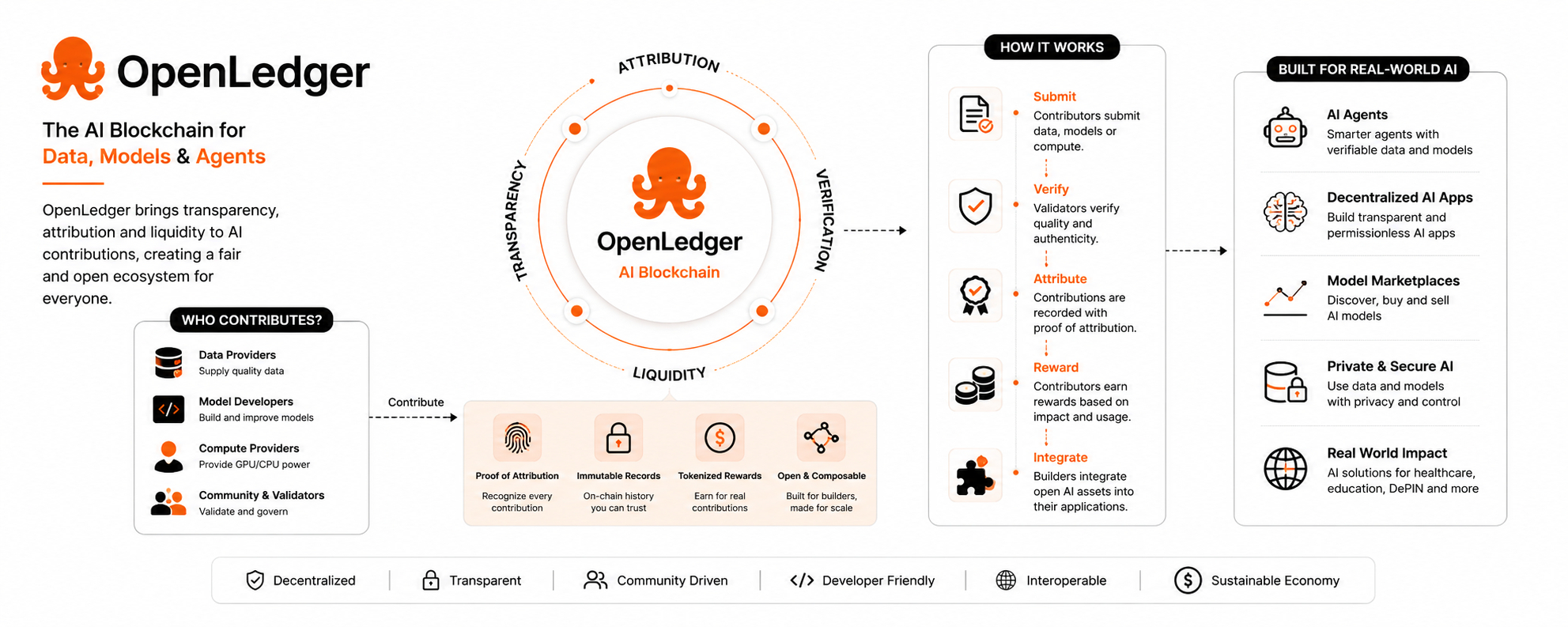
One thing that stands out to me about OpenLedger is that it isn’t only talking about building AI infrastructure. It appears to be focused on something more specific: making AI contributions measurable and valuable. As AI systems become more powerful, they rely on enormous amounts of data, models, and input from different participants. Yet the people creating that value are often invisible once the system is running. The question OpenLedger seems to be asking is simple: if someone contributes data or helps improve an AI system, how can that contribution be tracked and rewarded fairly?
That idea feels more relevant than many of the broader promises I hear across the industry. AI is moving quickly, but questions around ownership, attribution, and incentives remain unresolved. Most users benefit from AI products without ever knowing where the underlying data came from or who helped create the intelligence behind them. OpenLedger appears to be building around that gap, attempting to create a framework where contributions can be recognized rather than disappearing into a black box.
What makes the project interesting to me is that the focus feels tied to actual usage. If AI becomes a larger part of everyday applications, there will likely be increasing pressure to understand where information originates and how value is distributed. Developers, data providers, researchers, and communities all play a role in building these systems. Creating a way to connect their contributions to economic rewards could become more important than many people realize today.
Of course, I’m still cautious. Crypto has a habit of making early-stage projects look stronger than they eventually prove to be. Strong ideas are common. Execution is where things become difficult. A system can look impressive in presentations and early testing, but scale often exposes weaknesses that nobody anticipated. Real users behave differently than expected, liquidity conditions change, networks face stress, and edge cases appear that no roadmap can fully predict.
That’s why I’m not treating OpenLedger as a guaranteed success story. I’m simply watching it as a project that appears to be addressing a genuine challenge within the AI economy rather than relying entirely on narrative momentum. Whether it succeeds or not will ultimately depend on execution, adoption, and its ability to function under real-world conditions. But in a market full of projects chasing attention, OpenLedger stands out to me because it seems to be focused on a problem that actually needs solving.
