
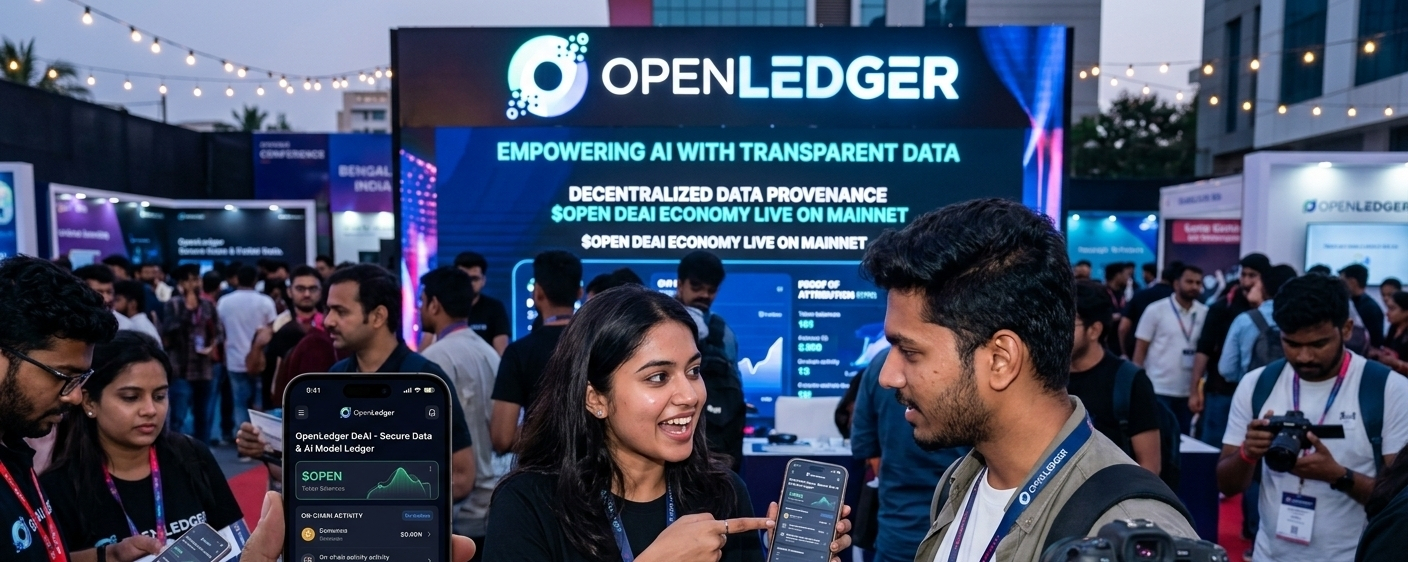
The Data Layer DeAI Actually Needs: Why OpenLedger ($OPEN) Is Redefining the AI Blockchain Race in 2026
The intersection of Web3 and Artificial Intelligence has long been dominated by a single, critical bottleneck: decentralized computing power. While most decentralized AI projects focus purely on pooling idle GPUs or renting out raw hardware, they completely overlook the core ingredient that makes AI function—high-quality, verifiable data. Tech conglomerates continue to scrape public internet data, train monolithic models in opaque "black boxes," and reap 100% of the financial upside, leaving individual creators and data providers without fair compensation.
As we move through 2026, OpenLedger ($OPEN) is directly challenging this paradigm by treating data, fine-tuned models, and autonomous agents as liquid, ownable, on-chain assets. Moving firmly from its pre-mainnet proof of concept into its mainnet operational phase, OpenLedger is staking its claim as the definitive settlement and data provenance layer for Decentralized AI (DeAI).
1. The Core Architecture: Resolving the "Black Box" Problem
Traditional AI workflows lack native support for data provenance, meaning it is historically impossible to trace exactly which dataset influenced a specific output from a large language model. OpenLedger solves this by designing an EVM-compatible Layer 2 infrastructure engineered exclusively for model and data workflows:
Proof of Attribution (PoA): At the heart of the network sits an immutable accounting mechanism. Using advanced gradient-based and influence-based mathematical modeling (I_{DataInf}), the network accurately calculates exactly how much a single training data point (d_i) influenced a final machine learning output (y). This shifts the dynamic from arbitrary rewards to mathematically verifiable value distribution.
Datanets: These function as on-chain collaborative networks where communities co-create, securely curate, and control niche, domain-specific data repositories for machine learning models.
The OpenLoRA Serving Framework: Deploying separate hardware instances for thousands of fine-tuned consumer models is economically unfeasible. OpenLedger's multi-tenant GPU infrastructure allows thousands of Low-Rank Adaptation (LoRA) models to share a single pre-trained backbone model simultaneously, drastically reducing overhead costs and optimizing throughput.
2. $OPEN Tokenomics and Supply Dynamics
The $OPEN token acts as the functional lifeforce powering gas fees, governance, and the economic architecture across the n
etwork.