
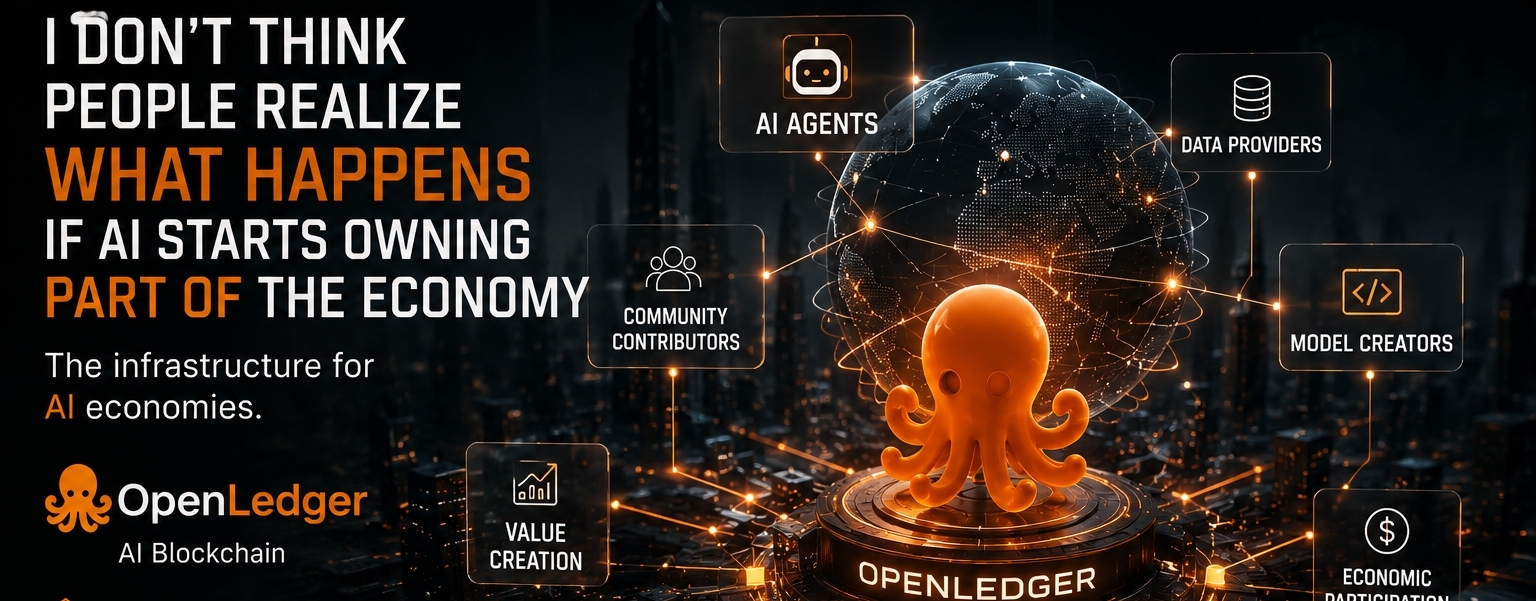

The more I think about OpenLedger lately the more I feel like most people are still looking at AI from a very small angle. Almost every conversation focuses on productivity faster tools smarter automation, cheaper execution, better models. That's the obvious layer, so naturally the market pays attention to it first.
But I keep coming back to a different thought entirely.
What happens if AI systems eventually stop acting like simple software tools and start participating inside economies directly?
That idea sounds exaggerated at first, but maybe not for much longer. AI agents are already moving toward handling workflows, processing information, coordinating actions, interacting on-chain, and eventually making certain operational decisions faster than humans can. Once systems begin operating continuously inside digital environments, the conversation shifts from “technology” into economics very quickly.
This is the point where OpenLedger started becoming more interesting to me.
At first I honestly treated $OPEN like most traders probably do: another AI narrative connected to agents, attribution, and automation. But after reading deeper into how the ecosystem is structured, it stopped feeling like a simple trend trade and started looking more like infrastructure for machine-driven coordination.
That's a very different idea.
What really changed my thinking was OpenLedger’s focus on attribution and ownership. Most AI systems today create value through enormous layers of data, interactions, feedback, and model activity, but contributors rarely participate meaningfully in the upside. The systems grow larger while the economic rewards stay concentrated around the platforms controlling the infrastructure.
OpenLedger seems to be exploring another direction entirely.
Instead of treating intelligence as something controlled only by centralized systems, the project keeps pushing toward an economy where contributors, developers, data providers, and even agents themselves become part of the value loop. The more I think about that, the more I realize this conversation is probably bigger than crypto speculation alone.
Because eventually AI economies will need systems deciding:
attribution
ownership
execution
monetization
coordination
And those systems may quietly become more important than the applications people focus on today.
The strange thing about infrastructure is that it usually looks unimportant during the early stage. Markets pay attention to visible products first because narratives spread faster than operational layers. We’ve already seen this happen with cloud systems, payment rails, APIs, and blockchain infrastructure itself. Most people ignored the deeper layers until dependency formed around them.
Maybe AI economies evolve the same way.
Still, I’m not blindly convinced. Strong ideas are everywhere in AI crypto right now, and attention rotates aggressively between narratives. @OpenLedger still needs to prove real ecosystem growth, sustained developer activity, repeat usage, and meaningful adoption around agents and attribution systems. Without actual economic behavior forming underneath, even intelligent concepts eventually fade.
But I keep returning to the same thought.
If intelligence itself starts participating directly inside economies, then the infrastructure coordinating that activity may become one of the most important layers of the next internet cycle.
And honestly I don't think the market fully understands what that could mean yet.
Do you think AI systems will remain tools controlled by large platforms… or could future AI economies become much more decentralized than people currently expect?