
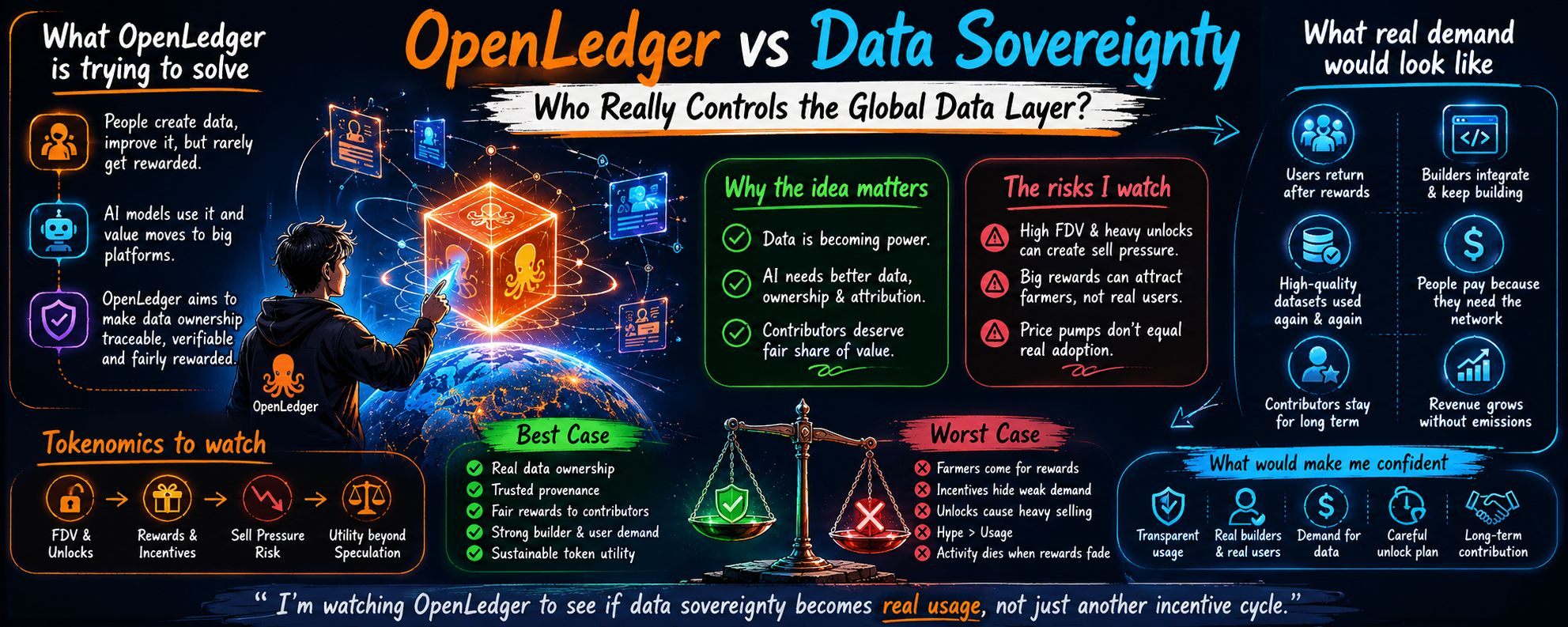

I’m watching OpenLedger closely because it sits in the middle of a problem that feels bigger than one project. I’m waiting to see what happens when the loud rewards calm down. I’m looking at whether people still use it when there is no campaign, no multiplier, no airdrop rumor, and no easy reason to farm. I’ve learned that crypto can make almost anything look alive for a while. OpenLedger is interesting to me, but I want to know if the interest is real or just rented by incentives.
The project is trying to solve a very real issue. AI needs data, but the people who create, improve, label, organize, or contribute that data often disappear from the value chain. Their work gets absorbed into models, apps, and platforms, while the rewards usually move upward. OpenLedger is trying to change that by building a system where data contribution can be tracked, owned, verified, and rewarded.
That matters.
If AI keeps becoming part of everything, then data becomes more than just information. It becomes power. It becomes ownership. It becomes control over what machines learn, what they remember, and who benefits when that knowledge creates value. This is why OpenLedger’s idea sounds important. It is not just talking about another AI tool. It is trying to build around the data layer underneath AI.
But I’m still cautious.
I’ve seen many crypto projects start with a serious problem and then get swallowed by token incentives. A project can have a strong mission and still attract people who only care about rewards. It can have real technology and still create fake-looking traction if most activity comes from farming. That is the risk with any project in this space, and OpenLedger is not above that risk.
The question I keep asking is simple: are people using OpenLedger because they need it, or because they expect something from it?
That difference matters.
If contributors are joining because they believe their data, knowledge, or work can become valuable inside the network, that is a strong sign. If builders are exploring OpenLedger because it helps them access better data, track provenance, or create AI products with cleaner attribution, that is meaningful. But if most people are only completing tasks, chasing points, and waiting for rewards, then the activity may not say much.
I don’t trust numbers without context.
Wallet growth can look impressive. Transaction activity can look impressive. Social attention can look impressive. Even price action can look impressive. But none of these prove that OpenLedger has real demand. Crypto prices can move because of hype, market timing, listings, influencers, or the broader AI narrative. A green chart does not prove that a product is needed. It only proves that buyers showed up for a moment.
For OpenLedger, the stronger proof would be usage that continues after incentives slow down.
I want to see contributors stay because the system gives them a real reason to stay. I want to see datasets that people actually use. I want to see builders coming back because OpenLedger makes their work easier or more valuable. I want to see AI apps, agents, or companies paying for trusted data because the network gives them something useful. That is the kind of demand that matters.
Tokenomics are another part I cannot ignore.
FDV matters because it shows how expensive the project may already be compared to its real usage. Unlocks matter because early investors, team members, or insiders can create sell pressure when tokens enter the market. Rewards matter because they can bring users in, but they can also train users to leave once the rewards are gone. Incentives can help a network grow, but they can also hide weak demand.
That is the dangerous part.
If OpenLedger rewards too much too early, farmers may come in, extract value, sell tokens, and move on. If unlocks are heavy, the market may struggle to absorb supply. If the token is mostly used to pay people for activity, then the project has to prove that this activity eventually turns into real demand. Otherwise, the token becomes a pressure machine instead of a value-capture tool.
I want the token to have a reason to exist beyond speculation.
For OpenLedger, that means the token should connect to actual network usage. It should make sense inside the data economy the project is trying to build. It should not only be about staking, governance, or vague ecosystem rewards. I want to see whether the token is needed when data is contributed, verified, accessed, used, or monetized. If the token is not connected to real economic activity, then the story becomes weaker.
The best version of OpenLedger is easy to respect.
In that version, contributors are not invisible anymore. Data has a history. AI builders can see where information came from. Useful contributions can be rewarded. Better datasets can support better models. People who add value to the AI economy can share in that value instead of being left outside it. That version feels important because it addresses a real imbalance in AI.
But the weaker version is also possible.
In that version, people join mainly for rewards. They farm tasks. They talk about data ownership because it sounds good. The community gets loud. The dashboard looks active. Then incentives slow down, unlocks begin, selling pressure rises, and the real user base turns out to be much smaller than it looked. That is not a small risk. That is one of the most common patterns in crypto.
So I’m watching OpenLedger with interest, but not blind trust.
The metrics I care about are simple. How many users return without rewards? How many contributors keep adding useful data? How many builders actually integrate OpenLedger into their products? How much of the data gets used more than once? Is there real revenue? Are people paying because they need the network? Is the token being bought for utility, or only because people expect price movement?
Those questions matter more than hype.
I also care about data quality. A data layer is only useful if the data is worth using. If OpenLedger rewards volume more than quality, the system can fill with noise. If verification is weak, bad data can enter the network. If reputation can be gamed, farmers will game it. If contribution tracking is unclear, the whole ownership story becomes fragile. Data sovereignty is not only about giving people control. It is also about proving that the data is clean, useful, and trusted.
That is where OpenLedger has to be strong.
It cannot just say contributors own their data. It has to show that contribution can be measured fairly. It cannot just say data will be monetized. It has to show who pays for it. It cannot just say AI needs decentralized data. It has to prove that builders prefer this system over easier centralized options. The market does not reward good ideas forever. Eventually, it asks for proof.
What would make me more confident is clear, boring evidence.
I want to see real users after the campaigns. I want to see builders who keep building. I want to see demand for specific datasets. I want to see transparent token usage. I want to see unlocks handled carefully. I want to see rewards support long-term contribution instead of short-term farming. I want to see OpenLedger become useful even when the market is not excited about it.
What would make me walk away is also clear.
If the project becomes mostly about price, I lose interest. If the community only talks about rewards, I get cautious. If activity drops when incentives drop, that says a lot. If unlocks create constant sell pressure and the answer is always more marketing, that is not healthy. If partnerships never turn into usage, they are just announcements. If no one can explain who pays, why they pay, and why they keep paying, then the model is not strong enough yet.
I’m not dismissing OpenLedger. I think the project is aiming at a real and important problem. Data ownership will matter more as AI grows. Attribution will matter more. Provenance will matter more. The question of who controls the global data layer will become harder to ignore.
But I’ve learned not to confuse a good problem with a finished solution.
OpenLedger still has to prove that its network is useful without loud incentives. It has to prove that contributors are real, builders are serious, and demand is not just speculation wearing better language. It has to prove that the token supports the economy instead of draining it. It has to prove that data sovereignty can become real usage, not just a beautiful phrase for another cycle.
So I’m watching the project, but I’m watching it carefully.
Who is actually using OpenLedger when rewards fade? Who is paying for the data? Who controls what gets verified? Who benefits when the data becomes valuable? Who holds the risk when unlocks arrive? Who buys the token because they need it, not because they hope someone else buys higher? And if the activity disappears when the incentives stop, was it ever data sovereignty, or was it just another crypto campaign with better wording?