
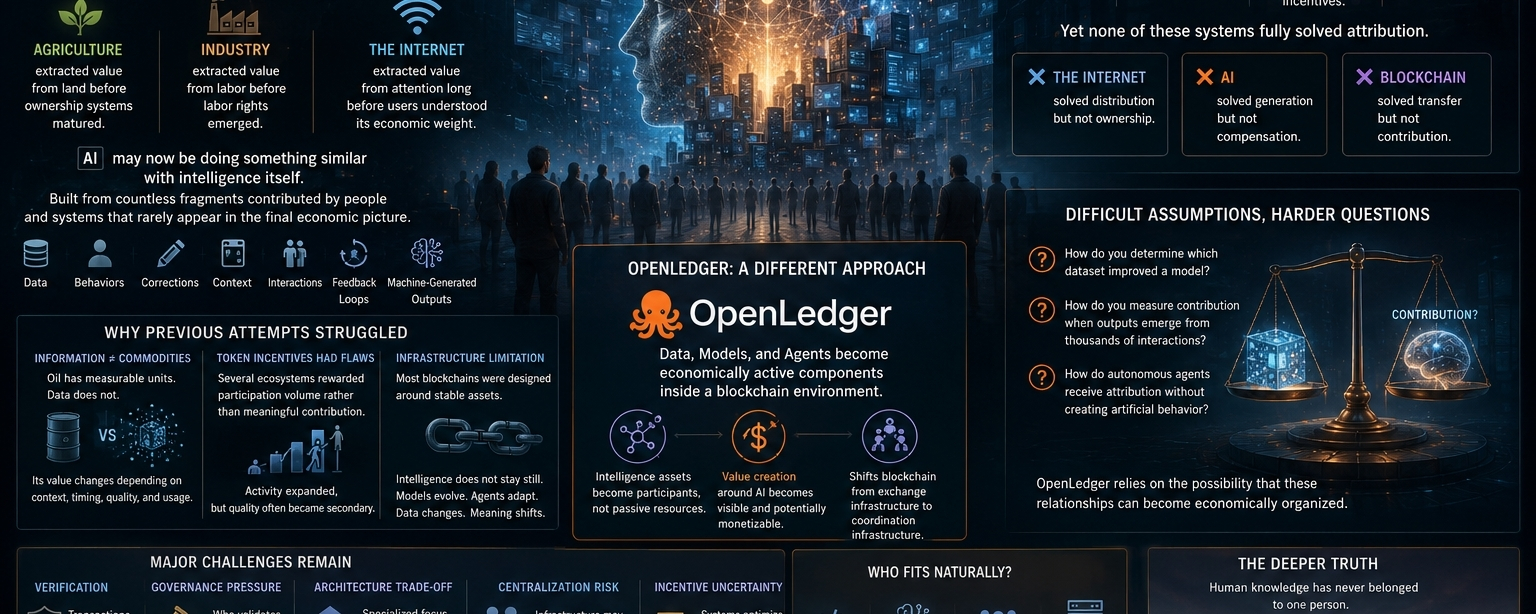
Agriculture extracted value from land before ownership systems matured. Industry extracted value from labor before labor rights emerged. The internet extracted value from attention long before users understood its economic weight.
Artificial intelligence may now be doing something similar with intelligence itself.
Not intelligence as human talent, but intelligence as accumulated inputs: data, behaviors, corrections, context, interactions, feedback loops, and increasingly machine-generated outputs. Modern AI systems are built from countless fragments contributed by people and systems that rarely appear in the final economic picture.
This creates a larger problem that existed before OpenLedger and even before AI blockchains entered the discussion.
Who owns collective intelligence once it becomes infrastructure?
The industry has attempted partial answers.
Cloud platforms created access. Open-source communities created collaboration. Blockchain introduced digital ownership and programmable incentives. AI accelerated production.
Yet none of these systems fully solved attribution.
The internet solved distribution but not ownership.
AI solved generation but not compensation.
Blockchain solved transfer but not contribution.
This gap became increasingly visible as AI models expanded. Training systems depend on enormous volumes of information, yet contributors often remain economically disconnected from the outcomes. Data creators may never know where information travels. Model improvements absorb countless inputs without visible attribution. Autonomous systems increasingly create outputs whose origins become difficult to trace.
Previous blockchain experiments tried to address parts of this.
Data marketplaces emerged with the assumption that information could become an asset class.
Many struggled.
The reason was simple: information behaves differently from commodities.
Oil has measurable units.
Data does not.
Its value changes depending on context, timing, quality, and usage. A useless dataset in one environment may become extremely valuable elsewhere.
Markets prefer certainty.
Intelligence rarely provides it.
Token incentive systems also introduced complications. Several ecosystems rewarded participation volume rather than meaningful contribution. Activity expanded, but quality often became secondary.
Infrastructure had another limitation.
Most blockchains were designed around assets that stay relatively stable: tokens, ownership records, transactions.
Intelligence does not stay still.
Models evolve.
Agents adapt.
Data changes.
Meaning shifts.
OpenLedger appears to emerge from this unfinished space.
Rather than treating AI as an application layer above blockchain, the project presents an alternative framing: data, models, and agents themselves may become economically active components inside a blockchain environment.
In practical terms, OpenLedger appears interested in transforming intelligence assets into participants rather than passive resources.
The project suggests that value creation around AI should become visible and potentially monetizable.
Conceptually, this is interesting because it shifts blockchain away from exchange infrastructure toward coordination infrastructure.
The network is not only asking who owns assets.
It appears to ask who contributes to intelligence creation.
Yet this transition introduces difficult assumptions.
For such a model to work, intelligence must become measurable.
That sounds simple.
It is not.
How do you determine which dataset improved a model?
How do you measure contribution when outputs emerge from thousands of interactions?
How do autonomous agents receive attribution without creating artificial behavior?
OpenLedger seems to rely on the possibility that these relationships can become economically organized.
This is plausible in theory.
Verification remains the harder question.
Traditional blockchains verify events because transactions are objective.
AI contribution often is not.
One model update may matter greatly in one environment and become irrelevant elsewhere.
Human judgment frequently remains necessary.
This creates governance pressure.
Who validates quality?
Who defines contribution?
Who resolves disputes when attribution overlaps?
The architecture itself introduces another trade-off.
Specialized AI infrastructure creates focus but increases ecosystem dependence.
General-purpose chains survive because they support many activities.
AI-specific systems depend more directly on builders, datasets, models, and users arriving simultaneously.
Without ecosystem depth, liquidity around intelligence remains abstract.
Centralization risk also remains unresolved.
The AI economy today is heavily influenced by organizations controlling compute resources, proprietary models, and large datasets.
Even inside decentralized frameworks, concentration can reappear.
Infrastructure may decentralize while influence remains centralized.
Economic incentives create another uncertainty.
History repeatedly shows that systems optimize toward rewards.
If intelligence monetization rewards quantity over usefulness, ecosystems may recreate familiar extraction cycles.
OpenLedger’s design will likely depend heavily on whether contribution quality can remain more valuable than activity volume.
The users who fit naturally into this structure appear to be AI developers, model builders, research communities, and infrastructure participants exploring decentralized intelligence systems.
Smaller contributors may still struggle if verification systems become complex or participation requires technical depth.
But beneath architecture, incentives, and blockchain mechanics sits a more uncomfortable issue.
Human knowledge has never belonged to one person.
Science, language, culture, and innovation evolved collectively.
AI merely exposed this reality at machine scale.
OpenLedger explores one path through that problem.
in ki imeg do