
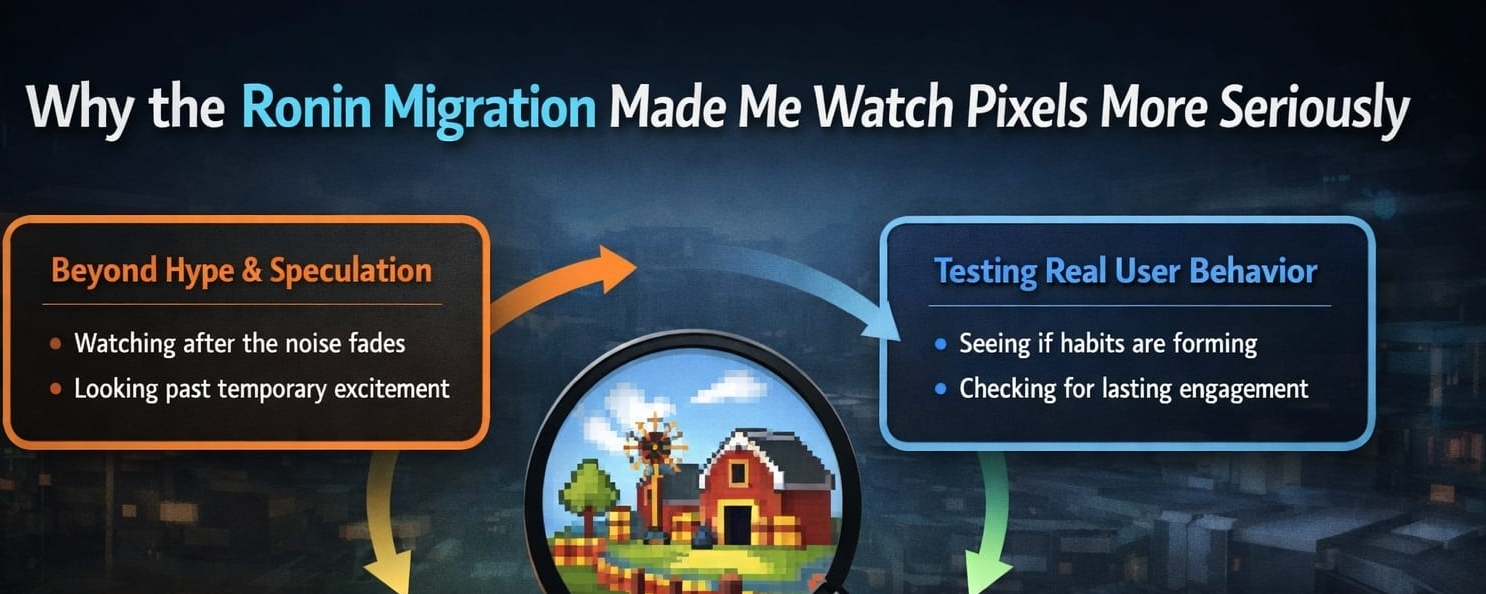

I have been watching Pixels more seriously since its move to Ronin, but not for the obvious reason.
I am not impressed by migrations just because they sound important on paper. Crypto has a habit of turning technical changes into grand stories before the real effects can even be measured. I have seen that too many times. What matters to me is not how clean the announcement looks or how loudly people celebrate it for a week. What matters is whether that kind of move actually changes the way a project lives, scales, and holds up once the excitement fades.
That is where my attention usually goes now.
I care less about how a project behaves when the market is shining a spotlight on it. Almost everything looks stronger under perfect conditions. Volume is higher, sentiment is warmer, and even weak ideas can borrow confidence from the mood of the cycle. In that kind of environment, people start confusing visibility with strength. A rising market does a lot of heavy lifting for projects that have not really earned their image yet.
I try to step away from that.
What I want to understand is what remains when the market stops helping. When speculation cools down. When the community gets quieter. When price action is no longer masking every weakness. That is usually the moment where the real shape of a project starts to appear. Not in peak attention. After it.
That is one reason the Ronin migration stands out to me in the case of Pixels. It did not just give the project a better narrative. It changed the environment around it. And environment matters more than people admit. A product can have interesting ideas, but if the surrounding infrastructure is not built for its kind of usage, growth becomes messy, user behavior becomes unstable, and the actual experience starts to break under pressure.
For a game, that matters even more.
Pixels was never going to be judged only by its token or its branding. At some point, it had to be judged by repetition. By whether people could come back again and again without the entire thing feeling fragile or forced. Farming games, social loops, in-game actions, player routines — all of that depends on consistency more than hype. A lot of people in crypto underestimate that. They think attention is enough. It is not. Attention can bring people in, but it cannot create habit on its own.
Habit has to be earned.
That is why I think the migration to Ronin was meaningful. Not because it created instant proof of success, but because it gave Pixels a better setting to test whether its user base could deepen rather than just expand. There is a difference between more users and stronger behavior. I always watch for that difference. A sudden wave of participation can look impressive, but I care more about whether the product becomes easier to return to, easier to trust, and more natural to stay with over time.
That part usually gets ignored when the crowd is excited.
Most projects look solid when the market is doing the work for them. That is the uncomfortable truth. In a strong cycle, bad design gets hidden behind momentum. Weak retention gets dressed up as adoption. Communities become louder, and people mistake volume for conviction. The numbers look clean. The posts sound confident. Everyone starts speaking as if durability has already been proven.
It usually has not.
This is why I pay attention to silence more than hype. Silence strips things down. It removes the performance. It lets me see whether the product still has gravity when people are no longer cheering every update. If users keep returning in quieter conditions, I notice that. If the ecosystem still makes sense without forced narrative support, I notice that too. If the project can hold relevance without being carried every day by speculation, that tells me more than any short-term spike ever will.
Retail traders often read these phases badly. They are too reactive to mood. When excitement slows, they assume the thesis is dead. When engagement becomes less visible, they assume interest is gone. When price cools off, they stop looking deeper. I think that is where some of the worst judgments in crypto come from. People are trained to read noise, not structure.
But structure is what survives.
With Pixels, I keep watching because I can see there is still something worth tracking beneath the surface. I still have doubts. I think that is necessary. I do not trust projects that look too easy to believe in, and I do not trust my own view unless it can survive skepticism. But doubt does not cancel interest. Sometimes it sharpens it. And in this case, the project still gives me enough to study seriously.
I watch the product depth. I watch whether user habits are becoming real or just temporarily incentivized. I watch how it sits inside the Ronin ecosystem and whether that positioning continues to strengthen its usefulness rather than just its image. I watch the narrative too, but only to see whether it can survive without constantly being refreshed by outside excitement.
That matters to me more than polished optimism.
Long-term potential is never something I hand out cheaply. I have no interest in becoming naive just because a project sounds culturally relevant or gets attached to a strong chain. I have seen how quickly this market rewards confidence before demanding proof. So I stay patient. I let time do some of the filtering. I would rather be late to something real than early to something that only looked durable because the market made it feel that way.
That is the frame I use with Pixels.
I am not looking for a perfect story. I am looking for signs of endurance. I am looking for a project that can survive pressure, survive boredom, survive the cooling of momentum, and still keep enough internal strength to matter. That is harder to fake. And because it is harder to fake, it is more valuable to observe.
In the end, I trust what remains after the noise leaves. I trust what still functions when fewer people are watching. Because in this market, truth usually becomes visible after the performance ends and only the structure remains.
