
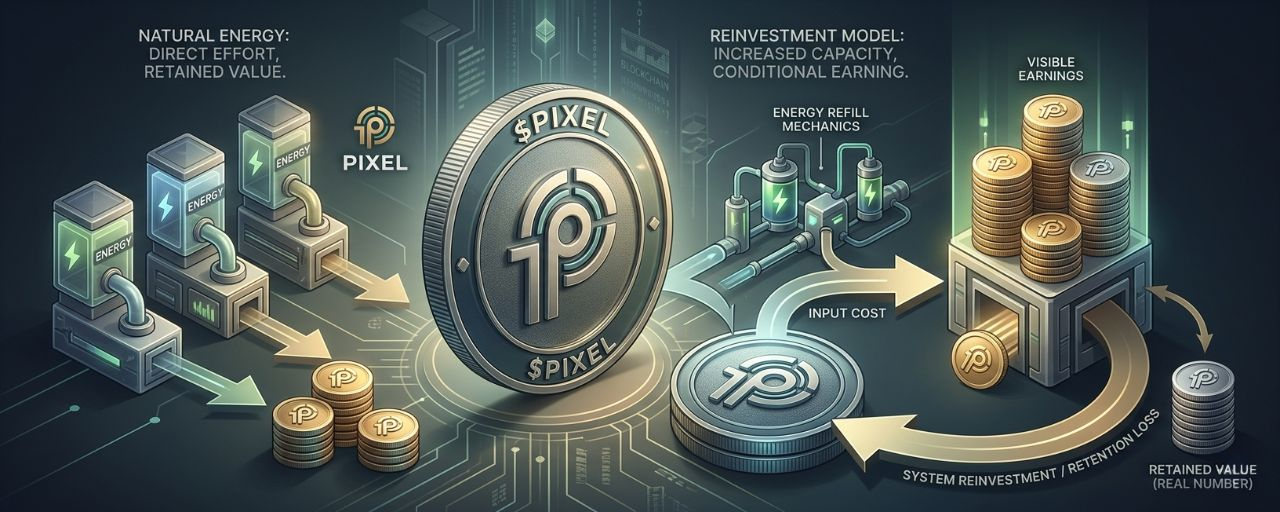
I spent more time than expected thinking about how value actually flows inside Pixels, and the part that stayed with me was not how much you can earn, but how that earning changes once you start optimizing the system. At a basic level, the loop feels simple. You use energy, complete actions, and receive resources alongside $PIXEL . It gives the impression that effort scales directly with outcome.
That assumption starts to break the moment you move beyond natural limits. Energy is not just a restriction, it is a filter. Once refill mechanics enter the equation, earning is no longer a pure function of activity. It becomes conditional. Every additional unit of output begins to carry an input cost that is easy to ignore at first, but impossible to avoid over time.
I found myself thinking less about total rewards and more about retained value. A player running only on natural energy operates under one model. A player actively reinvesting into energy operates under another. Both are earning, but they are not earning under the same structure. The second player is effectively trading part of their output to increase their capacity, which means the visible reward number is no longer the real number.
The more I sat with this, the more it felt like the system is not built around maximizing distribution, but around shaping behavior. $PIXEL does not just move outward as rewards, it circulates back into the system through energy, crafting, and progression decisions. That circular flow creates a quiet separation between players who participate and players who optimize.
What makes this interesting is that the gap is not explicitly stated anywhere. The interface shows you what you earn, but it does not immediately force you to calculate what it costs to maintain that rate. That calculation only appears when you start pushing the system harder, and by then, the structure reveals itself.
I am not convinced this is something every player will notice early, but I do think it changes how the economy behaves over time. Systems that reward raw activity tend to inflate quickly. Systems that require understanding tend to slow that process down. Pixels feels closer to the second category, where the advantage is not just time spent, but how well you read the loop you are inside.
That is the part that keeps my attention, not the earning itself, but the difference between what is shown and what is actually kept