


Most blockchain economies follow a simple rule.
The same token does almost everything.
It secures the network.
It pays transaction fees.
It rewards validators.
And sometimes it also governs the protocol.
At first glance, this looks efficient.
But the more I study blockchain economics, the more fragile this model starts to appear.
When a token becomes expensive, transaction fees rise.
When a token becomes cheap, validator incentives weaken.
When speculation dominates the token market, network usability often suffers.
It creates an awkward dependency between network usage and token volatility.
While exploring alternative approaches, I came across the design used by @MidnightNetwork , and it immediately caught my attention.
Instead of relying on a single token for everything, Midnight separates the system into two different components:
$NIGHT and DUST.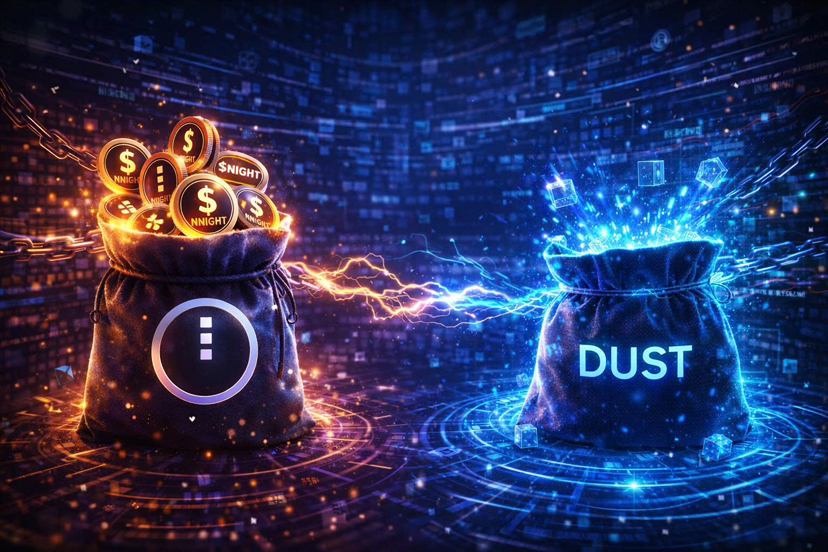
At first this might sound like a typical dual-token system.
But the relationship between them is quite unusual.
$NIGHT is the network’s primary token.
It plays roles that are familiar in many blockchain systems: governance, block production incentives, and ecosystem participation.
But here’s the interesting twist.
$NIGHT is not spent to execute transactions.
Instead, holding NIGHT generates a resource called DUST.
The easiest way to understand this is to think about energy systems.
Imagine NIGHT tokens acting like power plants.
They continuously produce electricity.
That electricity is DUST.
And that energy is what actually powers the network.
Every transaction consumes DUST rather than burning tokens.
The more NIGHT someone holds, the more DUST they generate over time.
This leads to some fascinating consequences.
First, transaction capacity becomes more predictable.
Instead of constantly buying tokens for gas fees, users can rely on the ongoing generation of network resources.
Second, DUST behaves differently from a typical crypto asset.
It cannot be transferred between users.
It cannot be traded on markets.
And it gradually decays over time if not used.
This means DUST cannot become a speculative asset.
It exists purely as network capacity.
From a design perspective, that’s a clever way to separate infrastructure usage from token speculation.
Another interesting implication is how this affects privacy.
Because DUST is shielded and non-transferable, transactions can be executed without exposing metadata in the same way traditional gas tokens often do.
That detail could play an important role for applications that require data protection.
Of course, no economic model is perfect.
Separating token incentives from transaction resources introduces new questions:
Will developers find the system intuitive?
How will markets value the NIGHT token if it isn’t directly used for gas?
And can the generation rate of DUST balance network demand over time?
These are not trivial questions.
But the more I look at Midnight’s design, the more it feels like an attempt to rethink a core assumption in blockchain architecture.
For years, we’ve accepted that the token must power everything.
Midnight seems to be asking a different question.
What if tokens secured the network…
while a renewable resource powered the activity happening on top of it?
If that idea proves viable, the economics of blockchain infrastructure could evolve in ways we haven’t fully explored yet.