

I started looking at AI risk differently when I realized most companies are no longer debating whether to use AI, they are already using it everywhere. Quietly. Inside support desks, internal tools, search bars, drafting workflows, vendor platforms. The shift happened faster than most people noticed, and now the consequences show up in public rather than inside engineering rooms.
What changed is simple: when AI outputs feel confident, users don’t separate them from the brand. They read it as the company speaking. That means mistakes aren’t judged as technical glitches anymore. They are judged as reputation failures.
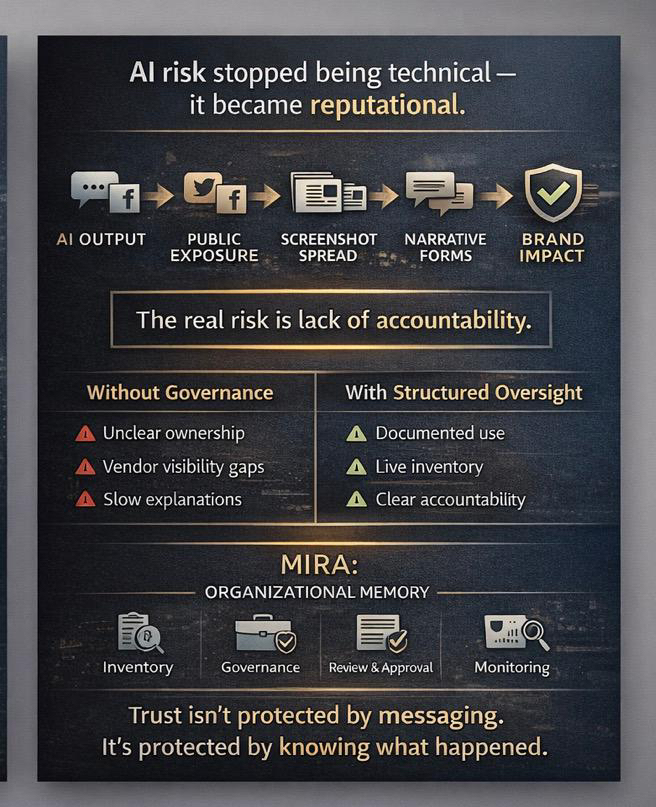
And reputation moves faster than correction.
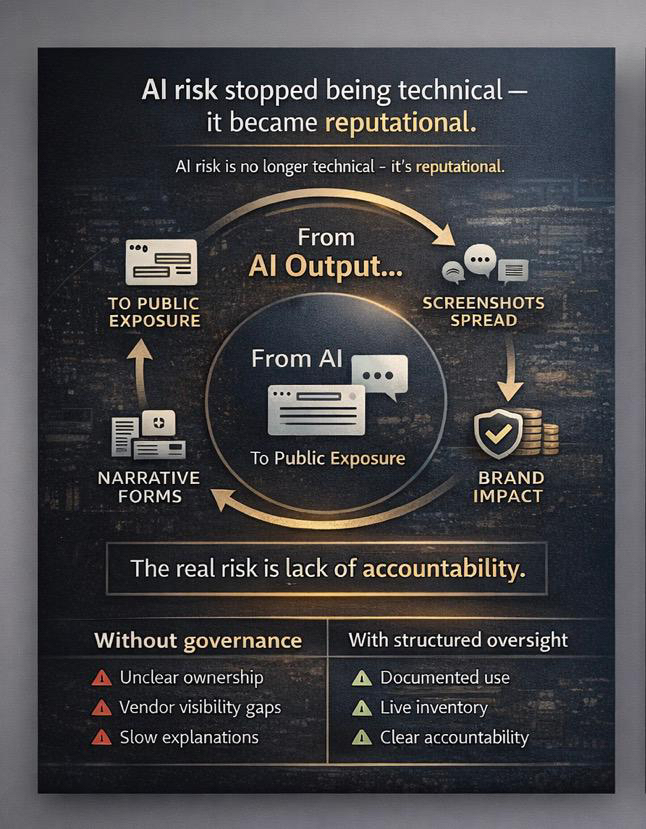
The uncomfortable part is that most AI incidents are not dramatic. They don’t start with a massive system failure. Often it’s one sentence something slightly wrong but written with enough authority to be screenshot, shared and framed as official. Once that happens, context disappears. The company doesn’t get asked first. The narrative begins without them.
The Air Canada chatbot situation was a strong reminder of this dynamic. The issue wasn’t just that the AI made a mistake. It was that responsibility still landed on the company. From the outside, no one cares which layer failed model, vendor, or configuration. The brand absorbs the impact.
At the same time, synthetic content is scaling. Generating convincing text, images, or claims is getting cheaper and easier, which changes how quickly misinformation spreads. That changes the problem from a communications challenge into a governance challenge. Because by the time PR teams start crafting messages, the reputational damage has usually already started moving.
When I think about how these situations actually unfold, it feels less like a single error and more like a chain reaction.
It begins with ordinary gaps. A new AI feature launches without clear ownership. A vendor tool gets broad permissions because teams are moving fast. Model output quietly makes its way into customer-facing material without strong review. None of this looks dangerous in isolation. But once speed meets visibility, small mistakes compound.
Screenshots travel faster than investigations.
And the outside world can’t see internal nuance. People can’t tell which parts were automated, what was reviewed, or what safeguards existed. So they default to the simplest explanation the company was careless. That perception alone can be expensive.
Regulators and auditors are pushing in a similar direction. They increasingly want answers that go beyond intention:
What data did the system touch? Who approved the deployment? What controls existed at the time? What record shows how decisions were made?
These questions are hard to answer when knowledge lives in scattered documents and people’s memories. That’s where many teams struggle most not because they lacked good intentions, but because they can’t reconstruct what happened fast enough.
This is where Mira starts to feel relevant to me.
Not as a promise that nothing will go wrong. That’s unrealistic. Instead, Mira seems designed around something more practical: making responsibility visible when things get messy.
The way I interpret it, Mira works like an organizational memory layer. Instead of forcing teams to manually reconnect scattered information during a crisis, it continuously keeps track of systems, data, vendors, and risk signals. It builds a living inventory rather than a static snapshot.
That matters because when scrutiny appears, companies don’t need perfect answers — they need credible, documented answers quickly.
According to MineOS’s description, Mira uses specialized agents that support privacy, risk, and compliance workflows. The important part isn’t automation itself. It’s the visibility created around how AI systems are used, what risks were identified, and what decisions were made along the way.
There is also a subtle but important workflow detail: Mira can help draft responses or assessments using existing inventories and documents, but humans still review and approve the final outputs. That balance matters.
Because the goal isn’t removing judgment.
The goal is making judgment traceable.
In practice, reputational resilience doesn’t come from perfect messaging. It comes from being able to show your work. When stakeholders ask what happened, organizations need more than reassurance, they need evidence that decisions were structured, monitored, and governed.
That changes how trust is built.
Instead of saying “we take AI seriously,” companies can point to clear records showing what was allowed, what was reviewed, and how risks were prioritized. Under pressure, that difference is enormous.
I think this is why AI reputational risk feels different from previous tech risks. It’s not just about whether the system functions. It’s about whether the company can explain itself in real time.
And explanation requires memory.
The more AI becomes embedded in everyday operations, the less sustainable reactive governance becomes. Waiting for issues to appear before building documentation or controls feels increasingly fragile. Quiet, continuous oversight, the unglamorous work becomes the real protection layer.
That doesn’t mean tools like Mira eliminate risk. Nothing does. But they shift the conversation from damage control toward preparedness.
From guessing what happened to knowing.
From relying on personal recollection to relying on documented context.
And maybe that’s the deeper shift happening right now.
Reputation used to be managed after the fact. Today it’s shaped by infrastructure decisions made long before anyone notices. The organizations that adapt won’t necessarily be the ones with perfect AI they’ll be the ones that can show clear ownership, clear governance, and clear accountability when things go wrong.
I used to think reputational defense was mainly about better communication strategies. Now I see it differently.
The stronger defense is quieter.
Know what you built. Know who approved it. Know how it operates.
Because when AI becomes part of everyday business, trust stops being a slogan.
It becomes a system you can prove.
#Mira @Mira - Trust Layer of AI $MIRA
