Blockchain stepped out of the basic peer to peer payments to programmable contracts, although most Layer 1s have a fixed execution cycle store data, run code, verify consensus. @Vanarchain reverses that model directly by engraving artificial intelligence into the protocol. It develops an AI native infrastructure, rather than an external AI add on.
@Vanarchain is a Layered 1 protocol designed to run smart and decentralized applications. Its architecture takes charge of performance, semantic processing of data and on chain reasoning, extending Web3 beyond its dormant storage into autonomous, logic based systems.
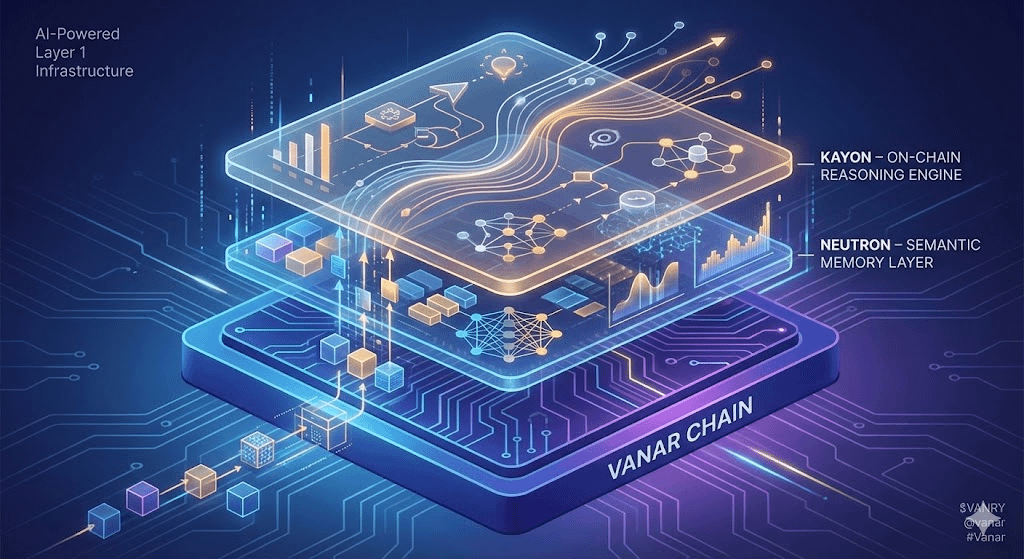
It provides complete EVM compatibility at the base and allows developers to deploy Solidity contracts without complex efforts and remain integrated with Ethereum. The actual differentiation is in the layers that are above the execution engine.
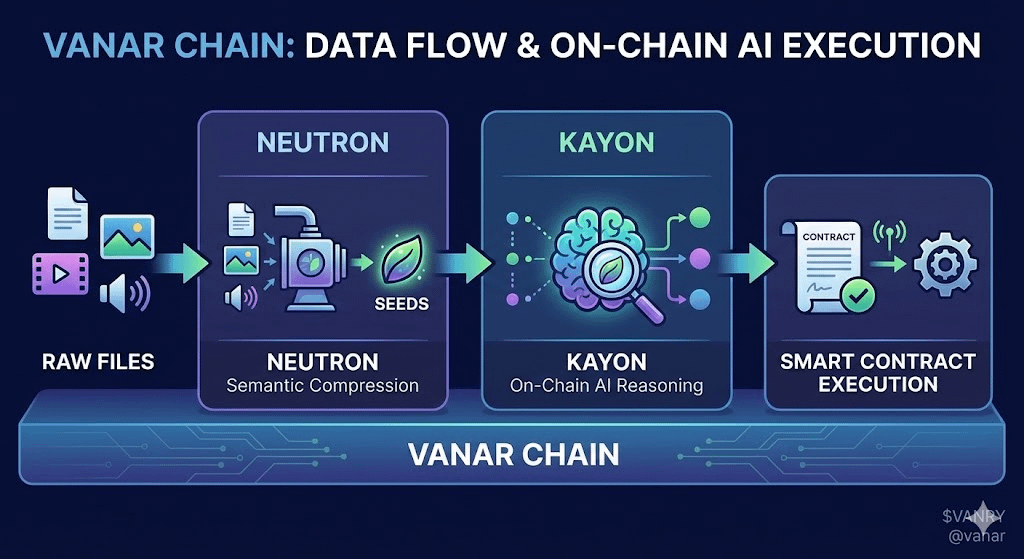
One semantic memory layer is neutron. Raw bytes are stored in traditional chains and they are data which has no meaning. Neutron presents the concept of Seeds, which compress and format these bytes in the way the blockchain is able to read them. Complex datasets such as documents, media, compliance records and others can be stored effectively and can still be interpreted by the semantics.
The on chain reasoning engine is called Keyon. Instead of using off chain oracles, Keyon allows contracts to read structured information within the chain. It transforms the basic conditionals into smart and situation aware decision makers.
Why does this matter?
Numerous dApps rely on off chain AI, document verification, identity verification, and analytics. The dependencies come with trust assumptions and security risks. The architecture of Vanar minimizes that friction by storing semantic compression and reasoning on chain, forming a more independent and resilient underlying architecture.
As an example, a DeFi platform on Vanar might be used to confirm compliance documents stored as semantic Seeds and execute actions as per the analysis of Kayon. The logic within a game could change dynamically through on chain AI data in a gaming application. Legal agreements and the implementation of rules would be automatically recorded in the blockchain and could be enforced by the enterprise.
The indigenous currency, $VANRY , powers the ecosystem. It charges transaction fees, AI services and rewards participation. Due to the computational requirements of AI tasks, increased on chain intelligence increases token demand, which is economically consistent.
Vanar Chain is also not just competing on throughput or a low gas; it is developing the smart infrastructure of Web3 an application infrastructure that requires decentralization and context awareness.
With machine reasoning and decentralization converging, that is where AI is going to have a crucial role as industries are restructured. Combining EVM compatibility, Neutron semantic compression, and Keyon on chain reasoning Vanar suggests a new paradigm blockchains not merely executing code, but reading and behaving on structured data.
In the long term, the model enables independent actors, AI based governance, smart compliance, and evolving dApps. Provided that Web3 has to support the next generation of digital infrastructure, protocol level smartness will be not as optional, but more necessitated. And Vanar Chain is upon that fringe.